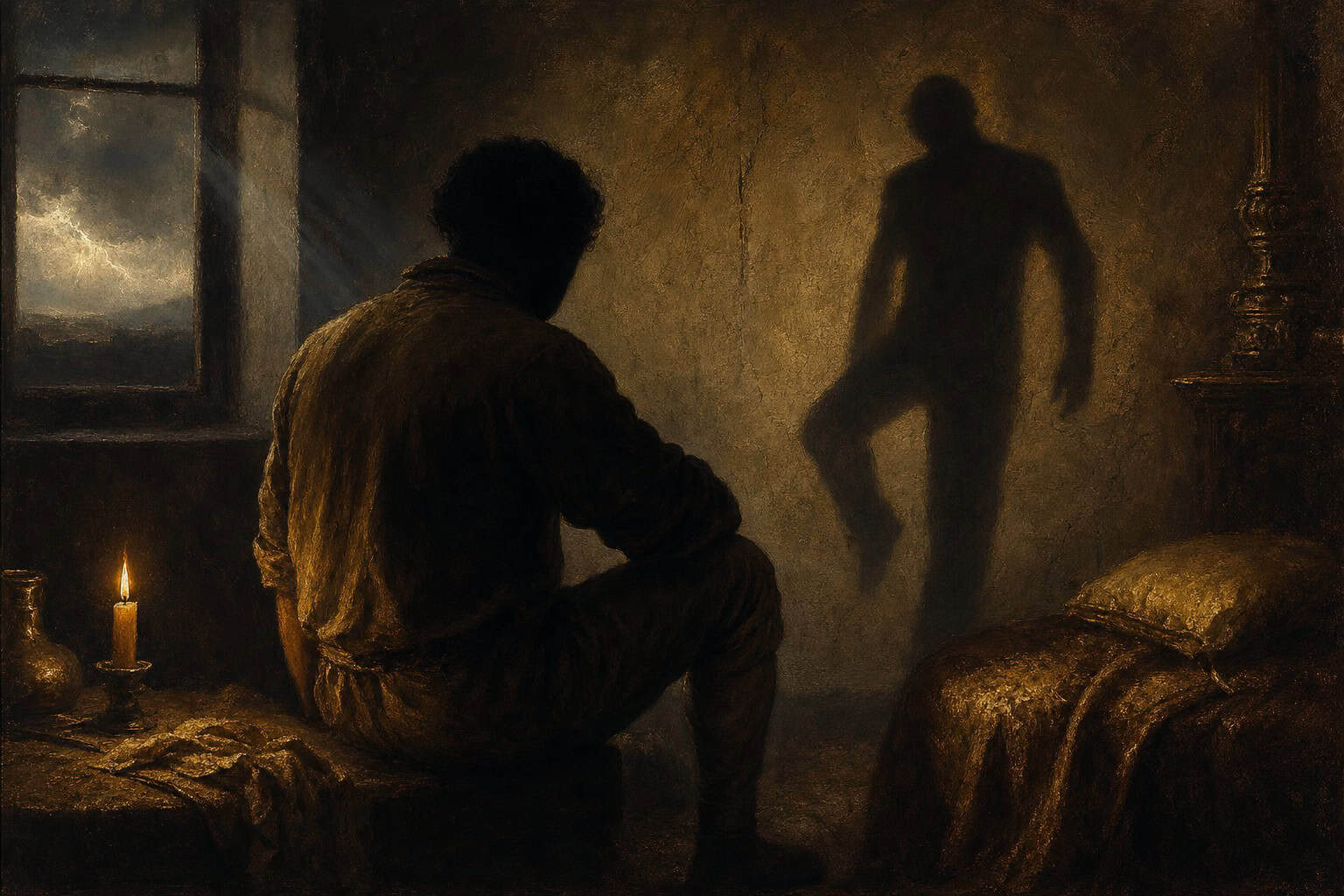
He stands in a dark he would not brag about, and cannot yet see that the wound crippling him is the same hand that refused, all night, to let him go.
A Single Candle in a Blacked‑Out Room
He stands in the kind of inner night you do not brag about, the kind born from concrete choices that stained his body and his relationships. It is not a poetic sadness but the sick, heavy dark after repeated sexual and romantic failures, when even the memory of touch feels contaminated. In that blackout, the usual lights are gone: no warm approval from friends, no charged flirtation, no clever conversation to distract. What remains is a thin, stubborn awareness of God that will not shut off, like a lone candle you tried to snuff with your fingers. The shame he thought would banish God instead strips away every competing voice, until this one small flame becomes impossible to ignore. This passage lingers right there, in that cramped interior space where the smell of burnt wax and sweat hangs in the air, and a man realizes the very darkness he created has made the light unbearable—and undeniable.
When the Mind Builds a Fortress Around the Skin
Pressed up against that little flame, he tries his oldest trick: he runs to his head. If he can turn failure into insight, maybe he can stay untouched. He reaches for shared books, shared arguments, shared ideas, as if the right exchange of thoughts could bypass the rawness of his own body’s history. The passage names this for what it is—not wisdom, but armor. Brilliant sentences stack like stone blocks between him and any real embrace, whether human or divine. He begins to see how he has used intelligence as a clean substitute for contact, confusing agreement with communion. The reckoning here is simple and brutal: his mind has not saved him from his wounds; it has only kept them from ever being held. To consent to love now would mean letting that fortress crack, allowing heat and touch where he has only ever allowed talk.
Walking on a Repaired Bone That Never Heals Straight
As the passage tightens, the image shifts from the candle’s glare to the body that must now move differently. He realizes God has not come to restore his former stride, the confident gait of a man who trusts his own balance. Instead, mercy feels like a deliberate break in the very place he leaned on most—his ability to manage, to charm, to understand his way out of pain. The language here is not gentle. Divine action is described like surgery without anesthesia, a bone snapped and reset at an angle that guarantees dependence. His newfound limp is not metaphor alone; it is the daily sense that certain desires, once effortless, now cost him something with every step. The pressure lies in this unanswered tension: can he accept a life where his weakness is not a phase to outgrow but a permanent joint, grinding and necessary, in his walk with God?
Divine mercy often leaves us limping, and the wound that breaks our self-sufficiency becomes, in time, the truest source of our strength.
The Ache in Your Own Step
This is where the passage turns outward without softening. It refuses to leave the reader’s body out of the scene. Most people know some version of this limp: the way a past affair still colors every attempt at closeness, the way secret habits shadow prayer, the way clever conversation feels safer than honest need. The book suggests that these aren’t just private embarrassments but potential pressure points for grace, if we stop trying to sand them smooth. What if the urge to fix ourselves back to some imagined purity is itself a refusal of dependence? The text invites a harsher honesty: that our most humiliating patterns may be the exact contour of our need for God, not obstacles to it. This has nothing to do with excusing sin. It has everything to do with refusing the lie that we must walk evenly before we dare lean on Christ.
Learning the Rhythm of a Crooked Gait
The scene does not resolve into comfort. He does not suddenly love his weakness or find a tidy formula for living with it. Instead, we watch a man testing his altered balance, taking spiritual steps that always list to one side, learning the strange rhythm of a life that cannot stand without support. The mind still wants to sprint ahead, drafting theories, building neat systems, but the limp drags him back into his body, into time, into dependence. What it means to let God love him here—without cleaning the record, without erasing the scars—remains unsettled. Yet something has shifted: he has stopped asking to be restored to who he was before the fall, and started asking who he is meant to become with this mark in him. The passage leaves him mid‑stride, breath a little uneven, discovering that every forward motion now begins with a small, necessary lean.