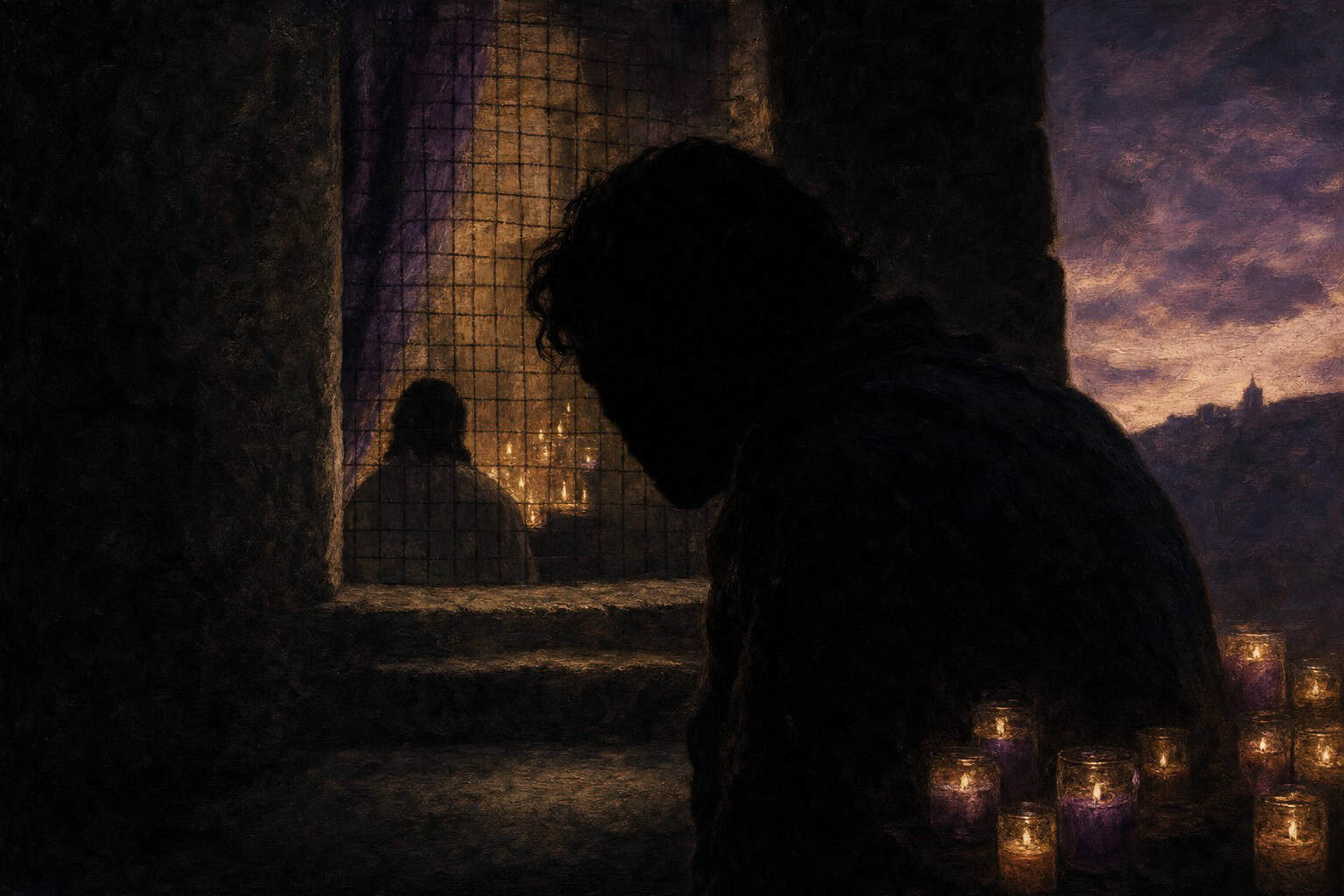
He watches her through the square mesh of a screen, close enough to touch, not yet knowing he is looking at the exact measure of how much of himself he gave away.
A Face Gridded in Wire
He stands outside the house, body held still by the frame of a window, eyes fixed on her face gridded by the square mesh of the screen. She is only a few feet away, sunk into an ordinary chair, lit by domestic light that does not belong to him. She has no idea he is there. His breath fogs faintly against the glass, his chest tight, shoulders drawn in as if he could press himself through the wire by sheer wanting. That mesh becomes more than hardware in this moment; it is a living net that gathers together his whole history of watching from the edge. The mark on his eye that once drew playground laughter is here again, dictating his role: the one outside, gazing in, unseen. Journals at home, old letters, half-prayers whispered into pillows—all his private devotions to her—run like current through his body as he watches. The window doesn’t just separate them; it exposes what he has been worshiping all along.
When Love Climbs Onto the Altar
Out there in the night air, he finally sees what the mesh has been hiding: he has not simply loved her; he has enthroned her. His discipline, his self-denial, the way he kept his distance and congratulated himself for purity—all of it has been scaffolding around a statue with her face. The lazy eye that made him a stranger in his own childhood photos trained him to survive by observation, and he mistook that skill for holiness. Behind piles of filled notebooks and long-distance phone calls where he gave everything and asked nothing, he told himself he was learning to love like God. But here, pressed to the window, the lie lands hard in his gut. Every insight, every so-called spiritual victory, has been quietly checked against one measure: Will this keep me close to her? The realization tastes metallic in his mouth. He is not just wounded; he has built a shrine on top of the wound and called it virtue.
The Screen That Will Not Tear
Nothing dramatic happens. No glass breaks, no voice speaks from heaven, no neighbor yells. She shifts in her seat, maybe turns a page, and the light inside hums on. Yet inside his chest, boards are being pried from a secret altar. It is slow, almost cruel in its slowness. The mesh in front of her face holds, square after square, each opening a small refusal: you may not step through; you may not claim this as ultimate. He realizes he cannot rush this undoing. To turn away from the window feels like betrayal; to keep staring feels like complicity. His childhood trust in adults, in priests, in any human figure who promised safety has already burned down; this love was supposed to be the one pure thing left. Now even that is being set on the same fire, and the only sound is his own heartbeat hammering against his ribs. The screen doesn’t yield. It makes him stand there and feel every nail being loosened from the false temple inside him.
An ordinary window can expose the idol we have made of another person, revealing how much of our worship we spent on human affection.
Your Own Face Behind Someone’s Mesh
Most readers do not stand outside literal windows like this, but the pattern is the same. Somewhere in the mind there is a face held in place by an invisible grid: a parent whose approval steadies your breathing, a child whose success keeps you from despair, a mentor, a lover, even a priest. We say we trust God, but the body tells on us—the way the stomach drops when a text goes unanswered, the way sleep vanishes after a sharp word from that one person. Like him, we may cloak our dependence in religious language: sacrifice, vocation, fidelity. We write careful messages, keep mental ledgers, fast from lesser distractions, secretly hoping our devotion will earn a glance. This passage names that pattern without softening it. It insists that when any human face becomes the horizon line of our hope, the grid has already formed, and God, in mercy, will eventually press our nose against it until we see the bars we’ve mistaken for blessing.
Squares of Wire and the Waiting God
He does not walk away in triumph, nor does he crash dramatically into the room. He simply stays there, a man with his life pressed against a sheet of woven metal, feeling both the pull of her warm, ordinary presence and the colder, deeper pull of a God who will not be an accessory. The mesh holds the tension. Each square is a tiny decision not yet made: to cling, to release, to demand, to receive. His throat is dry; his fingers twitch with the useless urge to knock. She remains unaware, innocent of the vast drama playing out inches from her cheek. In that stillness, the old darkness of his childhood and the fierce claim of divine love occupy the same narrow space between skin and wire. The scene does not tell us which way he will turn. It leaves him—and us—standing before the screen, feeling the rough pattern against our own forehead, with the night air cooling the sweat on our hands.