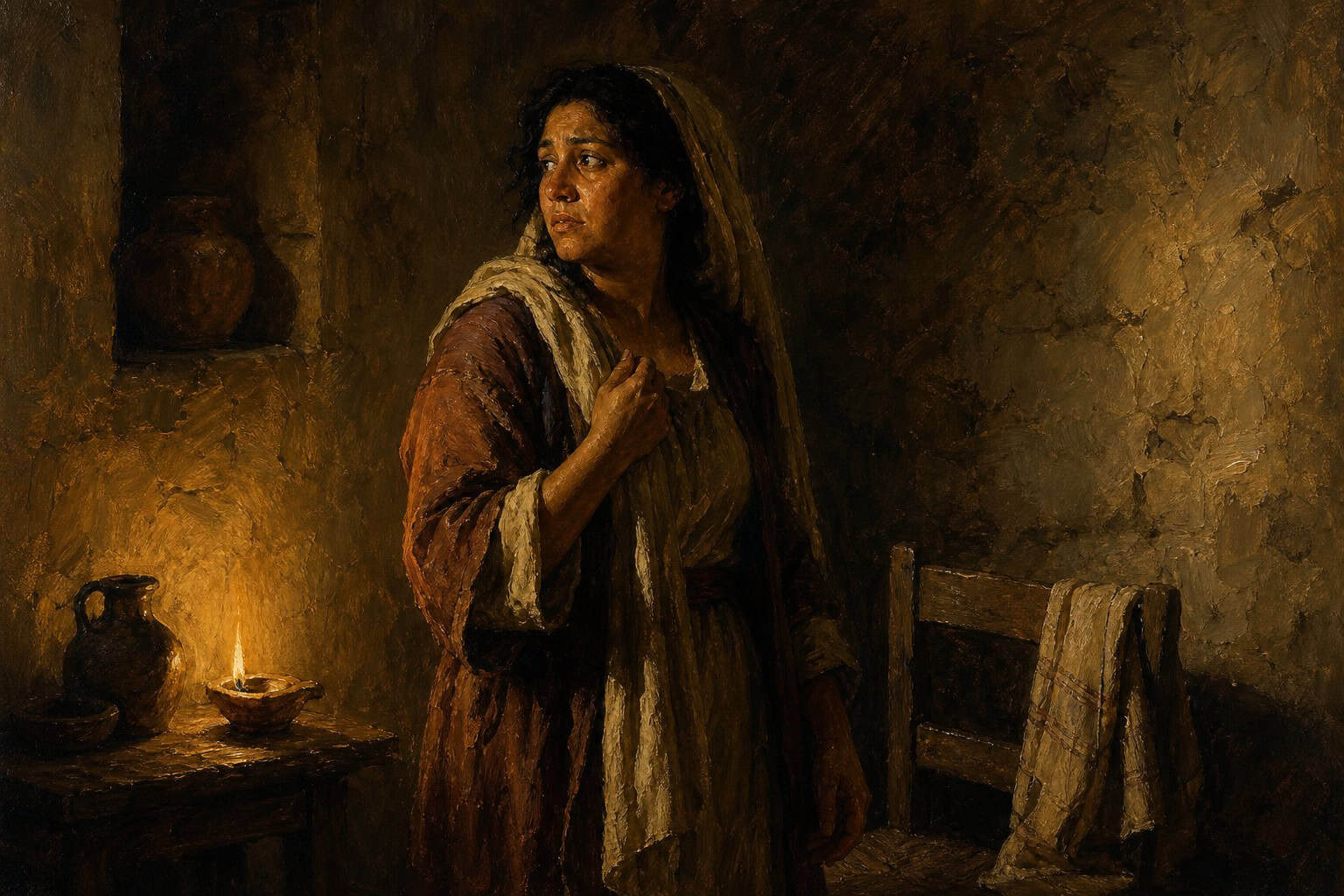
Hypocrisy in the church, in Bible verses, in the heart: how a man used holy words to keep love out. A reflection from Confessions to the Empty Chair.
The Lineage I Recited Like Coins in the Dark
There was a season when I could name my ancestry the way a miser counts coins by feel, sure of every one in the dark. I called myself a son of Solomon, a spirit in the line of David, and I said it as praise. To the women who came near me I announced that I would never bend the knee to their tears, never build a temple to any foreign god to please them, never dethrone the one Lord in my heart for the sake of their flesh. It sounded like fidelity. It felt like strength. I remember the exact posture of it, the lifted chin, the steady low voice, the pleasure of listing kings I claimed as kin while a real woman sat close enough to touch. Reading that man now, from years away, I can see the stones he was stacking. Every verse he loved became a brick. Every doctrine he was proud of became mortar. He built a wall of holy material and mistook it for a soul, and no woman could climb it, and he was glad. This is the oldest trick the pious play on themselves, and it is quieter than any open blasphemy. We take the language given to us for nearness and we bend it into distance. We take words meant to open the chest and lay them across the chest like a lid. I was not lying about God when I spoke of Him. That is the worst of it. Yahweh was real to me, the single Lord, the God who had marked me before I drew breath, and my belief was not counterfeit. But I used what was real to keep from being reached. The room I stood in with those women was small and warm and human, lamplit, close, and I refused to actually be in it. I stood instead in a temple of my own making, high and cold and echoing, addressing an audience of one, myself. The hypocrisy a hurt person senses in the church is not always a lie about doctrine. Often it is stranger and worse than a lie. It is a true doctrine turned into a tool, holiness pressed into service as a hiding place, Scripture recited so loudly and so well that no one can come close enough to see the frightened man crouched behind the recitation. I was that man. I quoted the King of kings to keep a single woman, in an ordinary hour, from knowing me. The verses were sound. The heart behind them was hiding. And a hiding heart, dressed in perfect theology, is still a heart that has chosen not to love.
Straws on the Camel, One Confession at a Time
Her name was Leigh, and I did to her what I had done to all the others, only slower and with more care. I confessed things to her in layers, the holy alongside the profane, and I watched her face for the flinch. In my own mind I thought of it as loading straws onto a camel’s back, adding weight, waiting for the exact moment the weight would break her. How much of me can she take, I asked myself, as if love were an endurance trial and I were the man appointed to administer it. This is the part I am most ashamed to read. She had already shown me grace before I began. She stayed. She leaned toward me. She said she had never met anyone like me, that the things I said aloud were things she had thought her whole life but never once put into words. And what did I do with a gift like that? I built more tests. I trusted my old wounds more than I trusted the living woman in front of me. Every straw I added was a small strike aimed at a rejection I had already decided was on its way, a rejection she had not offered and had no intention of offering. Here is the machinery the church-wounded soul knows too well, because it runs the same machinery. We tell ourselves we are testing whether the other is faithful, whether they can bear the true weight of us. It is a lie. We are not evaluating anyone. We are sabotaging them. We are dismantling the very closeness we claim to be measuring, and we do it early, on purpose, so that when it collapses we can murmur that we saw it coming all along. My tests were prophecies I fully meant to fulfill. There is a truth of space hidden in this that I could not feel while it was happening. Leigh had come toward me. She was near, genuinely near, inside the same conversation, the same silences between our thoughts, the same warm circle of light. And every test I set was a step I took backward, deeper into the high cold place, so that her nearness could never quite arrive where I stood. I mistook this backward stepping for discernment. It was fear wearing the good robes of wisdom. The camel’s back does not break because the animal is weak. It breaks because a man keeps loading it while telling himself he is only being careful. I called that loading consideration. It was contempt for a grace I did not believe I deserved, and therefore a grace I had made myself unable to receive. She kept offering. I kept weighing. Between us the straws piled up, and I called the pile prudence, and it was only my refusal to be loved.
She Saw Past the Words to the Soul Beneath Them
Then came the sentence that quietly unbuilt my whole architecture, though I did not recognize it as an unbuilding for years. She told me she had always been the one who gave advice, the voice of reason among her friends, the one who steadied others through their loves and their arguments with their parents. But with me, she said, the order was reversed. You are to me, she told me plainly, what I am to them. I heard it then as flattery, as proof of my depth, more mortar for the wall. I hear it now as an open door I refused to step through. Because she was not describing my superiority. She was describing her own surrender. She had set down the role she carried everywhere else, the strong one, the wise one, the one others leaned on, and she had made herself small and open in front of me. She had let herself be led. Without ever saying the word, she had handed me the soft underside of a life spent being strong for everyone around her. And I answered that trust with more tests. I answered her openness by asking her, coolly, whether God was permitting her to see what He had blinded all the others to, as though her love were a theological specimen I had been granted leave to examine under glass. The vast thing I could not feel then is this. A person who lets herself be truly seen has placed in your hands a weight that dwarfs any doctrine you own. It is heavier than lineage, heavier than pride, heavier than the whole cold temple I had labored to raise. And that weight, strangely, makes room for you. That is the awe I missed entirely. The one who sees past your words to the soul underneath does not use what she finds to shrink you or to win. She clears a place where you can finally stand as the frightened, complicated man you actually are, with no wall required and none permitted. I was standing inside that cleared place and did not know it. I kept my eyes on the wall I had built and never once turned to see the room she had opened.
We do not always quote God to draw near Him; sometimes we quote Him to keep another soul from reaching us.
The Cold Withdrawal I Dressed as Devotion
When a man like the one I was cannot pass a test he himself invented, he does not confess defeat. He disappears. I know this because I did it, over and over, and each time I clothed it in the language of prayer and reason so that even I could not see the plainness of the cruelty. When circumstances overwhelmed me, when the nearness grew heavier than I could carry, I went silent. I told myself this silence was discipline, the funneling of raw feeling through the cool channel of reason, the manly refusal to be swayed by a woman’s crying. I even admired my own coldness, describing it to myself as a hard headwind that dried their tears and provoked their anger and made them turn their faces away, as though I were weather and not a man who had chosen his own frost. Reading it now, I flinch at the vanity of the picture. Going silent was never retreat, whatever I pretended. Retreat is honest. Retreat says, I cannot manage this, and I am leaving, and it grants the other person the dignity of a plain fact. What I did was quieter and far crueler. I withheld my presence and forced the other person to live inside the emptiness I had made, to carry the weight of my unspoken struggle, while I scrambled behind the wall to recover the upper hand. The cruelest power a person holds is the power of calculated absence, and I wielded it while assuring myself I was being faithful to God. Leigh did not turn her face away as the others had. That is precisely what makes this act read worse in hindsight, not better. She stayed near. She kept asking to hear more of me. And so my silence must have fallen on her not as weather but as verdict, as accusation, as some crime she could not identify. She would have lain awake wondering what she had done. She had done nothing at all. She had only seen me, clearly and without recoiling, and I could not survive being seen, so I punished her patience with my absence and named the punishment devotion. This is the hypocrisy the church-hurt heart keeps circling and cannot quite catch in words. It is not the loud sinner sprawled in the back pew. It is the man who uses the highest things to license the coldest acts. It is the one who prays where he owes an apology, who quotes where he owes a confession, who vanishes into holy silence and leaves another soul standing alone in a room that has grown suddenly enormous, straining to hear a voice that has decided, supposedly for the sake of God, to give her nothing.
The Small Warm Room I Kept Fleeing
I have carried these pages the way a man carries a stone he cannot set down, and I will not close them with a tidy repentance, because the honest truth is that I still catch my hand reaching for the same wall. The urge to answer nearness with doctrine, to answer love with a test, to answer being seen with silence, did not die the day I finally understood it. Understanding is not freedom. But I have learned to name the lie for what it is, and the naming is where the real battle starts, and that battle is waged against myself far more than against any woman who ever risked coming close. What I see now, reading the man I was, is that all his proud talk of surrender was surrender turned inside out. He would bend the knee to a King enthroned on high precisely so that he would never have to kneel low and human in a small warm room beside someone who loved him. He confused domination with faith. He believed his refusal to be moved was purity, when it was only the caved-in space of a frightened little soul that could not bear to be fully alive in the presence of another. Real surrender, I have slowly come to believe, is not the cold recitation of God’s supremacy over a woman’s flesh. Real surrender is letting yourself be seen, and then staying in the room. It is receiving a grace you did not earn instead of testing it until the strain snaps it in your hands. God was never the wall. I made Him the wall, quarried Him for stone. He was, the whole time, the very nearness I kept fleeing, present in Leigh’s patience, walking beside me through my worst hours, low and quiet and unhurried, refusing to abandon the man who kept abandoning everyone. He did not stand overhead on a throne restraining nature, the way I preferred to imagine Him. He sat close, in the warm lamplight I would not settle into. If you have come here carrying a wound the church gave you, or a wound you fear you have given in the church’s name, I will not hand you a clean resolution, because I do not own one. I have only the confession itself, spoken plainly, without the wall. That is what these chapters are. In Confessions to the Empty Chair I sit down before the space where the seen self should have stood, and I try, at last, to stop reciting and start being present. The chair across from me is still empty. But I am learning, late and unsteadily, to speak into it honestly, which is already more than I managed in that warm bright room I would not let myself stay inside.