You receive what you surrender: how the coldness you build after heartbreak becomes the exact poverty you inherit in every bed after.
The Top Bunk She Refused to Let Me Leave
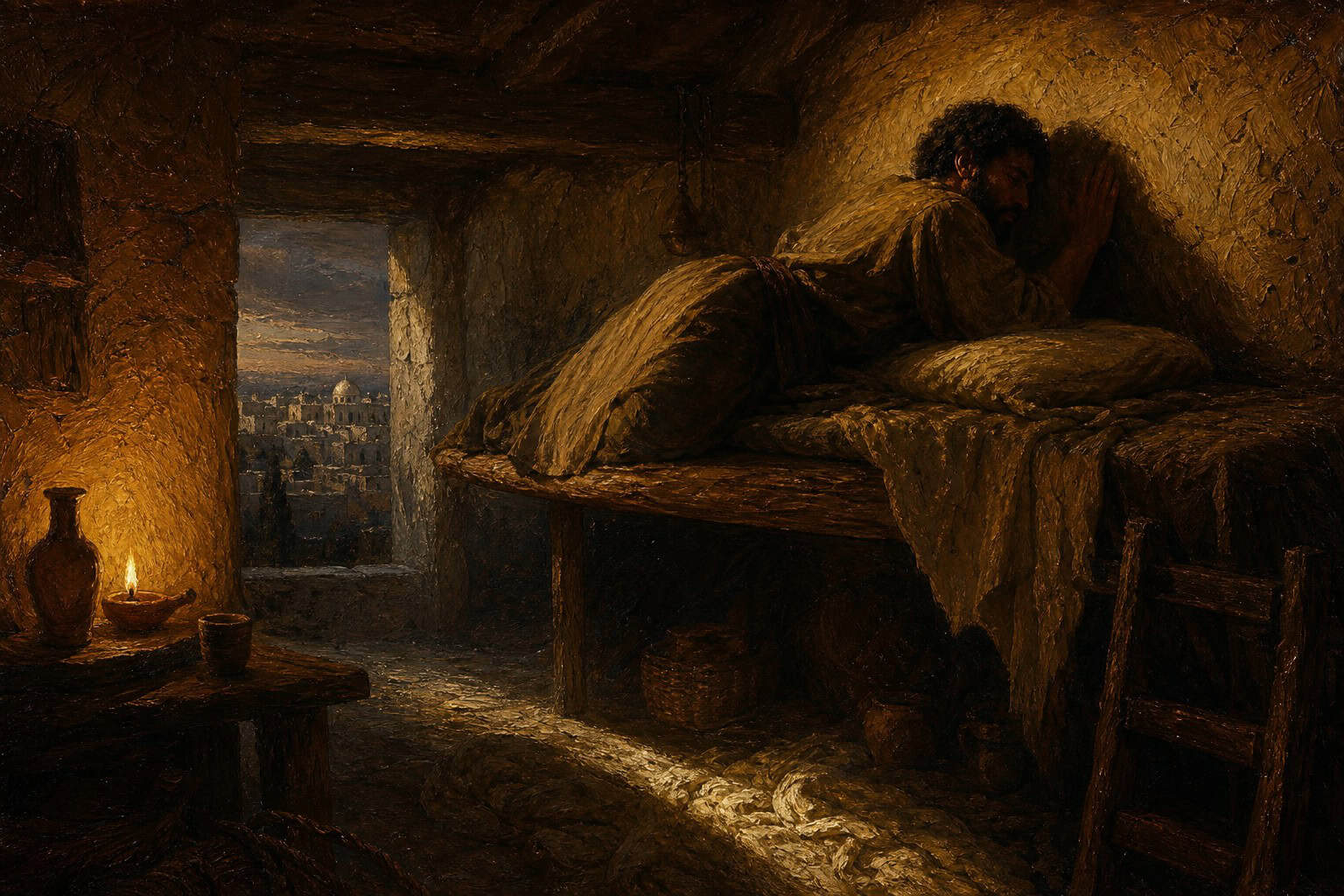
It began with a bed I did not want. A woman named Cindy insisted, within hours of meeting me, that I climb up beside her, though I had offered the floor. I climbed. I remember the quiet I had learned long before this room, the practiced quiet of a boy keeping still through a thin wall where other bodies slept close by, the habit of not being heard. That old skill served me now in a strange way, the way a scar can teach a hand to grip. I had walked into her space carrying a fresh wound and a colder plan, and she made room for me before I had decided what I wanted from her. The ladder was narrow. The mattress sagged toward the middle so that our weight rolled us together whether we chose it or not. What I see now, reading it from far off, is that I did not go up there for her at all. I went to prove something to a woman who was not in the room, a woman who had already left, whose absence I carried like a stone in my chest. Cindy was near me, warm and breathing and willing, and I was somewhere else entirely, standing over a memory, hoping this stranger’s body would deliver a message the absent one would never read. That is the shame I did not feel then and feel now, sitting cold in my throat: I was using nearness to accomplish distance. Her closeness was a tool for my leaving. The physical space between us shrank to nothing, our shoulders pressed in that cramped bunk, the ceiling close enough to touch, and yet the true distance between us grew wider than any room could hold. I told myself this was recovery, a step in a new direction, the first fruit of a harder self I was proud to be building. I did not ask what it cost her to be a step. I did not ask who she was underneath the willingness, what she might have carried up the ladder to meet me, what quiet war she had already been losing before I arrived. The question I would put to that younger man is simple and merciless. When you finally got the thing you thought you wanted, why did the room feel so hollow? Why did a warm body an inch away leave you as alone as you had been on the whiskey nights that came before? The answer was already forming in the dark, though I could not read it yet. You cannot arrive somewhere you have decided never to enter. I had come to receive comfort while surrendering nothing at all. And a man who surrenders nothing receives, in the end, exactly that much.
A Small Gesture Turned Into a Permit
There was one moment, a plain and bodily thing, that I seized on and made into scripture. She lifted herself to help me. That small motion, unspoken but unmistakable, told me she agreed to what came next. But I did not leave it there, where it belonged, as one human being trusting another. I treated it as more. I treated it as absolution. Here was consent, clean and clear, and consent was the only thing my new law required of me. If she wanted this, then I owed nothing beyond my presence in the flesh, and I could keep my soul packed away in the dark where no touch could reach it. I built a whole principle on that raised hip: consent is primary, emotion is separate. I told myself that the act could live entirely apart from the tenderness the last woman had used against me like a knife slipped between ribs. What steadied me in that moment is a terrible thing to set down in daylight. Desire steadied me more than any drink ever had. It gave me a reason to be there that felt like honesty when it was only appetite wearing honesty’s coat. And her willingness, freely given, became the very thing I hid behind. If she said yes, then my absence could not be a sin. If her body agreed, then my withheld heart harmed no one, or so the argument ran in the private court I kept. Do you see the trick I played on myself? I took her small courage, her openness, the ordinary bravery it takes to let someone near, and I used it as a wall. She reached toward me, and I answered by fortifying. Now I have to ask the hard thing and stay inside it without softening it. Was I ever really with her at all, or was I only using her yes as a passport to be somewhere else? A body can cooperate while a soul stands with its arms crossed at the far edge of the room, watching. I know this because I was that soul, and I remember the exact temperature of it. I moved through the familiar motions, the practiced touches that once, with another, had meant something, and I felt them mean nothing, felt them work as shields against feeling anything. There is a kind of presence that is really the deepest absence, a way of being here that guarantees you never arrive. Consent had absolved my body of trespass, fair enough. It could not absolve me of the colder crime, the refusal to be found, the quiet decision to remain a stranger to the person who had let me in. That crime has no partner to accuse it. You commit it alone, in the private dark of your own choosing, and you carry it alone, and it surfaces in no one’s testimony but your own conscience, years on, in a stillness you cannot escape.
The Fortress I Built to Keep Love Out
Then came the naming, and the naming was the true event. Lying in the wreckage of that hollow encounter, staring at the ceiling a foot above my face, I felt something set, the way wet mortar sets when you leave it overnight. I called it the first stone of a fortress. But I was honest enough, even then, to see what kind of fortress it was. Most men raise walls to keep something precious safe inside them. Mine was raised the other way around. It was built to keep love out. I would remain cold. I would remain withdrawn. I would sleep with as many women as I could manage, and each one would be a small mockery of the woman who had betrayed me, a protest lodged under the foot of her memory. I wanted others like Cindy, women grown enough to braid friendship and skin together without complication, without jealousy, without the dreaded emotional expectation that had once left me undefended and bleeding. Comfort without cost. Nearness without the risk of being truly seen through. I thought I had discovered a secret, a clever back door, a way to have the warmth of the body while sealing the soul in stone. What I had actually discovered was a prison with excellent locks and a single prisoner. Here is what the older man understands and the younger one could not. The absence of pain is not the same as healing. I had mistaken numbness for strength. I had mistaken the courage to wound for the courage to mend, and they are not cousins; they are enemies. Every woman who came near that fortress became proof of its walls rather than a person I might have loved. I kept each of them at the exact distance where they could touch my body and never my life. And the more I fortified, the smaller my capacity for joy became, until the very thing I had wanted, to be at peace, to be free of that first woman’s power over me, receded further with each conquest, like a shore you swim toward that keeps sliding back. You cannot punish an absent betrayer by starving yourself of love. You only complete her work for her. You finish, with your own hands, the maiming she began. This is the truth the whole passage turns on, and I set it here because it is the hinge on which everything after it swung. The heart that gives nothing is not spared the loss; it is handed the smaller loss again and again, forever. I had chosen the small, endless loss over the great, terrifying risk. I had chosen to stand in the entryway of my own life and refuse to step across. And God, I have to say now, was not gone from that cramped room. He was there inside the emptiness itself, quiet, unbanishing, walking with me into my own coldness, present in a grief I did not yet have the courage to call grief.
The heart that gives nothing is not spared the loss; it is handed the smaller loss again and again, forever.
Hunting the Good Girls for Their Hidden Dark
The fortress needed a supply, and so my mind turned, in those days, to a colder hunt. I was at a religious university, a place where women’s desire was pressed flat between two shames, the shame their faith laid on them and the shame their friends would heap on them the moment they slipped. Female longing there was a muted thing, actualized in whispers if at all, held down further, I told myself with the confidence of a fool, by the plain arithmetic of lower drive. And yet I was convinced their numbers were large, these women hiding their appetites in plain sight, and that the very energy they burned maintaining their good-girl faces was itself the proof of what churned beneath. They could not fool me, I believed. I could read the hidden dark under the modest surface, the way a hunter reads a bent blade of grass. What I was really doing, I understand now with a clarity that shames me, was making seduction into a kind of theology. To become compelling enough that a woman would break her own convictions for me, to be the very reason she abandoned the rules she had built her faith around, that became my measure of worth. Not connection. Conquest of a conviction. I mistook the breaking of another’s boundary for intimacy, when it was only intimacy’s ugliest counterfeit, a coin stamped to look like the real thing. And I have to ask the question I most want to skip past. Why did I need to prove I mattered by making someone else fall? Because underneath all the strategy sat a much older terror, the boy’s terror of not being enough, of being looked at and found wanting and left standing there. Every new partner was an audience for a performance of power that hid that infant fear. I turned the whole business into a stage, and I was its trembling actor. I was not the strong man I played. I was a frightened one, dressing his shame as strategy, sharpening his mind into armor and weapon at once, learning to survive the searching gaze of another by never letting anyone gaze long enough to see the fraud beneath the poise. And what of the women themselves, the ones I catalogued and pursued? I never once wondered, in those days, what shutting down they had learned, what split they carried between the self that felt desire and the self that had to disown it in front of God and friends, the way their own bodies went quiet and cold under the weight of the same shame I was hunting them for. I saw only targets for a doctrine. I did not see people wrestling the identical war inside their own skin, keeping their real selves elsewhere, safe, while their bodies performed a permission they did not feel. That failure to see them is its own confession, and I make it here. I made theology out of my wound and called it wisdom, and I sent it out into the world to go looking for the wounds of others.
What the Empty Bunk Kept Trying to Tell Me
So where does it settle, all this cold architecture, all this stalking of hidden appetites? It settles in a bunk that felt like nowhere at all. It settles in the plain fact that I got exactly what I built and it was worth nothing when the light came up gray through the window. I had surrendered nothing of myself, and so I received nothing back. That is not a punishment God dropped on my head from a great height. It is simply the law that governs the thing, as steady as gravity. You receive what you surrender. Hold your heart shut and every embrace hands you back your own emptiness, warm for an hour, cold by the morning bell. I wanted comfort without vulnerability, and vulnerability turned out to be the only door comfort ever comes through. I had bricked it over with my own careful hands and then complained the house was freezing. What I see now, reading that younger man from the far end of years, is that his whole codex was a wound pretending to be a philosophy. Consent is primary, emotion is separate. It sounds like clarity. It was cowardice given a clean and lawyerly name. And the strange mercy of it, the thing I did not expect to find when I went back to look, is that even there, in the emptiest bed, in the coldest protest against a woman who had already gone, I was not entirely alone. There was a presence that did not scold and did not haul me out by the collar, that simply stayed, walking beside me in the very sin I was so proud of, quiet in the hollowness, waiting without hurry for me to grow tired of the fortress and its stale air. He did not tear the walls down. He let me live inside them until I could no longer stand the smell of my own safety, until the mortar itself began to sicken me. That is how grace moved in those years, not as a hand that yanked me clear, but as a companion who refused to leave me alone in it. I could not name the ache then. I called it victory and slept on it. I know now it was grief, the grief I would not let myself weep, disguised as strength, hardening into a strategy that would cost me long years and other people’s trust. If you have built your own version of this fortress, if intimacy has come to feel like a battlefield and you cannot say when or why, then perhaps you already suspect what it took me far too long to learn. This is written from inside those walls, and from the slow, unfinished labor of learning to unlatch a single window and let the air move. The whole of it lives in Confessions to the Empty Chair, and it begins, as this did, with a warm body, a cold heart, and a man convinced he had just won.