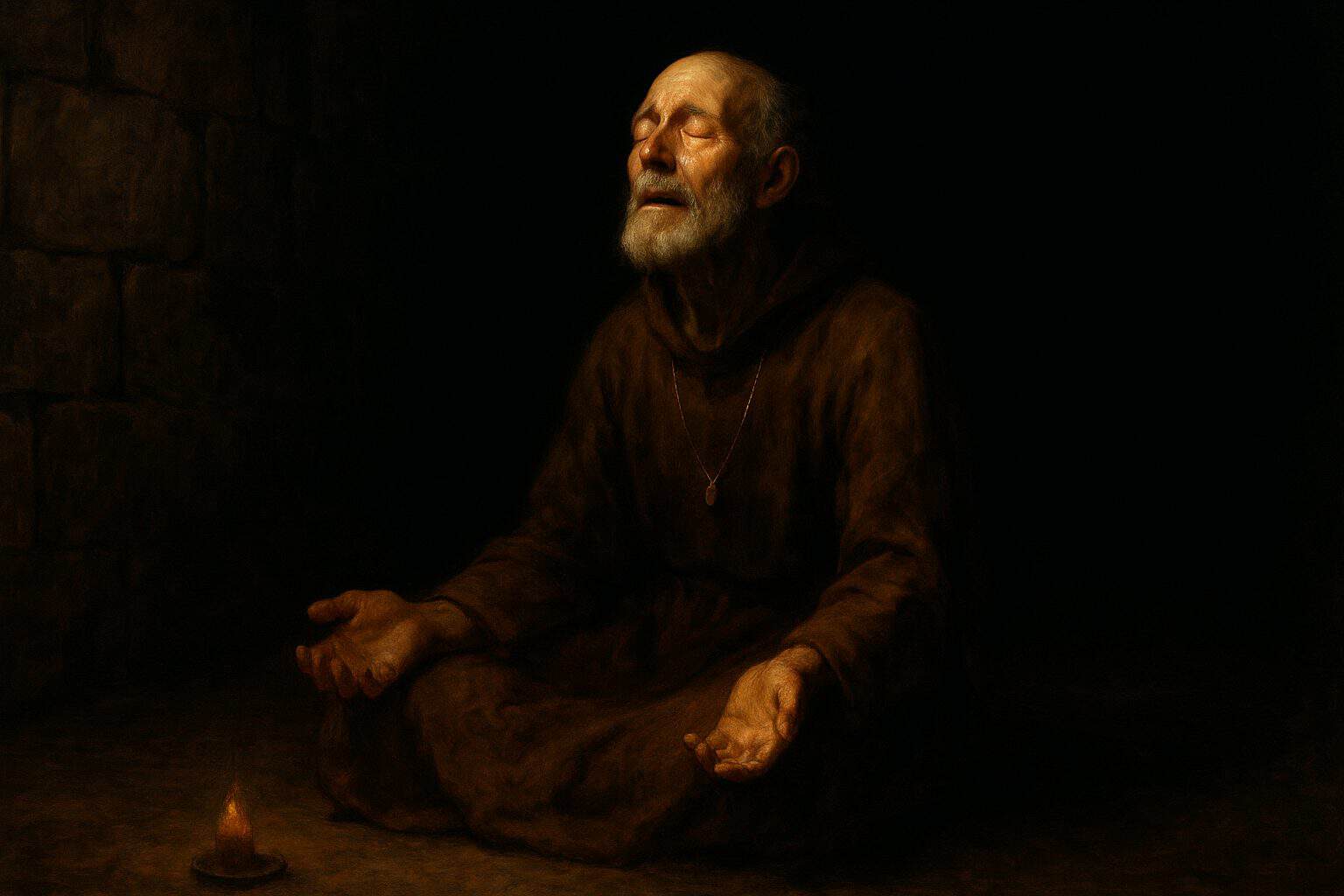
How darkness itself becomes the medium of divine approach
The Tent of Meeting
There is a space within us that admits no other presence when God draws near. Not metaphorically, but phenomenologically—a clearing opens in consciousness where the usual furniture of the self must be removed. The mystics have always known this. John of the Cross mapped it with the precision of a cartographer charting unexplored territory: the soul empties itself of created things not through hatred of creation but through the discovery that God approaches in a mode that requires vacancy.
The phenomenon presents itself first as loss. A man discovers he has elevated another’s love “above the LORD’s,” has seated someone “upon your heart’s throne.” The recognition arrives not as abstract theological error but as lived desolation—what scripture calls “the abomination that causes desolation,” an idolatry that invites its own undoing. The tent of meeting, that interior sanctuary where divine and human were meant to converge, has been occupied by what cannot sustain such weight.
“To allow a woman into this tent of meeting, to elevate the need for her love and approval above the LORD’s, is to displace God and seat her upon your heart’s throne.”
The structure reveals itself: we build sanctuaries within ourselves, consecrate them to what we imagine will save us, then experience the collapse when these provisional gods fail. The “hollow afterglow” that follows, “the sense that I had spent myself on a god who could not save me”—this is not merely disappointment but phenomenological disclosure. The soul discovers its own architecture through what devastates it.
The Grammar of Desolation
Desolation has its own grammar, its own way of structuring experience. “Lust mistakes consumption for connection. Gluttony seeks to fill a spiritual void with material weight. Greed hoards what was meant to flow.” Each misdirection carries its own phenomenology—not moral failure abstractly conceived but lived disorientation, the soul moving “toward desolation, often disguised as fulfillment.”
John of the Cross knew this territory intimately. His Dark Night maps how the soul’s attachments must be severed not through violence but through a more radical operation: God withdraws the very capacity for satisfaction from created things. What once nourished becomes ash. What once oriented becomes confusion. The mystic does not choose this emptying; it happens to him, arrives as grace wearing the mask of abandonment.
“My spirit writhed in futile protest before collapsing, succumbing to a new desolate sorrow… the disorientation of being thrown back into the world.” The phenomenology is precise: first the writhing, the futile protest against what cannot be changed; then the collapse, not into nothing but into “new desolate sorrow.” New because this sorrow has a different quality than ordinary grief. It carries within it the memory of presence now withdrawn.
The Paradox of Solitude
“He must be willing to be alone in this world, preferring to stand with loneliness than to kneel with companionship in subjugation.” The sentence reveals a structure that runs through all authentic spiritual experience: the discovery that certain truths can only be received in solitude, that companionship itself can become a form of bondage when it requires the surrender of what is most essential.
This is not misanthropy or spiritual pride. It is phenomenological necessity. The soul discovers that its deepest identity exists in a register that cannot be shared, cannot be mediated through another human presence. John of the Cross called this the todo y nada—the all and nothing that marks the soul’s approach to God. Everything must be released so that Everything might be received.
The paradox intensifies: those without faith interpret this movement as “an abdication of personal responsibility,” a “resigning ownership over personal freedom, choice, and responsibility to others.” They see surrender where the mystic experiences the most radical form of agency—the choice to remain open to what exceeds choice itself.
The Language of Desecration
“In my imagination, the only language big enough for what was done to me was the language of desecration: the abomination of desolation in the holy place.” Sometimes ordinary language fails. The soul reaches for biblical imagery not as metaphor but as the only adequate phenomenology for certain experiences. The holy place—that interior sanctuary where the self knows itself as inviolate—has been breached. What follows is not just trauma but desecration, a particular form of wound that affects the very capacity for the sacred.
John of the Cross understood this. His imprisonment in Toledo, the months of darkness and degradation, taught him that certain sufferings attack not just the body or psyche but the soul’s very orientation toward God. The dark night is not depression or spiritual dryness but something more radical: the experience of God’s absence as a mode of God’s presence, darkness as the medium through which infinite light approaches finite capacity.
“This new sorrow bled into the permanent melancholy started years earlier after God withdrew into silence.” The phenomenology is layered: new sorrow bleeding into old, divine silence not as simple absence but as a presence too intense for ordinary perception. The mystic learns to read this silence, to recognize in it not abandonment but approach.
Death as Revelation
“Death-dust mandates separation of the flesh and spirit before heaven-spirit reanimates the flesh.” The phenomenon of death reveals something essential about the human structure: we are not simple unities but complex compositions, held together by a force that will one day release its grip. The bereaved discover this not as doctrine but as lived reality. They speak of the deceased as “with Jesus” while simultaneously feeling the weight of absence. “They say these things assuming that spirit and flesh exist as some kind of mutually exclusive duality. They are not.”
“Ours is not to remain a disembodied soul in heaven but a reunited and purified body-soul in the New Jerusalem.”
The Christian vision insists on eventual reunion, not as spiritual abstraction but as concrete futurity. The body matters. Its dust matters. The separation is real but temporary. John of the Cross knew this tension intimately—how the soul must learn to live between severance and reunion, must inhabit the gap between what is lost and what is promised.
“In one final act of rebellion against death, the living weep, feel defeated and impotent, and whisper prayers on behalf of the dead.” The phenomenon is universal: faced with death’s finality, something in us rebels, insists on connection beyond severance. The prayers whispered for the dead reveal not primitive superstition but phenomenological truth—the human refusal to accept relationship as terminable.
The Refining Fire
The night that refines is not a single darkness but a process, a movement through successive purgations. John of the Cross mapped this with scholastic precision: the active night of the senses, the passive night of the senses, the active night of the spirit, the passive night of the spirit. Each phase has its own phenomenology, its own particular form of suffering and transformation.
“An oppressive void, a ‘presence in the room’ leeching warmth, hope, and peace from the individual, leaving them feeling intimidated, defeated.” This is not metaphor but description. The soul under purgation experiences presence as absence, fullness as void. What the mystics call kenosis—self-emptying—arrives not as chosen asceticism but as imposed desolation.
Yet within this desolation, something else stirs. The soul begins to recognize that its suffering has structure, that the darkness has intelligence. This is not random affliction but purposeful refinement. The dross burns away. What remains is what was always essential but hidden beneath accumulated attachments.
The Horizon of Faith
“Each of us chooses a narrative that provides a framework in which to process meaning, interpretation, and understanding in life.” The choice is not arbitrary. We select the story that best accounts for the phenomena of our lived experience. For those who have passed through the dark night, only the mystical narrative suffices—the story of a God who approaches through absence, who saves through stripping away, who resurrects through death.
This is not masochism or spiritual pathology. It is the discovery that certain transformations require darkness as their medium. The seed must be buried. The grape must be crushed. The metal must enter the fire. John of the Cross did not invent this pattern; he simply described with unprecedented precision what the soul undergoes when God undertakes its transformation.
“I did not have this language at the time. Back then, I only knew the hollow afterglow.” Language comes later, after the experience has been survived. In the midst of the dark night, there are no words, only endurance. The soul discovers retroactively what it has undergone, finds in the mystical tradition a map for territory it has already traversed.
The night that refines does not explain itself while it works. It simply does its work, leaves the soul changed in ways it will spend years understanding. What seemed like abandonment reveals itself as approach. What felt like death discloses itself as birth. The darkness itself becomes luminous, not with created light but with the radiance that only darkness can reveal.