Mind games girls play: the secret trials, the split selves, the verdict reached before you knew you were on trial. A hard, honest reading.
The Pill Bottle That Kept the Only Light
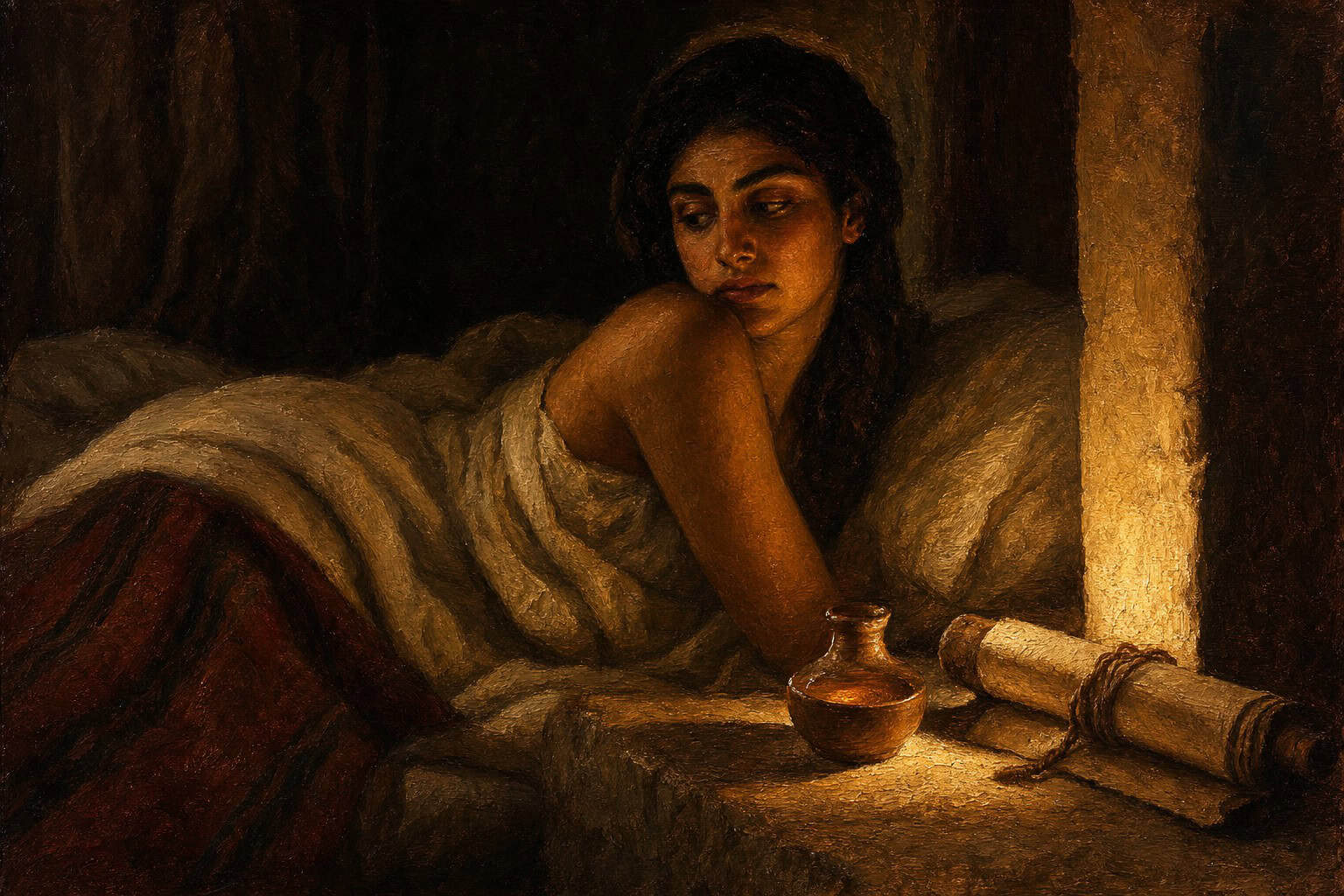
You feel it before you can name it. A woman lies close to you in the gray of early morning, warm under the same blanket, breathing the same air, and still something in her pulls back into itself. On the nightstand a small bottle stands where the first light catches it, and you learn, too late, that she swallows what is inside partly to endure your nearness. That single object is where Chapter 13 of Confessions to the Empty Chair lays its finger on the exact place the ache lives. The man typing mind games girls play into a search bar is not asking about clever texts or the silent treatment. He is asking why he keeps failing tests he was never handed. Anthony sits here with a woman he calls Jane, a lover raised by scholars, a reader of old and difficult books, and he confesses that her body stayed in the bed while her verdict on him had already been signed and sealed. There is no fight in this scene. There is no shouting, no cruel line thrown across a kitchen, no slammed cupboard. There is only a man who wanted to sop up every drop of a shared life and a woman who had quietly decided he was not the one, softening the friction of that decision with medicine she measured out in the dark. That is the first thing the passage teaches, and it teaches it without raising its voice. The game you cannot win is not always played with malice. Sometimes it is played simply to survive the person lying beside you. She is not lying to wound him. She is managing a war inside her own chest, and he is standing in the middle of it without a map, without even the knowledge that a war is on. He wants harmony, passion, surrender, a delight bounded only by imagination. She wants something shaped like her upbringing, like her father’s quiet authority, like the men who arrive stamped with a spirit she already recognizes. Their wants do not meet. They pass each other in the dark like two people carrying candles down opposite halls. He names this discord, and the word is honest, because two people can share a bed and share nothing else at all. The bottle beside the pillow is not a stage prop. It is the sound of a heart protesting a presence it has already refused to keep, a body being made bearable by chemistry because the soul could not make it bearable on its own. If you have ever loved someone who took something in order to stand you, you know this room, and you know the strange cold that can live at the center of physical warmth. This is where the book begins to answer the question the searcher did not yet know how to ask.
The Court You Were Never Summoned To
The tension gathers now, and it gathers around one unbearable idea that the chapter states plainly and then refuses to soften. Anthony writes that his disqualification as her husband was a foregone conclusion, a verdict reached long before he even knew a trial had been convened. Read that slowly, because it is nearly the whole answer to the searcher’s question. The mind game that wounds deepest is not the flirtation or the running hot and then cold. It is the secret court. Somewhere inside her, charges were filed, evidence was heard, a sentence was handed down, and he was never called to testify. He never learned the accusation. He learned only the outcome, and he learned it the way you learn winter, by the cold that seeps under the door before you see the frost. This is the cruelest thing that gets done in silence, and it is done in a private courtroom where the accused is neither permitted to speak nor allowed to hear the charge. If you have ever felt yourself measured by a ruler nobody would show you, this is your scene laid bare. You bring your strength, your want, your open and empty hands, and it is simply not accepted, and no reason is given, and you cannot appeal a ruling that was never read aloud. He shows her his hunger and his force, and she turns her face from it. Later a man cut in the shape of her father, a scholar’s protégé, shows her the very same thing, and she opens to him without hesitation. The difference was never in the strength itself. The difference was in whom she had already decided to accept strength from, and that decision was locked away in her long before the first man arrived. This is what makes the game feel like madness to the one losing it. You keep adjusting yourself, changing your tone, softening or hardening, trying to pass an exam whose questions were never written for you to see, and the pass was never on offer in the first place. The seats were assigned before you entered the room. Anthony notices something colder still, that women in friendship draw men close enough to study them, to weigh each spirit and quietly file it under prospect or non-prospect. The sorting happens early and it happens without sound. The man being sorted often feels only warmth, only easy welcome, only the pleasant safety of being liked, right up until the day he discovers he was placed under a heading he will never be allowed to leave. The book does not offer this as sour proof that women are cruel by nature. It offers it as a hard fact about how a frightened heart defends itself. She built her judgment from the inside out, from her own long history, and he was conscripted to stand for a story finished before he ever spoke his name. The trial was hers. The sentence fell on him.
The Woman She Cut Into Two
This is the turn, and it cuts to the marrow. Anthony sees at last that Jane did not fail to love him because she was cold or empty. She loved by dividing herself down the middle, and that division is the true engine driving every mind game underneath the one the searcher can see. She made two versions of herself and kept them in separate rooms. One was pure, lifted, guarded by old books and refined ideas, kept safe from the mess of being wholly known by any living man. The other was carnal, the version that met his hunger in the dark, the version she could use and then set down like a book returned to a shelf and finally, quietly, discard. She never let the two women meet. To let them meet would be to stand fully seen, and being fully seen frightened her more than loneliness ever could. So she kept the thinking self clean and gave the body away as something separate, something that did not count against the real her, something she could disown in the morning. This is the deepest thing the chapter uncovers, and it reaches far past this one couple. We do not murder love only by saying the word no. We murder it by splitting ourselves into puppets, by performing one self in this room and another self in that one, so that no single person ever gets to hold the whole terrible truth of us at once. She used her beloved books the way another person uses a locked door. Beautiful words became the bricks of a fortress that looked, from the street, like depth and cultivation. The reading was genuine. The refinement was genuine. And it was also armor against the raw, embarrassing claim of a love that wanted every part of her in the same moment. He never learned the shape of her heart from her fondest pages, and she never let him, because those pages were the very wall she hid behind. The whole game runs on this hidden split, and once you see it in her, you begin to feel the smaller version of it working in yourself, the self you show and the self you keep locked upstairs where no lover is admitted.
The cruelest rejection is not the no you hear, but the trial you were never told had begun.
Loving the Drawing Instead of the Man
After the revelation comes the long cold aftermath, and the book refuses to hurry out of it. Anthony asks a question that walks out of the pages and follows the reader home. When a woman decides a man is worthy, she often does it by first painting a version of herself across him. She looks at his face and sees, sketched over his features, a picture of who she wishes to become. Does she love the man standing there in his own flesh and history, or does she love the drawing she has laid across him like a mask? This is the quiet violence of the whole thing seen from the far edge of the wound. She never met him. She met her own imagination wearing his skin, warmed by his warmth, mistaken for him. When he failed to match the drawing, when his strength and his want came in the wrong shape and from the wrong man, the sketch smeared and there was nothing beneath it she cared to keep. He is left holding what he calls the remains of the woman his presence disturbed, cradling pieces of someone who could not hold him back. There is real erasure here, and it belongs to both of them at once. He is erased because he was never truly seen, only used as a surface, useful for a season and then wiped bare. And she is erased too, because a person cut into a pure self and a disposable self is a person slowly vanishing, never quite enough of either to be fully kept, thinning out under her own careful management until little remains to embrace. The shame in this scene runs honestly in both directions. He is ashamed of his gluttony, of the want to consume every drop of pleasure and call the aftertaste peace. She carries the shame of a body handed over in secret while the mind stayed clean upstairs, pretending not to know what the flesh had done. Neither shame is comfortable, and the book will not let either one slip out the back. This is severity without contempt. Anthony does not brand Jane a villain. He names her wounded, and in the same breath he names his own hunger as half of the discord between them. The fallout is not a tidy lesson about steering clear of women who play games. It is a harder and stranger thing. It is the recognition that we all draw pictures over the people we claim to love, that we all keep back the rooms we are most afraid to open, and that the games begin the moment two frightened people meet and neither will risk being known all the way through. The searcher wanted a trick that wins. What the chapter hands him instead is a mirror held very close to the face.
An Old Promise for the Flesh She Feared
Where does it settle. Not in triumph, and not in blame. It settles into a strange tenderness that only Confessions to the Empty Chair seems willing to reach toward. At the close of the passage Anthony turns and speaks straight to her, to Jane, and the tone shifts under his hand. He reminds her that God made sex, that God did not flinch from the woman who bled but healed the very flesh He had made with His own touch. That line carries more than any tactic a search result could sell. The whole apparatus of the mind game, the secret trials and the split selves and the drawings smeared over real men, rises out of a single fear, that to be a body is to be unclean, that to be fully known is to be found wanting and thrown out into the cold. Against that fear the book sets one stubborn claim and plants its feet. The flesh is not shameful. The whole person, mind and body and history and hunger together, is meant to be held as one thing and not sorted into a clean upstairs and a disposable downstairs. She could not gather her desire into one because somewhere she believed her own body was a stain. And so she cut herself in two, and in the cutting she could never truly give herself to anyone. The healing the chapter points toward is not learning to play the game more cleverly or spotting the secret court a little sooner. It is refusing to split at all. It is daring to stand as one person, seen entire, wanting and wanted in full light with nothing kept behind a locked door. That is terrifying, and the book knows the size of the terror, which is why it will not pretend the terror is small. If you came asking about the mind games girls play, this is the answer you did not expect and the one that will keep working in you long after the screen goes dark. The games are not weapons aimed at you. They are the smoke rising off a fire burning in someone who cannot bear to be known all the way down, and you have almost certainly lit the same fire in your own chest. Anthony does not resolve his own story here. He leaves you inside the ache, still holding the drawing and the secret trial and the bottle catching the dawn on the nightstand. What the chapter gives is not a way out. It is a name for the wound, spoken with unnerving mercy, and an old promise that even the flesh we are most ashamed of was fashioned by love and can be mended by it.