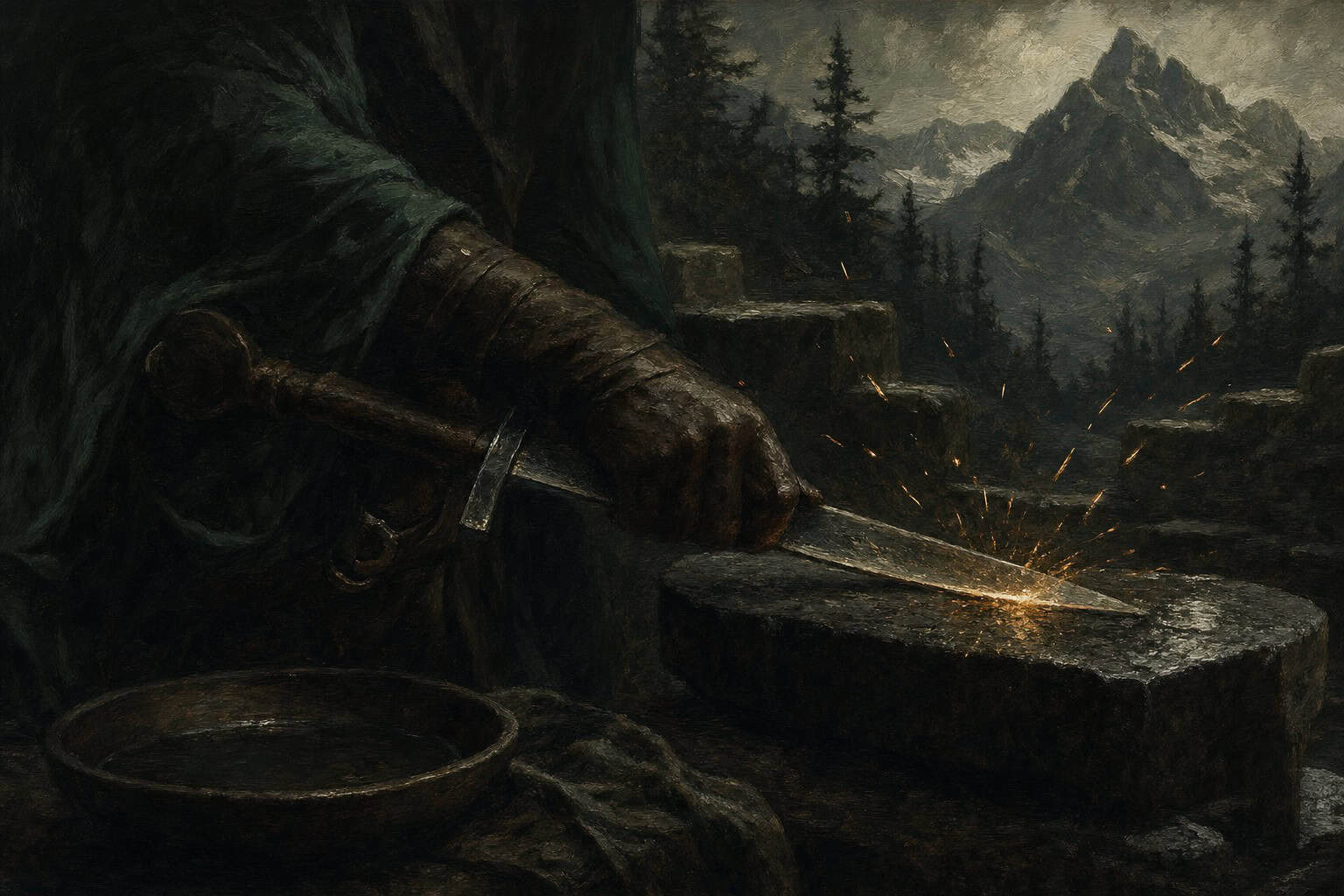
Steel leans hard into stone and throws its thin spray of sparks, and nose-close to the grind he feels it: how a soul fed only on comfort and easy flesh begins to hunger for an edge, even one that cuts.
Sparks Jumping from the Edge
Steel pressed hard against stone throws off a thin spray of sparks, and in this passage Anthony stands right there, nose nearly at the grind. He stays close to the image: blade leaning into whetstone, that harsh drag that vibrates straight through the wrist and into the ribs. Men, he notes, often flinch at the first sting of contact, mistaking that shrill scrape for an attack instead of repair. Rust feels painless by comparison; corrosion is quiet, powdering away at the edge with no drama, no light. But the stone carries its own history of wounds, faint channels worn into its face by other blades that dared to be pressed hard enough to change. What separates a mere scratch from real grinding is not poetry but pressure: one skates along the surface, the other commits to loss. To sharpen another, a man must first let his own edge be taken to that same stone, feeling metal leave him as dust while sparks mark each pass.
The Paid-Off Alarm Bell
Here the grinding turns scandalously intimate: flesh becomes a kind of currency, a soft coin used to buy silence from the soul. Anthony tracks the trade with painful clarity. A man senses betrayal, neglect, or contempt in the small details—a late reply, a glance that slides past him—but lets the body’s pleasure drown out the sting. He offers himself eagerly in bed, not only from desire but from fear, as if one more night of satisfaction might purchase amnesia for what his spirit has already seen. Each climax becomes a receipt: proof that things cannot be that bad, that the union still “works”. Yet the deeper self does not accept this payment. It records how touch is used as distraction, how tenderness becomes a smokescreen thick enough to hide rot. Muscles remember the bargain, holding a strange fatigue after pleasure, a limp heaviness that no amount of sleep can cure, because the alarm bell has been bribed but not convinced.
A Body That Won’t Stop Flinching
As the whetstone metaphor cuts closer, the body itself begins to rebel against the lie. Anthony stays grounded in small, ordinary sensations: a stomach that clenches when a partner’s name lights the phone, a sudden heat in the face during certain stories, a jaw that wakes up sore. These are not random ticks; they are the flesh spelling out what the mind refuses to read. He describes how ignoring this somatic script turns the man into his own saboteur. The more he uses pleasure to numb, the louder the body protests in other ways—tight shoulders, restless sleep, a chest that feels caged during moments that should be calm. There is no tidy lesson here, only growing pressure. His nerves keep jerking like a blade catching on a nicked patch of stone, that jolt each time the metal snags instead of gliding. The question is no longer whether something is wrong; it is how long the body can keep translating the soul’s warnings before it gives out in some more drastic tongue.
When comfort becomes mere furniture and flesh becomes currency, the soul begins to ache for something sharper than safety, even if it cuts.
The Man Who Turns Himself into a Cushion
Out of this inner tension grows a quieter tragedy: the man who makes himself soft enough to be sat on. Anthony shows him in plain relief—steady job, predictable kindness, endless patience, his life bent into the shape of someone else’s comfort. He becomes like a favorite couch: always there, always supportive, never demanding more than casual use. At first this feels holy to him, almost virtuous. He tells himself he is imitating Christ by absorbing weight without complaint. But the soul is not built to live as upholstery. The woman in his life learns she can rest on him without ever needing to rise with him; he asks for no ascent, offers no sharp word that would slice through her evasions or his own. For an ordinary reader, the warning cuts close: every time you mute your capacity to challenge, you press yourself flatter, trading the dignity of personhood for the safety of being merely comfortable. One day you realize people lean on you but never look at you.
Sparks That Have Not Yet Fallen
By the end of this passage the whetstone has become more than an image; it is a verdict on what passes for love and courage. Anthony refuses to let the reader hide in pious phrases. He names the inner legion plainly: the coward that calls itself humble, the sensualist that calls itself affectionate, the comfort-giver that calls itself loving while quietly accepting erasure. The grinding work of the whetstone is not to rescue any of these voices but to expose them, to strip away enough metal that the blade’s true line can emerge. Yet he withholds any easy promise that this will happen. We are left with a man standing over his own life, feeling in his hands both the blade he has allowed to dull and the stone that could cost him more of himself than he thinks he can spare. The sparks are already flying in his imagination; whether they land on water or find something dry enough to burn remains unsettled, hovering in the air like dust motes lit by a passing car.