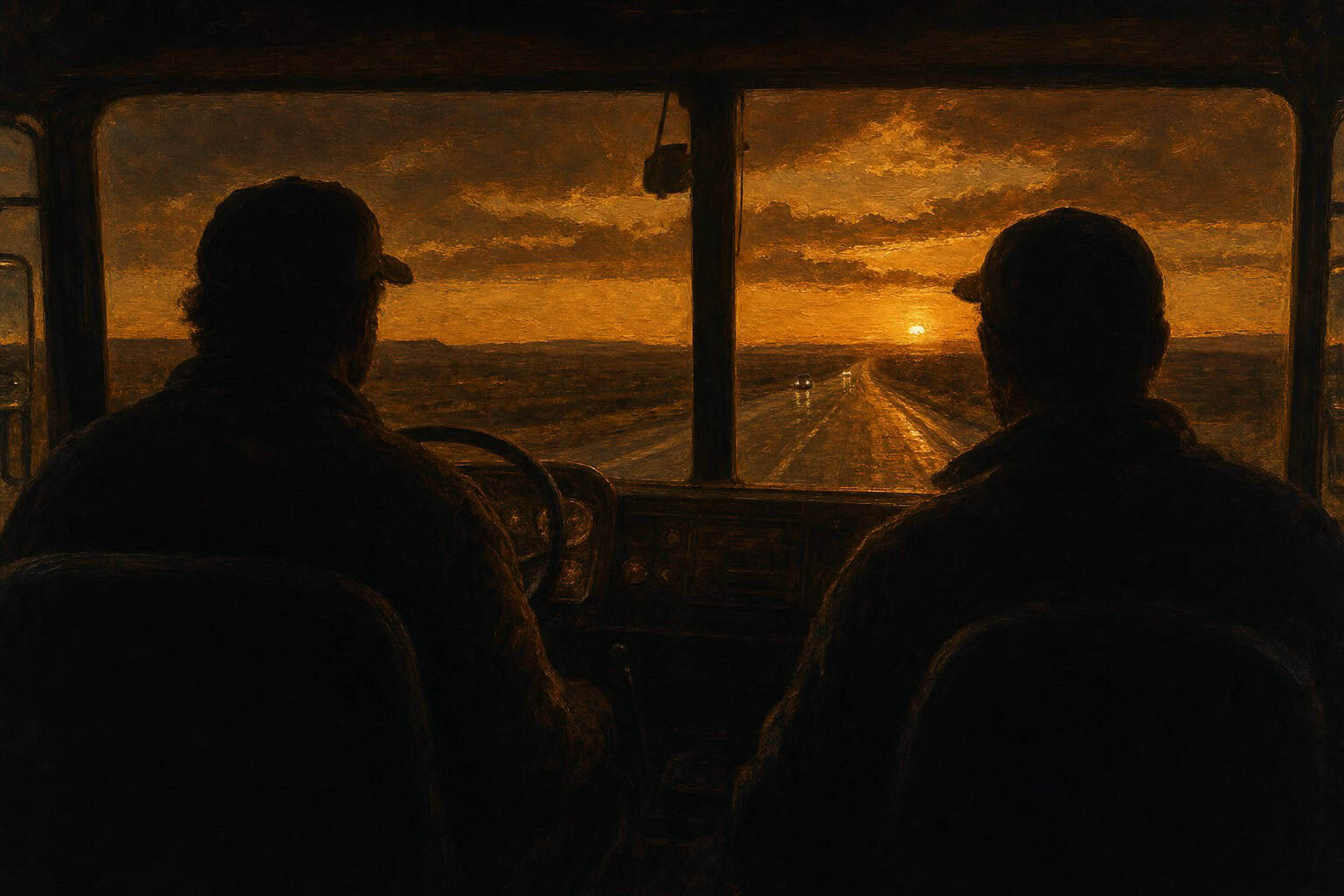
Two men ride shoulder to shoulder at dusk, trading the reputations of people not in the truck, and he feels the old ache — the myth of him always arrives before he can.
Highway Confessional in a Moving Cab
Dusk presses against the windshield while the truck hums along an unremarkable stretch of road. Two men sit shoulder to shoulder, eyes mostly forward, trading intelligence from separate fronts of the same long war. One speaks in short, dry reports about women, about bodies that blur together with motel wallpaper; the other names the drag of waking up again in the bed that still smells like childhood. No one asks for saving. The cab becomes a brief sanctuary not because it is warm or hidden, but because everything in it is moving and therefore cannot last. Cupholders jammed with gas station coffee cups and the soft blue glow of the dashboard frame this narrow window where speech comes easier than silence. They both know if they parked too long, if they tried to make this a standing appointment at a kitchen table, whatever is holy here would curdle into performance.
When a Naked Offer Carries Teeth
Somewhere among these reports, another scene surfaces: a body offered without protection, framed as trust. The memory is not soft-focus. It smells like sweat gone sour, cheap sheets, a condom wrapper pointedly left unopened on the nightstand like an accusation. She calls the risk intimacy, calls the refusal an insult. In that moment, you learn how a snare feels from inside the animal. This is not the quiet trembling of someone letting themselves be known; it is the hard edge of someone using their own flesh as leverage. The pressure is simple: prove your care by agreeing to share the danger. A false gospel of love that demands you gamble your life to validate their worth. In the truck, telling it sideways, you can feel again the tug between hunger and the sudden, clear knowledge that not every exposure is holy.
Rumor as Scent on the Air Before You Arrive
Running underneath these stories of bodies and beds is a lesson about how desire actually travels. You discover that access to the supposedly untouchable never comes from swagger in the moment, but from what drifts ahead of you like aftershave in a crowded bar. Your name moves first, carried by people who have tasted you in one way or another: a friend who drops a half-story at a party, an ex who lets her sadness leak just enough to tint you with danger and safety at once. By the time you step into a room, you are already half-real, half-legend. You feel it in the glance that lingers a second too long, in the way someone knows your joke before you finish it. This is not random chemistry; it is a network bending around the story it has decided you are. You start to see how carefully or carelessly you have been seeding that story, and how little control you have once it leaves your mouth.
Our reputation arrives before our flesh, and we spend years learning that the myth we let precede us is rarely a self we could bear to be known as.
The Outsider’s Accent When the World Shifts
All of this—the moving cab, the baited bed, the rumor-trail—lands hardest for the man who never quite learned the native tongue of belonging. If you grew up misreading every room, feeling your own voice scrape against the grain of normal, you carry an accent even when you are silent. That exile once felt like a curse: lunches eaten alone, jokes that arrived three beats late, touches that always seemed to overshoot or shrink back. Yet as the world starts rewarding strangeness over polish, your old liability mutates into a strange kind of fluency. You already know how to live without the safety of the crowd. You already know how to watch the currents that move beneath what people say. The danger now is not that you will always be outside, but that you might finally be invited in—and be tempted to sand down the very dissonance that has kept you honest.
Learning to Keep the Dissonant Note in the Choir
Beneath the banter and the field reports, the true pressure is simpler and more frightening: how to let yourself be loved by God without letting that love erase the crooked music that has carried you this far. The man in the passenger seat knows his darkness is not a costume; it marked him before he had words for sin or grace. The skills he learned in that shadow—reading traps in tenderness, surviving on the edges of other people’s warmth, mastering how myth travels—have kept him breathing. But now every new kindness, every hint of a gentler way, sounds like a request to become someone else entirely. To accept mercy feels like betraying the boy who had none. The truck eats miles. The road noise fills the spaces they do not name. Somewhere between exits, the question hangs like cigarette smoke in the cab, refusing to clear.