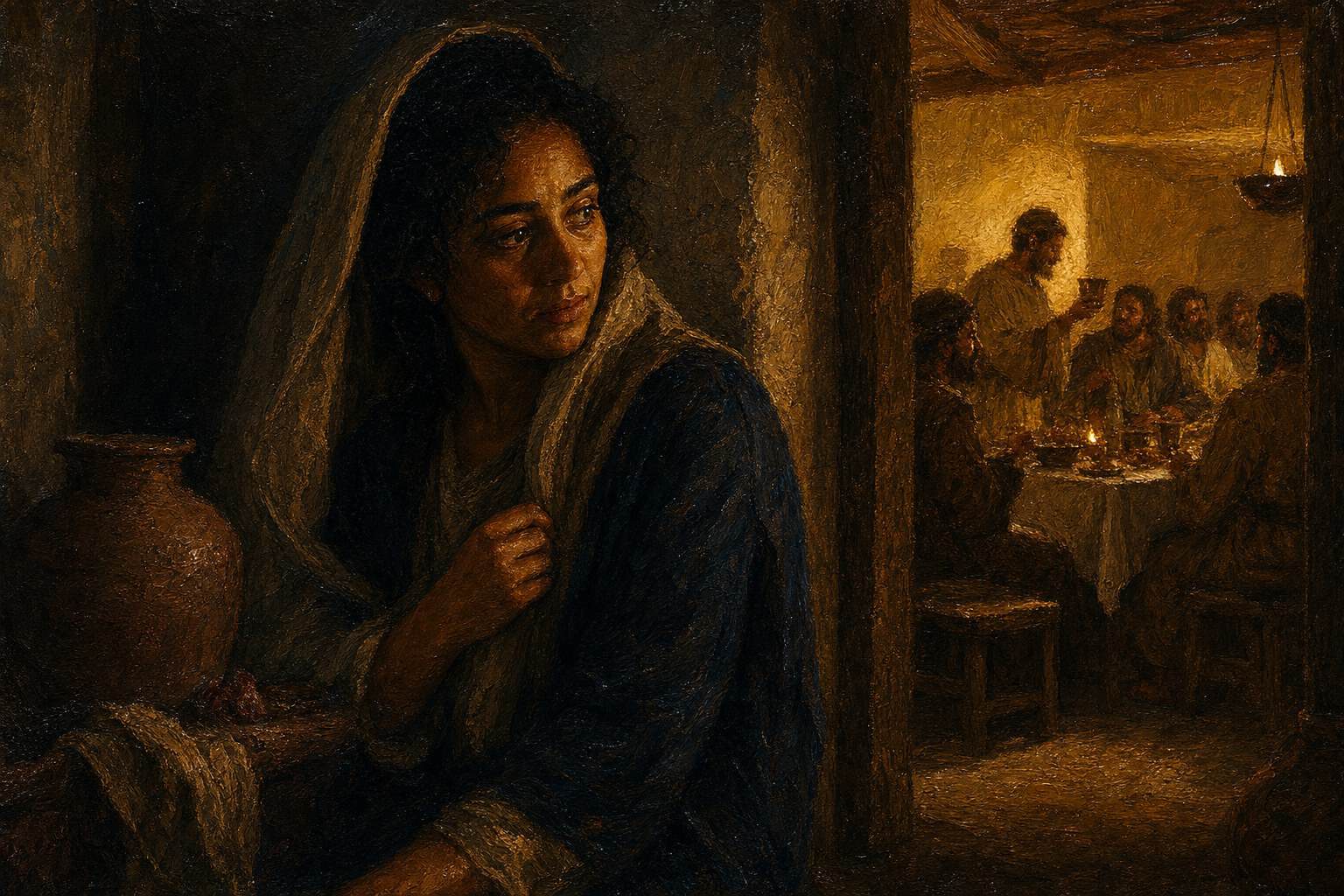
To love is to suffer — you already know the sting. A hard, tender look at why the ache is real, and where God stays when love wounds you.
The Boy Watching the Feast From the Dark
You were three when the world first showed its teeth. A babysitter’s cruelty. A caregiver’s punishment at daycare. Small hands cannot name what is done to them, so you called it confusion first, and later you called it hatred, and you were closer the second time. I want to sit beside you in that memory now and tell you what you could not know: the hatred was already a wound wearing a mask, borrowed from the very people who hurt you. By elementary school you had learned that the rich kids ran on different rules, that the girls treated you and your friends as something less than human, and the arithmetic of that lesson never left your body. You felt it in your stomach before you had words for it. Then came the junior-high years, where beautiful people found each other without effort, without depth, without a single true word passing between them. You stood outside their easy warmth like a creature at the edge of a lit hall, close enough to hear the laughter, too far to be counted in it. You watched them feast. You wanted in with a hunger that shamed you, and you despised what you wanted with a disgust that felt, in the moment, like a kind of virtue. Both feelings were true at once, and both were poison in the same cup. I know the exact posture of that boy — shoulders drawn tight, eyes cataloging every hollow pleasantry, every couple that swapped partners like a game of musical chairs, every conversation that never reached below the surface. I know it because I have carried him for decades and cannot set him down. What you called observing was really starving. You told yourself you saw more deeply than they did, that your loneliness was a species of contemplation, a higher seat with a clearer view. It was not higher. It was a shadow you chose because the light had already refused you, and a shadow chosen too many times stops feeling like a choice and starts feeling like a face. You did not yet understand that to be unseen is its own specific agony, sharper than being struck, because it tells the body a quieter and crueler thing: that you are not enough to be kept. That is the erasure I want to name plainly for you, without softening it. It was not only that they hurt you. It was that they looked past you as if you weighed nothing at all, and you were young, and you believed the weighing, and you began to do it to yourself in the dark.
When Obedience Tasted Like Swallowed Stone
Every Sunday you heard the command clearly, from the front of a church that smelled of wax and old wood: do not be conformed to this world, be transformed, go out and love with compassion. And you believed it. That is the part I ache over most, sitting here on the far side of it. You were not a cynic wearing faith like a costume — you tried, genuinely, with your whole raw heart. You went out among them wanting to obey, wanting to give love and receive some small portion of it back, wanting comfort and acceptance and peace without abandoning the God you already loved. And what came back was not bread. You asked for bread and something hard was pressed into your open palm. You reached for a fish and closed your fingers on the cold muscle of a snake instead. Obedience was supposed to feel like walking into a warm kitchen; it felt like a blade slid quietly between two ribs. I need you to hear, across all these years, that your confusion here was honest and your protest was human and I will not shame you for either. You were not wrong that it hurt. You were only wrong about what the hurt was telling you. You read the pain as proof that God had chosen the worse thing for you on purpose, that heaven itself was mocking your effort, that standing apart from the world had earned you only the world’s contempt with God’s silence stacked heavy on top of it. The tension you could not yet hold was this: the command to love never once promised that love would be returned to you, or come back soft, or arrive safe. Nobody told you plainly that loving the people who dehumanize you would feel like walking straight back into their teeth, again and again, offering an open hand to a mouth. You wanted the reward folded inside the same act that cost you everything you had. And when the reward did not come, you began to suspect the whole arrangement was cruel by design — that God asked for tenderness and paid you in stones and cold scales. I will not pretend the ache was smaller than it was. It was enormous. It filled the whole room of you. But I will tell you gently that you misread the currency you were being paid in. You thought the suffering was the sign of a broken promise, a contract God had failed to keep. It was, instead, the shape love takes when it enters a world that has not yet learned how to love back. You had not been cheated. You had been quietly enrolled in something you did not sign up for.
The Sword Was Not the Lie — The Bargain Was
Here is the turn, and I say it gently, because I know it will cost you something to receive it. You went to the world and its girls seeking comfort, acceptance, pleasure, and a peace you could rest inside, all while still loving God with the same breath — and you found conflict, pain, and misunderstanding waiting at the end of every reaching. You read that outcome as God’s failure, as evidence He had abandoned the deal. It was not. The trouble is you had struck a bargain that no one, least of all God, had ever offered you: I will love, and in exchange I will be spared the wounding. That bargain does not exist. It never existed anywhere. To love anything at all — a girl in a hallway, a friend, a stranger, the God who seems to withhold Himself — is to hand that thing the power to open you, and there is no hidden version of the arrangement where you keep the loving and refuse the cost. The two are one flesh; you cannot cut them apart. You thought the sting was evidence you had done it wrong, that you had misread the instructions. The sting was evidence you had done it at all.
The love that costs you nothing was never love; it was only a hand held out to keep the world at arm’s length.
What you called being handed a snake instead of a fish was simply the true and honest weight of loving a world that had not yet learned to love you in return — and no one, not even God, promised you a lighter one to carry. But hear the quieter deception too, the one that hid beneath your loud anger where you could not see it working. In those years you began to convert your rejection into a kind of pride, to bear the abandonment like an ornament pinned to your chest, to prove your manhood by how much of it you could endure without flinching or asking for help. You told yourself the endurance was making you strong. It was only making you cold. The harder you worked to stand above the pain, to observe it from that high contemplative seat, the colder the air around you grew — and the cold was your own breath, freezing on the walls you kept building. You mistook the ice for armor. It was a cell, and you were fitting yourself inside it, one refusal at a time, calling the echo of your own hunger by the name of wisdom.
The love that costs you nothing was never love; it was only a hand held out to keep the world at arm’s length.
The God Who Did Not Fix It, But Stayed
So where was He, in all that stone and cold and swallowed sword? You believed He had gone completely silent, and I will not insult you by pretending the silence was not real — it was real, and it was terrible, and you were right to feel the fear of speaking into a room that gives you nothing back, night after night. But I have lived on the far side of that silence now, and I have to correct you, tenderly, on what it actually was. It was not absence. It was presence in a form you were too raw and too young to recognize as presence. God did not lift the loneliness off your shoulders. He did not clear the beautiful shallow crowd from the hall and set you a warm place at their table with your name on it. He did not turn the snake back into a fish to make the lesson stop hurting. He did something stranger and much harder to accept: He sat down in the dark beside you and would not leave. Every tear you cried in those years, certain no one was watching, certain you were entirely unwitnessed — He was the witness the whole time. The erasure you feared most, that terror of not being enough to be kept, was answered not by a sudden rescue but by a companionship you were not yet able to feel against your skin. You wanted Him to reach in and fix the wound cleanly. He wanted, instead, to be inside the wound with you. I know precisely how insufficient that sounds to a boy who is bleeding and wants only for it to stop. It sounded insufficient to me for a long, bitter stretch of my life. But the deprivation was never punishment. It was cultivation. He was starving you of the easy comforts, the cheap warmth, so that your faith would grow its own working muscle — so that when every prop was finally kicked away you would still find Him standing there, unseen, in the flattened landscape where you were certain only you existed. That single collapsed perspective, that terror of one eye open with no depth and no other soul to carve the world into three dimensions — it was never truly single. There was a second presence in the room the entire time, quietly cutting depth into a place you had judged empty. You simply had not yet turned your head to look for Him beside you.
What I Carry Back to You Now
I cannot promise the boy at the edge of the feast that the wound ever fully closes. That would be a lie, and this is not the place I keep for lies. The resentment you built as a shield in those years followed me into rooms you cannot yet imagine, sat down at tables you have not reached; the hatred you thought was protecting you became, for a long and terrible stretch, almost impossible to tell apart from who I was. That is the true danger I want to hand back to you across all these years — not the pain of loving, which you cannot avoid and should not try to, but what you will do with the pain if you let it harden into a permanent shape. Loving will cost you. Being unseen will keep on costing you, in currencies you have not learned to count yet. But the disgust you cultivate to survive it will cost you far more in the end, because it turns inward eventually and does not stop turning. A man who despises the world long enough begins, without noticing the exact day, to despise the one doing the despising. I know this. I met him in the mirror one gray morning and did not recognize him at first. What I would give to reach the boy watching that lit hall and simply loosen his tight shoulders with my hand — to tell him the ache is not a verdict passed against him, that being passed over is not the same thing as being nothing, that the God who seemed to press stones into his palm was already living inside the hunger, weeping there with him and refusing, maddeningly, to explain Himself. You will not get the tidy answer you keep asking for. You will get something better and much harder to hold: a Presence that does not remove the dark but walks every step of it beside you, tear for tear, cold breath for cold breath. To love is to suffer — yes, plainly, always, without exception. But to refuse to love is to suffer too, and to suffer utterly alone, with no companion inside the cell you built with your own hands. I wrote all of this down, the whole descent and the strange nearness I found at the bottom of it, in Confessions to the Empty Chair, because someone else is standing right now exactly where you stood, at the dark edge of a room full of easy warmth, believing the ache is proof of their own worthlessness. It is not. It is proof they are still capable of love. That is the last thing I would carry back to you, and the first thing I would say to them.