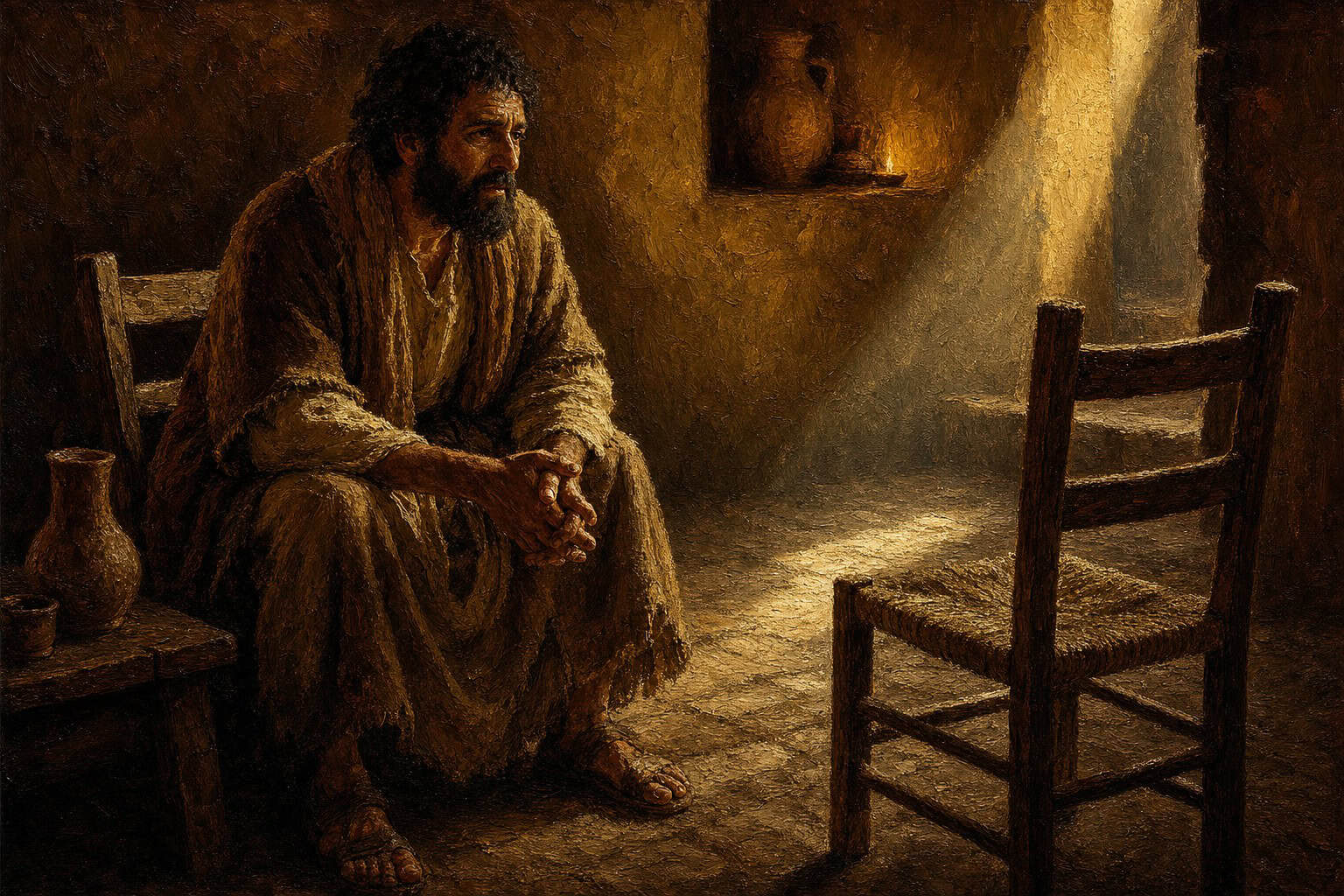
You sit in an empty chair and speak to someone who left. What that silence teaches about hunger, absence, and the God who stays.
The Crib Above Which No One Leaned
You pull a chair close and you talk to no one. That is the whole act, and it is stranger than it sounds. There is a seat, its wood cool under your palm, its cushion holding no weight but the ghost of one, and you lower yourself down across from it and begin to speak as if a body sat there breathing. In the second chapter of Fractions of the Soul, the narrator does something like this in reverse. He fixes his gaze on a woman and tries to explain her from the inside out, tracing her all the way back to a small room and a wooden railing. He describes an infant left alone in the dark, crying for milk, hearing no footstep cross the floor to answer. That crib is its own empty chair. Someone should have leaned over that railing. Someone should have gathered the child up and pressed her against a warm chest until the crying slowed and her breath fell into the rhythm of another heartbeat. No one did. So the child learned that the space above the crib was hollow, that the arms she reached for closed on cold air, and she laid the foundation of a whole life on top of that hollow. When you sit in your own empty chair, you are sitting where she sat. You are speaking into the gap left by a person who was supposed to be here and simply was not. The narrator understands that gap because he lives inside one too, though his is furnished with books and long arguments instead of men. He turns his hunger into thinking. She turns hers into touch. But both of them are talking to a chair. The strange mercy of the exercise is that it forces you to admit the seat is empty. You cannot pretend the absence is company. You cannot smother it with the next warm body that walks through the door. You have to look at the vacant wood and name what should have been there and never was. That naming is the first honest thing you have done in years. Most of us spend decade after decade dressing the absence in someone new, again and again, until we forget it was ever an absence at all, until we call the dressing-up love. The chair asks you to stop dressing it. It asks you to sit with the plain fact that a place was left open early, before you had words for it, and to feel in your own chest how much you still lean toward that empty seat. The whole chapter begins here, in the room where the crying went unheard, and it never lets you look away from it.
The Cry That Only the Wrong Ears Catch
There is a cruelty threaded through the scene the narrator draws, and he does not soften it. The child cried for milk and the cry went out into the dark and struck nothing. Years later, he says, the cry is still going out. It never stopped. But now the only ones who hear it are men with reaching hands. The infant hunger became a kind of frequency, a pitch the body sends out without meaning to, and the wrong ears are tuned to it. She calls for a mother and a mouth arrives. She calls for warmth and use arrives, sits down, looks at her with interest that feels, for a moment, like being seen. Sit in the empty chair long enough and this is the thing that begins to throb under your ribs. You realize the seat has been filled before, many times, by people who came not to hold you but to feed on you. You mistook their appetite for love because appetite, at least, shows up. It crosses the room. It fixes its eyes on you. Any attention is warmer than the silent room, so you let them in, and you tell yourself this one is different, this one heard the true cry beneath the surface cry. He did not. He caught the frequency and followed it the way an animal follows a scent on the wind. The narrator is unsparing about this pattern, and he is unsparing about himself, because he knows he has been the one who came for the wrong reasons. He has looked at a woman and thought he could chart her coordinates, learn her rules, hold out his bruised heart on a platter and buy his way back into her caring. That is its own hunger wearing the mask of devotion, and he names it as a flaw in the way he sees. Sitting in the chair, you have to ask whether you have ever offered someone your simple presence, or only your need dressed up as generosity. The space between two people is never neutral. It hums with what each of you carried in. If you carried an empty crib, you will keep drawing in the ones who feed on emptiness. The room fills with bodies and stays vacant. And here the ache turns from anger toward something older and cleaner. The cry itself is not shameful. The cry is holy. It is the sound a soul makes when it was built for love and got hunger handed to it instead. The tragedy is not that you want to be held. The tragedy is that the wanting has learned to answer only to those who will consume it. The empty chair lets you hear your own frequency at last, unmixed, before the wrong ear catches it again and mistakes it for an open invitation.
When the Seat Was Never Theirs to Offer
The turn in this part of the book is hard to hold in your hands. The narrator suggests that a soul damaged deeply enough can become something that only looks human from the outside. He reaches for a cold, uncanny word for it, borrowed from a world of machines that wear our faces. He describes a person who moves through the world in human shape but cannot register that the people she wounds are real. In her line of sight, they simply are not there. A partner stands directly in front of her and does not exist. This is not a monster grinning as she chooses evil. This is something more terrible and more pitiable at once: a being who was set outside the boundary of love so early, so completely, that she never learned others live inside a boundary at all. She was placed outside first. Now she cannot perceive the inside. She was handled roughly, screamed at, struck, left to face the dark alone in that crib, raised the way you would train an animal rather than raise a child. And here is where the empty chair does its deepest and most brutal work. You sit across from the seat and you slowly understand that the person you keep addressing may never have been able to answer you. Not out of chosen silence, but because the part of them that answers was starved before it could ever grow. You have been speaking to a chair because the chair was, in some real and awful way, all that was ever there. The love you kept negotiating for could not be negotiated, because the one you negotiated with could not take in the terms. This is the moment the whole exercise stops being about closure and becomes about grief. You are not going to win them. You were never going to win them. The seat was never yours to fill, and it was never theirs to offer.
The chair is empty because the love that should have filled it left first, and every touch since has been a search for the warmth of that vacated seat.
The Platter Going Slack in Your Hands
After a revelation like that, the body goes quiet in a particular way. Not peace. Something heavier and lower, a stillness with weight in it. You sit in the chair and the arguments you had rehearsed, the case you were building point by point, the platter you meant to hold out with your heart on it, all of it goes slack in your hands. There is no one to make the case to. The narrator lives inside this slackness through much of the chapter. He is a man who thinks his way toward everything, and thinking has always been his warmth, his stand-in for the chest he never got to sleep against as an infant. He built his intellect as a place to hide from the raw and shifting weather of feeling, where nothing holds still and abandonment can strike without warning. Now that intellect stands useless in front of the vacant seat, sharp and unable to reach anyone. He calls it a blemish in the way he sees. He believed his mind could solve the puzzle of another’s desire, and he understands at last that treating a living person as a puzzle to be cracked was its own quiet failure to love. What do you do with the space once the negotiation ends? You could fill it again. You could draw in the next warm body and begin the cycle from the top, and most of us do exactly this, because the empty room is nearly unbearable and appetite always shows up faster than love. But the narrator stays in the discomfort. He lets the space remain empty. He turns the lens back on himself and holds it there: the times he came to the crib not to hold but to be held, the times he read someone’s polite indifference as a secret code he alone could break, the way he handed over devotion that was really a demand in disguise. He does not tie any of it off with a tidy lesson. He does not forgive himself cheaply, and he refuses to condemn her simply, because he can see the crib behind her too. He lets the questions stay open, unhealed, honest, aching. And in that open, unfilled space something else becomes possible. Not a person. Not yet. But a presence. The Catholic understanding running beneath this scene is that the empty chair is never truly empty once you finally stop forcing a human being into it. There is a Third who sits down in the silence. Not to fix the hunger. Not to erase the crib or reverse the wasted years. But to be there, quietly, in the dark, in the very place where you were left alone. He does not lift you out of the room. He lowers himself into it beside you. That is a stranger thing than rescue, and harder to receive, because it asks you to stop demanding rescue and simply let yourself be kept company.
An Infinite Hunger and a Human Chest
Longing is a strange grief because it never fully closes, and Fractions of the Soul refuses to pretend otherwise. You will rise from the empty chair and the hunger will still be sitting in your chest, exactly where it was. You will still, on certain nights, reach for the wrong warmth and half-know it as you reach. The crib does not seal over. What changes is what you do with the reaching. The book insists the ache itself was never the flaw in you. The ache is the truest thing you carry. It is the soul remembering it was made for a love it has not yet held, a wholeness it can name but cannot grasp, a warmth whose shape it can feel even in total dark. That reach outruns every person who ever occupied your chair. It outran your mother, who left the room. It outran the ones who came only to feed. It even outruns the good ones, because no human chest was ever built to be the final resting place of a hunger this deep. This is the thing the narrator circles all through the chapter without ever landing on it squarely, because to land would cheapen it. He wants the woman he describes to find real love, and he watches her keep calling out on a frequency that only predators can hear. He wants it for himself too, though his own hunger keeps ducking behind logic. And beneath both their hungers is the identical original cry, the one that went up from the crib into the silence, the cry for arms that would hold and not consume. The consolation the book offers is not comfort. It is company. The seat across from you is empty of the person, yes, and it may stay that way. But the room is not empty of God. He was in the crib. He was in the silent dark above the railing. He was there in every tear that struck no human ear, present the whole time, walking beside you even through the years you spent stuffing the chair with strangers. He did not stop the abandonment. He was down inside it. If you want to understand your own empty chair, and why you keep sitting across from someone who cannot answer back, this chapter will hold a small lamp to it without flinching and without lying to you about how much still hurts when the light falls. It will not promise the seat gets filled. It will tell you Who else has been sitting in the dark of the room the whole time.