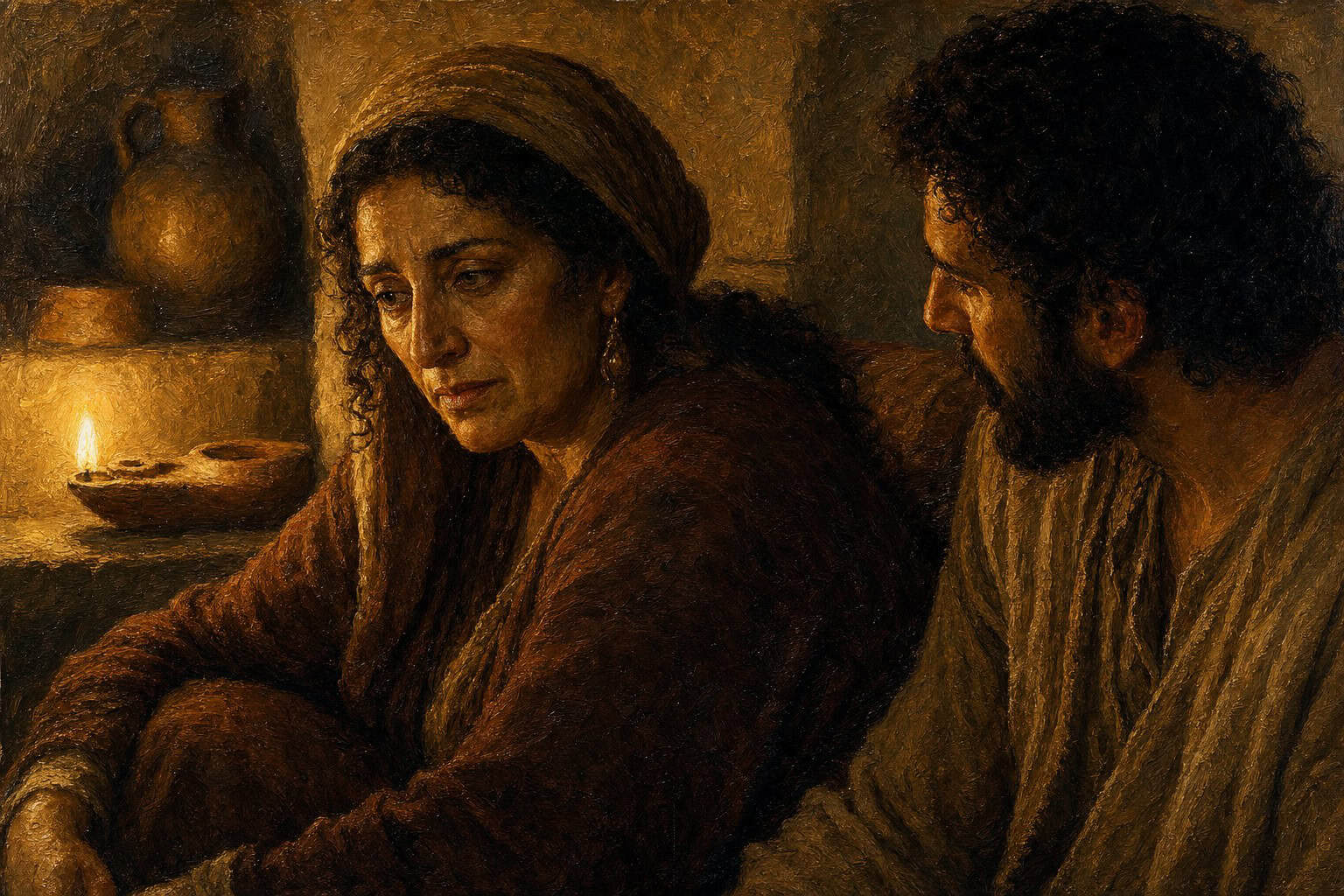
Locked in with someone and lonelier than ever? A reflection from Fractions of the Soul on the distance that opens while bodies press close.
Two Bodies on One Couch, and the Cold Between Them
You are on the couch. Her leg rests across yours. Her head is on your shoulder, warm, breathing slow, and you can feel the small rise and fall of it against your collarbone. By every measure you are close. The apartment is small, the door is shut, and there is nowhere else either of you needs to be tonight. The lamp throws a low gold light over both of you, and outside the window the street has gone quiet. By every account this should be enough. And yet something inside you is standing at a great distance, watching the two of you from across a field you cannot cross. This is the exact ache that opens the fourth chapter of Fractions of the Soul, where two people share a room, share touch, share slow hours, and the man inside the story feels the miles grow between them even as the pressure of her body increases against his. He does not report a fight. There are no raised voices, no slammed cabinet, no cold shoulder to explain the cold. He reports something quieter and worse. He reports proximity without arrival. The scene meets you exactly where you actually live: not abandoned in some empty hallway, but shut inside a warm space with a person, and still starving. The book is unflinching about how touch gets used. It names the way a hand laid on the arm, a message answered in seconds, a body pulled close at night can become a kind of medicine swallowed against the fear of being alone. Not communion. Anesthetic. You reach for the other person the way a frightened man reaches for a drink, to make a rising panic go quiet for one more hour. The warmth holds you both, and the holding numbs, and the numbness passes itself off as peace. But numbness is not the same thing as being met, and some low part of you knows the difference even while you keep taking the dose, night after night, the way you take anything that lets you sleep. That is the trap of being locked in with someone. The lock keeps you from wandering off, but it does not force two souls to actually touch. You can memorize the rhythm of a person’s breathing and the exact weight of her head on your chest and still not know whether you have ever been seen by her, or only kept by her, the way a person keeps something they are simply afraid to lose. This chapter begins there, on that couch, in that gold light, in that warmth, and it refuses to lie to you about any of it. It sets down the first hard fact plainly, so that everything harder can be faced.
The Woman Who Loves a Man Who Isn’t Quite You
Then the chapter presses on a bruise most people carry and never say out loud. When she looks at you, resting there against you, what does she actually see? Fractions of the Soul offers a brutal answer, and it does not soften the blow. Her gaze does not discover you. It invents you. Early on, before she knew much of anything, she built a picture of who you are, a picture stitched together from her own hopes and her own hungers and her own old wounds, and it is that picture she keeps close at night. Her love lands on the man in her imagination, and you happen to be standing exactly where that man is projected, filling his outline with your real breath. You feel this without having words for it. It is why a kind word from her can leave you colder than an insult would. She praises the version of you she made, and the praise slides right past the raw fact of you, running off like rain off glass, touching nothing underneath. This is where the slow terror of erasure enters the scene. You are physically present and slowly disappearing at the same time. Every day you perform the man she needs, answer the way he would answer, reach for her the way he would reach, and every day the actual you goes a little quieter, a little more unseen, until you begin to wonder whether anyone has ever loved the plain fact of your existence rather than what that existence does for them. The book calls this the original wound of human love, and it does not flinch from it. We are loved for what we represent to someone else. We are chosen for the role we fill inside their private story. And so the loneliness of being locked in with someone is not, in the end, a failure of nearness at all. It is the discovery that nearness was never going to be the cure. You can share a bed for years, learn a person’s every sigh, and still remain two private theaters, each one performing devotion to an audience that never quite arrives, each playing a love no one in the seats can see. The chapter lets this sit without any softening. It does not hand you a clever method to fix the way she sees. It does something harder and far more useful. It tells you the truth about the gap, so you can stop blaming yourself for a hunger that no amount of closeness could ever feed. There is shame threaded all through this stretch of pages, the shame of being found not-enough to be truly known, the small animal wish to cover yourself and vanish from the light. But naming the thing changes it. Once you see that the distance between you is not proof of some defect in you, you can stop clawing at the other person to close a wound they did not open and cannot close. The clawing itself, the book quietly shows, is the very thing keeping you both stuck in the numbness.
Adam Chose the Dark So He Wouldn’t Be Alone
Here the chapter turns hard, and the turn is severe. Fractions of the Soul reaches back past the couch and the lamplight to the oldest story of two people standing among trees in a garden. The common telling says the first man was tricked, fooled, argued into ruin by a woman who had already been fooled herself. The book flatly refuses that comfort. It argues that the man was not deceived at all. He saw clearly. He understood the full cost of what was in front of him. And knowing the cost, he chose shared damnation over solitary paradise. He would rather fall with her into the dark than stand alone in the light without her. Read that slowly, because it is the whole hidden engine of why you stay locked in with someone even after the room has plainly gone cold. The first sin of love after the garden was not lust, and it was not pride. It was this: preferring mutual destruction to the raw terror of being left behind. You have done it. Nearly everyone has done it. You have followed someone into a dark you saw coming from a long way off, because the dark with them felt survivable and the light without them did not. You told yourself it was loyalty. You told yourself it was devotion, sacrifice, love. And there was real love inside it, twisted tight around a fear so ancient it feels welded to your bones. You watched the wrong turn coming and took her hand and walked into it anyway, because her hand in the dark was worth more to you than open sky alone. This is the sharp center of the chapter, and it lands like a flat palm pressed hard against your breastbone. The man in the story is not a fool here. He is a mirror. He shows you the exact shape of the choice you keep making, dressing it up each time in nobler clothes so you do not have to see it plainly. The book will not let the clothes stay on. It sets the two figures among the trees beside the two of you on the couch and lets you feel that they are the same choice, made in the same fear, wearing the same tender excuses across all the years between them.
The worst loneliness does not come in an empty room; it comes while you are holding someone and feeling the space between you widen.
What the Numbness Was Hiding All Along
After that blow, the chapter does not rush to bandage you, and that restraint is its mercy. It lets the recognition settle into your body the way cold settles into a house after the heat is cut. If the first man chose the dark rather than face the solitary garden, then the anesthetic of touch was never really about the other person at all. It was about the thing waiting on the far side of solitude, the thing you have been medicating with slow hours and held hands and warm couches your whole life. Fractions of the Soul names it without cruelty but without mercy either: the terror is not of her leaving, but of what you would have to become if she did. A person locked in with someone by fear is a person who has quietly outsourced the whole burden of existing to another. She holds the panic at bay simply by being there. As long as her weight is on your shoulder, you do not have to answer the harder question of whether you can stand at all on your own. This is why the loss of such a partner does not merely hurt; it shatters. The chapter does not stage that loss on the page, but it lets you feel its shadow leaning in from the edges of the room. If the other person were suddenly gone, the whole illusion of safety would collapse at once, and the demand you have been running from your entire life would arrive at your feet all at once, unpaid and enormous: the demand to be a self, to own your own existence, to face the bare room without a hand to grip. The quiet after the turn is that slow, dawning arithmetic done in the dark. You begin to understand that the distance you felt on the couch was not a flaw in the relationship to be repaired. It was a truth about being a person, showing itself most sharply in the exact moment you tried hardest to escape it. The book offers no trick to make the distance vanish, because the distance is not a mistake. It is the place where you are, at last, alone enough to be honest. And into that honesty, quietly, another possibility enters. If you were only ever loved as a projection, then somewhere there might be a love that sees the raw fact of you without inventing you first, a gaze that does not need you to play a part. The chapter sets that possibility down at your feet without forcing you to pick it up, and lets you sit with the strange relief of having finally been told the truth.
The Dust That Falls When You Stop Performing
Where the chapter finally settles is not in despair, which is what you might expect after such a hard walk, but in a strange, clean quiet. Fractions of the Soul has spent these pages stripping away one comfort after another: the comfort of blaming her, the comfort of blaming yourself, the comfort of believing that more closeness would fix the ache. What is left when all of that falls away is small and real and yours. The book turns here toward the divine, and it does so with a claim that unsettles even the faithful. It says that a single genuine touch of the divine renders every human achievement into dust, not by comparing them and finding them lesser, but by revealing what reality actually is underneath everything you built to feel safe. This is not soft, warm faith. Faith, the book insists, is not comfort. It is devastation first. It strips away the illusion that your constructions matter, that the role you performed for her mattered, that the picture she kept of you was ever the ground you stood on. And in that stripping, something opens. The man who has spent his life being loved as a projection, holding another to keep his own terror quiet, is being pruned, cut back to living wood, so that something lasting might grow where the numbness used to be. The chapter names sorrow as a kind of pruning, painful and necessary, never to be worshipped for its own sake, but never wasted either. You do not read these pages and feel patched up. You feel accurately seen, perhaps for the first time, and that accuracy is its own severe kindness. The loneliness of being locked in with someone, the book finally suggests, may be the exact pressure that drives you to seek a gaze that does not invent you, a love that knew the true shape of your heart because it made that heart in the first place. That is where the chapter leaves you, and it is why you will want the whole of the book in your hands. It does not promise to fill the couch beside you. It promises something stranger and better: to tell you the truth about the space between two people, and then to point past that space toward the only one who does not need you to perform. The lamp still burns low. Her breathing is still slow against your shoulder. But you are awake now in a way you were not an hour ago, and the dust of everything you thought held you up is settling gently onto the floorboards, and for once you are not afraid of the sound it makes as it falls.