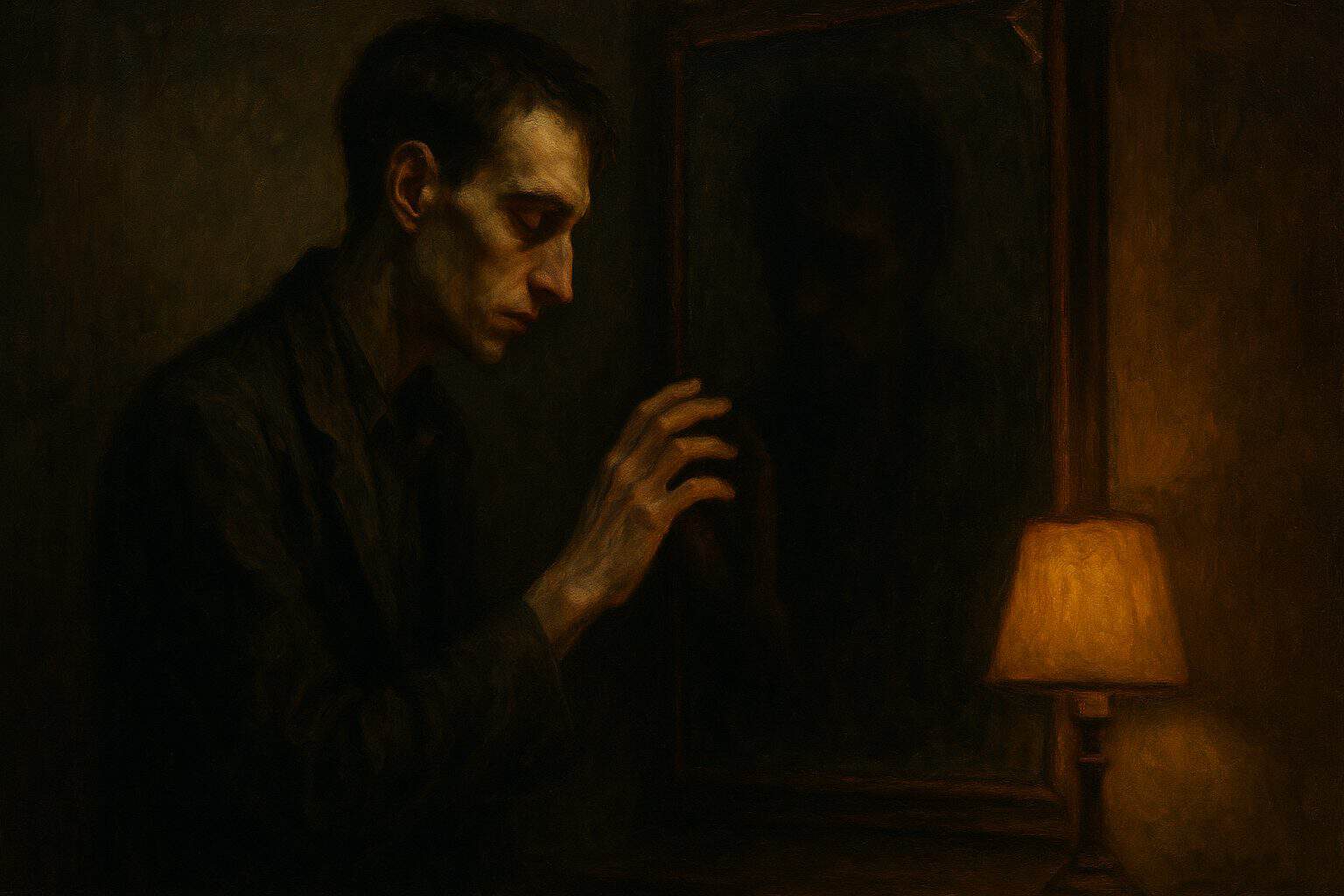
How the self learns to disappear before it can be disappeared, threading absence through presence like smoke through glass
The Grammar of Withdrawal
There is a particular gesture the body makes when it reaches toward warmth only to pull back at the last moment—not from the heat itself but from the anticipated cold that will follow. Watch how the hand extends, fingers beginning to open, then curls inward before contact, retreating into the safety of its own hollow. This is how erasure begins: not with violence from without but with a preemptive vanishing from within.
In Fractions of the Soul, Anthony names this movement precisely: “reaching hesitantly toward emotion, only to retract, abandoning it before it could inevitably abandon me.” The phenomenology here is exquisite in its precision. The emotion exists, the reaching happens, but between impulse and completion lives a terrible foreknowledge. The self has learned the rhythm of loss so thoroughly that it performs the abandonment first, becoming both the one who leaves and the one left behind.
The Mirror’s Double Absence
Stand before a mirror in half-light. Notice how you become both substance and shadow, how the reflection seems sometimes to lag behind your movements by the smallest fraction of a second. Now imagine living as both these figures simultaneously—the one who casts the image and the image cast, never quite synchronized, never quite separate.
“She is both the person standing in front and behind the mirror, herself and her replicant, and her shadow and its source.”
This doubling that Anthony observes in Jeannètte reveals something essential about how erasure operates in intimate space. The beloved becomes a kind of hologram, present and absent in the same gesture, manufacturing distance through the very fact of proximity. “She manufactured distance through long absences, leaving me to wake up in an empty bed”—but the absence was already there, woven into presence like a watermark in paper.
The phenomenologist Sartre understood this: consciousness exists as pure negativity, a nothingness that nihilates the thickness of being. But in lived experience, this philosophical truth becomes unbearably concrete. The empty bed holds more reality than the occupied one because absence, once it enters love, retroactively empties even the moments of presence.
The Technology of Self-Redaction
Consider how we learn to edit ourselves in real-time, developing an almost surgical precision in removing the parts that might disturb before they can disturb. “I know I disturb more than I console, so I redact myself to preserve a fragile peace.” This is not simple self-censorship but something more radical—a kind of ongoing self-surgery performed without anesthetic.
The mechanism works like this: First comes the recognition of one’s own capacity to unsettle. Then the preemptive strike against that capacity. But the redaction never quite succeeds in creating peace; instead, it creates a different kind of disturbance, the disturbance of the conspicuously absent, like a conversation full of words that carefully circle what cannot be said.
“I threaded honesty through jokes and prayed no one tugged the stitch and unraveled me completely.” Here the self becomes a kind of textile, woven from concealment and revelation in such intricate patterns that even the weaver cannot say which thread is which. The joke becomes a delivery system for truth, but also its prophylactic, ensuring that if the truth is rejected, it can be retroactively reclassified as mere humor.
The Empty Chair’s Shifting Occupant
In Confessions to the Empty Chair, Anthony reveals something profound about the structure of address itself: “The ‘you’ I address is not a single person; the occupants of the ’empty chair’ constantly shift… And always, God sits in the empty chair.” The phenomenology here opens onto something vast—how absence itself becomes the most reliable presence, how we speak most truly to what is not there.
The empty chair holds everyone and no one. It becomes the repository for all the conversations we cannot have with those who are present, all the words we cannot speak to faces we can see. The chair’s emptiness is not a lack but a plenitude—it can hold any listener we need it to hold, can receive any confession without judgment or flight.
But notice the theological turn: “And always, God sits in the empty chair.” The divine becomes identified not with presence but with a particular quality of absence, an absence that listens, that receives without consuming, that holds without grasping.
The Phenomenology of Being Uncounted
“Erasure stung worse than hate because hate still points at you. I stood where I used to stand and counted the empty.” This distinction between erasure and hate illuminates something essential about how the self experiences its own negation. Hate, however painful, maintains a kind of relationship. It acknowledges, even as it rejects. It sees, even as it condemns.
But erasure? Erasure removes even the dignity of opposition. You stand in the same physical space you always occupied, but the space itself has been reconfigured around your absence. You become like a ghost who doesn’t know they’ve died, going through familiar motions in a world that no longer registers your presence.
The counting of the empty becomes a terrible arithmetic—not counting what is there but what is not, not measuring presence but absence. Each empty space once held a connection, a recognition, a small confirmation of existence. Now they form a constellation of voids, a map of where you used to matter.
The Clarity of the Unchosen
“I chose clarity because no one chose me.” This statement cuts through to something essential about how abandonment reconfigures the abandoned. When you are not chosen, repeatedly and consistently not chosen, a strange kind of freedom emerges. Not the freedom of infinite possibility but the freedom of having nothing left to protect.
“A man’s vulnerability also depends upon deceit, on his self-deception in the face of her deception; he is weak to the degree that he accepts her at face value.”
Clarity becomes both weapon and shield, a way of refusing the deceptions that make vulnerability possible. If you see everything clearly, if you strip away all illusion, then perhaps you cannot be fooled again. But this clarity carries its own burden—it makes you see not only others’ deceptions but your own, not only their failures to choose you but your own participation in remaining unchosen.
Trust and the Transcendental Ego
“I do not possess some magical transcendental ego floating above it all observing thoughts, feelings, and behaviors from others in their purity.” This confession reveals something crucial about the lived experience of mistrust. We imagine that if we could just achieve sufficient distance, sufficient objectivity, we could protect ourselves from the betrayals that come from being too embedded, too involved.
But the body knows better. The body remains stubbornly present, feeling what it feels, reaching when it reaches, recoiling when it recoils. There is no watchtower of pure consciousness from which to survey the battlefield of relationship safely. We are always already in the thick of it, vulnerable by virtue of being alive.
“But the core reason was much simpler: I trusted no one. I told myself I could not. I should not. Loving Jeannètte led to this desolation.” The movement from particular wound to general principle happens almost imperceptibly. One betrayal becomes the template for all possible betrayals. One abandonment teaches the self to expect abandonment everywhere.
The Horizon of Ultimate Reckoning
In the manuscript fragments, Anthony writes of “eventual death” and how “Either orientation reverse-engineers to how one conducts themselves in the world in the here and now.” Death becomes the ultimate erasure, the final redaction, but also strangely, a kind of clarification. In the face of ultimate absence, all our small erasures and self-redactions reveal themselves for what they are—rehearsals for a disappearance we cannot prevent.
“We are free to regret both the things we have done and the things we have not done within the horizon of ultimate acceptance or denial.” This freedom is terrible in its completeness. Every moment becomes an opportunity for regret, every choice a potential source of future mourning. But perhaps this is where plausible deniability finally fails—at the horizon of death, all our careful concealments become transparent.
The Return to Singularity
“The individual then calls each of their involvements back home to themselves… transcribing the legion of their social entanglements with their singular body.” This gathering back, this return to the singular self, represents both a kind of healing and a kind of loss. All the ways we have scattered ourselves to avoid being a target for abandonment must be recollected, but in the recollection, we discover how much of ourselves we’ve given away.
The body becomes the final text where all our erasures and redactions are written. Every withdrawal leaves its mark, every preemptive abandonment carves its channel. We become palimpsests of our own defensive gestures, manuscripts where the deleted text shows through beneath the surface.
The Altar Abandoned
“All that remains is for the man to acknowledge her absence and walk away from the altar she refuses to tend.” The religious imagery here is not accidental. The altar suggests something sacred that requires tending, something that dies without regular devotion. When one person abandons the altar, the other faces a terrible choice: tend it alone or acknowledge its abandonment.
But there’s something else here, something about the nature of sacred space itself. An untended altar doesn’t simply become neutral space—it becomes a monument to absence, a marker of where the sacred used to live. Walking away from it requires acknowledging not just that it won’t be tended but that it once was, that something holy lived there and has now departed.
The phenomenology of erasure, as it lives in Anthony’s work, reveals itself finally as a double movement—the self simultaneously erasing and being erased, redacting and being redacted, each gesture of withdrawal creating the very absence it seeks to prevent. We become experts in our own disappearance, threading absence through presence until we can no longer tell which is the thread and which is the space between.