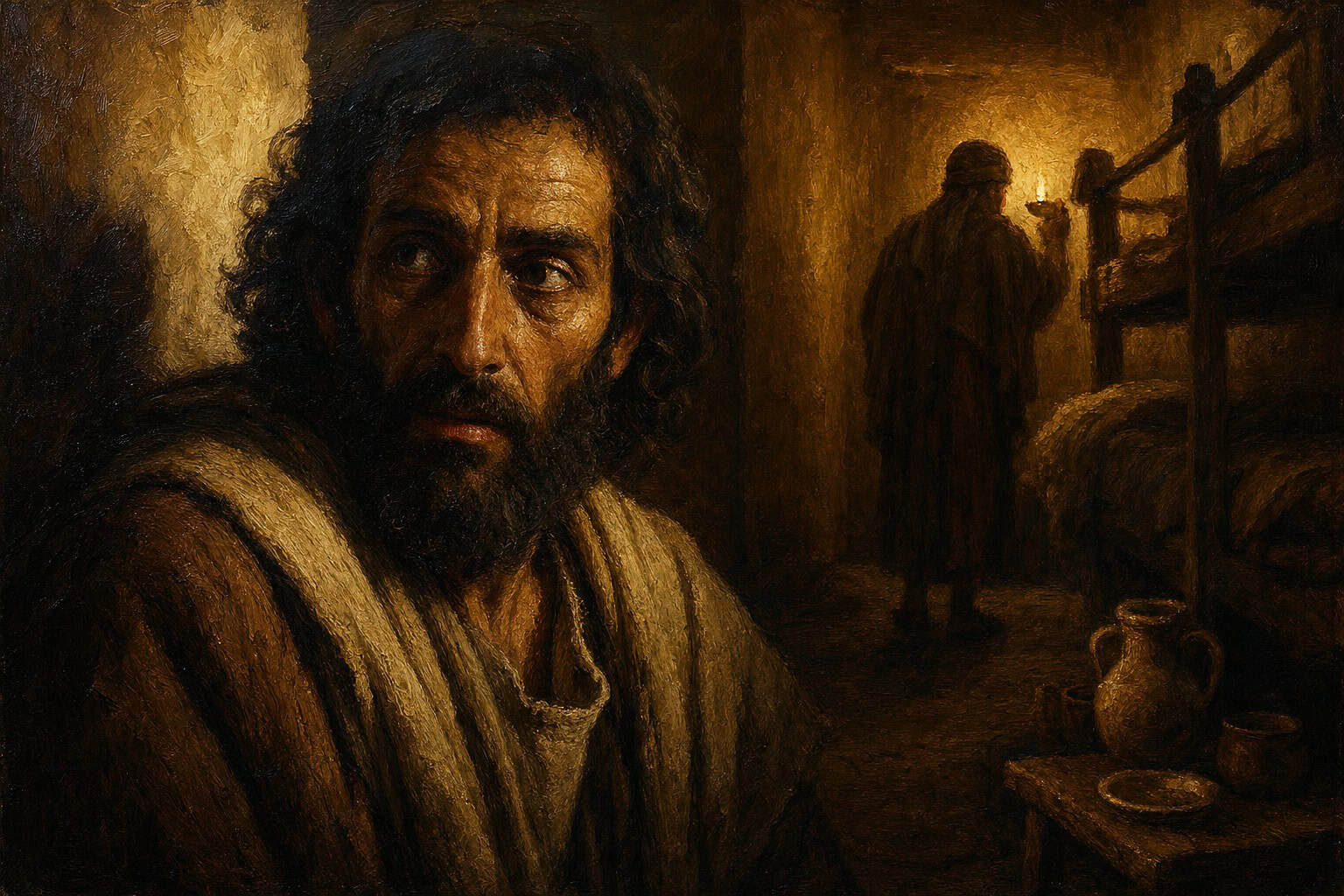
If love feels like a crime, this reflection on Confessions to the Empty Chair sits inside the wound where intimacy became warfare, not healing.
The Top Bunk She Insisted On
You typed the question because something inside you already ached with it. If love is a crime, then maybe the safest thing is never to be caught loving again. That is exactly where the narrator of Confessions to the Empty Chair stands in this eighth chapter, in a narrow room where a woman named Cindy has pulled him up onto the top bunk within hours of meeting him. He had offered to sleep on the floor. She would not have it. The space itself is small and borrowed, the kind of place where you keep your voice down because there are brothers behind the next wall, where the body learns to move quietly out of long practice. He had that practice already, learned in another bed, in another woman’s room, before all of this went wrong. So it begins in tightness. Close walls, low ceiling, the hush of a place not meant for what happens there. He notes the details with a flat precision that is itself a kind of confession, because a heart fully alive does not count the inches between itself and the wall. He is measuring nearness because he no longer trusts it. The physical closeness is total; two bodies on a bunk cannot be farther apart. Yet the distance he carries into that room is enormous, a whole country of grief walled off behind his ribs. Notice how he tracks the practical business of staying quiet, the muffled sounds, the brothers next door, as if the room were a problem to be solved rather than a place to be met. This is a man who has stopped inhabiting rooms and started managing them. He is here and not here, breathing the same warm air as the woman beside him while his real self stands somewhere far off, watching, careful, unreachable. That is the first thing the older narrator sees when he looks back. He came into that small space already sealed. The question you brought to your search is his question too, only he answered it long ago with a wrong answer, and the wrongness took years to name. He thought he was healing. He was arming himself. He would even call this arrangement the first fruit of some dark blessing, a proof that he had found a way through, when it was only a way around. And the room, so cramped and warm and willing, became the first outpost of a war he had declared against his own capacity to open. You feel it before you understand it: the terrible calm of a man who has decided that love itself is the enemy, and that the smaller he becomes, the safer he will be.
A Small Gesture Turned Into Permission
Watch what he does with one movement. Cindy lifts herself to help him, a plain physical cooperation, and he seizes on it like a man grabbing a rope thrown to him in dark water. In his mind it becomes proof. Unspoken but clear, he tells himself, and the storm in his chest goes quiet. This is the exact place where the scene turns cold, though it wears the costume of tenderness. He needed that gesture not for pleasure but for absolution. If she helped, then he owed her nothing. Her willing body became a document he could sign and file away, permission to remain absent while present, to give his flesh while keeping his soul locked behind his teeth. The older self, writing this down, does not spare himself. He sees now that he used her consent as a wall. He turned a woman’s plain desire into an excuse against his own responsibility to be there, fully, as a person and not a technique. And this is where the ache you carry meets his. When intimacy feels empty, it is often because we have done this same trick without naming it. We take the smallest sign of another’s willingness and use it to license our own retreat. Desire steadied him, he admits, more than whiskey ever did, and that admission is chilling, because it means she was medicine, not a person. He was not meeting Cindy. He was dosing himself with her, managing his own grief through the warmth of her body. The scene is not violent. Nothing forbidden by any obvious rule occurs. That is what makes it so exact and so damning. The failure, if there is one, is quieter than any law can reach. It is the failure of using a real person as a shelter, of accepting nearness only on the condition that it never touch him. He wanted her mature enough to blend friendship with intimacy without complication, without jealousy, without the vulnerability that the woman before her had turned into a weapon against him. He wanted, in short, the shape of love with none of its exposure, the closeness with none of the danger of being known. And he was calling this arrangement wisdom, dressing his fear in the language of a man who has finally grown up. The chapter lets you feel how reasonable it sounds from inside the wound, and how much it costs. Every practiced gesture becomes a way of being present without arriving, of touching without being touched. He moves through the motions his body once made in love and finds they still work, only now they mean nothing, and the emptiness you feel in your own arrangements is the same emptiness he is describing here with unflinching honesty.
The First Stone of a Fortress Built to Keep Love Out
Then comes the moment that reorganizes everything. In the aftermath, lying in that cramped bunk with his breath finally slowed, he does not soften. He hardens into a principle. He calls it the first stone of a fortress, and he is precise about its purpose: it was built not to keep love in, but to keep love out. Consent is primary, he decides; emotion is separate. He formalizes his coldness into a law, a private codex meant to protect him from ever being pierced again. He even imagines it as a covenant, something sworn, something binding, as though he could turn his heartbreak into scripture and his withdrawal into a vow. And here the shame beneath the whole scene finally rises to the surface, because a man does not build a fortress unless he believes there is something inside worth hiding, something he cannot bear to have seen. That is the truth this chapter uncovers slowly and refuses to let you look away from. His whole strategy is not strength. It is the wish to cover himself and vanish from his own gaze. He cannot stand to be seen and found wanting, so he arranges his life so that no one, including himself, ever gets close enough to look. The women become mirrors turned to the wall. The conquest becomes a performance staged for an audience that can never judge him, because he has made sure they never truly arrive. Beneath the theology he wraps around it, beneath the dark blessing he imagines he is serving, there is a small, frightened person who was hurt and decided that being hurt was worse than being hollow. He chose hollow. He built the wall in the one place a wall does the most damage, straight through the middle of his own chest. The older narrator, looking back, does not pretend this was clever. He calls it a strange, hollow victory, and the word hollow does all the work. He won. And the winning emptied him. The prize was a smaller soul, a shrunken capacity for the very joy he had lost and was pretending to replace with a colder, more manageable substitute.
We mistake the absence of pain for healing, and build a fortress that keeps love out by keeping us at war with it.
Hunting for the Hidden Girls Behind Their Good Faces
The fallout spreads outward from that bunk into a whole way of seeing. He begins to look at the women around him with a cold, counting eye. On a religious campus where female desire is shamed from every direction, where a young woman is caught between the church’s warnings and her friends’ watching, he becomes convinced that the good-girl faces are masks. He tells himself the modesty is a costume, that beneath it a hidden hunger waits to be unlocked, that their very effort to seem pure proves the appetite underneath. He decides that seducing such a woman, getting her to break her own rules, would be the true measure of his worth. This is where the scene reveals how far the wound has traveled from its source. What began as self-protection has curdled into a hunt. He no longer wants intimacy at all. He wants proof. Each woman becomes an audience for a performance of power that hides, underneath, the oldest fear of all, the dread of not being enough, the child’s terror of being left, dressed up now as a man’s easy confidence. He even builds a theory to justify it, reasoning about testosterone and hidden impulses and facades, as if the whole thing were a matter of clear-eyed observation and not a machine for manufacturing permission. The older self sees the self-deception plainly and asks the hard question he cannot fully answer: what was he really doing when he decided every woman was secretly like him? Was he seeing truth, or was he recruiting the whole world into his own justification, so his darkness would feel less lonely? He accuses the women of hiding their impulses, of keeping up appearances, and he is so certain they cannot deceive him. But the older voice knows the deeper deception ran the other direction. He was the one hidden. He was the one performing a good face, the face of a man who had recovered, who had figured love out, who had turned his grief into a working strategy. The whole predatory theory was a way of not looking at himself. And through all of this, the chapter refuses to let God become a rescue. There is no lightning, no voice, no sudden repair. There is only, faintly, a presence that walks with him even here, in the very sin of it, in the small room and the colder rooms that follow. Grace does not lift him out. Grace, if it is anywhere, is in the honesty that lets him write this down years later without excuse. That quiet nearness in the dark, refusing to fix him and refusing to leave, is the most unsettling mercy in the whole account. He is accompanied inside his fortress. He just cannot yet feel it.
What the Sealed Heart Cannot Feel
So is love a crime. This chapter answers you sideways, and the answer is more merciful than the question. Love is not the crime. The failure is what we do to love when we have been broken by it, the way we take the most sacred exposure a person can offer and turn it into a transaction we can survive. He wanted relationships without complication, without jealousy, without the vulnerability that had once been used against him. He got them. And the getting hollowed him out until intimacy became a set of practiced motions that protected him from remembering what his own body had once known about opening. If you came here because closeness feels like warfare, because you cannot tell anymore whether you are protecting your heart or imprisoning it, then you are standing where he stood on that top bunk, deciding whether to lay the first stone. The book does not scold you for standing there. It knows the ground too well. It knows the small room, the borrowed warmth, the willing gesture you tell yourself absolves everything. It knows how the mind builds elegant theories to keep from feeling one plain thing. What Confessions to the Empty Chair offers instead is a companion who went the whole distance into that cold and lived to describe it without flattering himself, so that you might recognize the fortress before you finish building yours. The most piercing thing in the chapter is not the sin. It is the discovery, made slowly and against his will, that the walls he raised to keep out pain kept out everything else too, including the joy he was still, somewhere, hoping to find. A sealed heart does not stop hurting. It only stops feeling anything large enough to be worth the hurt. He wanted to be safe. He became numb, and mistook the numbness for peace. And underneath even that, refusing to shout, refusing to leave, there is a nearness he could not banish no matter how many rooms he moved through. That is where this chapter leaves you, not with a lesson pinned neatly to the wall, but with a wound held open under a plain light, and a quiet presence beside it that will not fix you and will not walk away. The rest of the book keeps that same posture, patient and honest, sitting with the ache instead of erasing it. It is worth walking into.