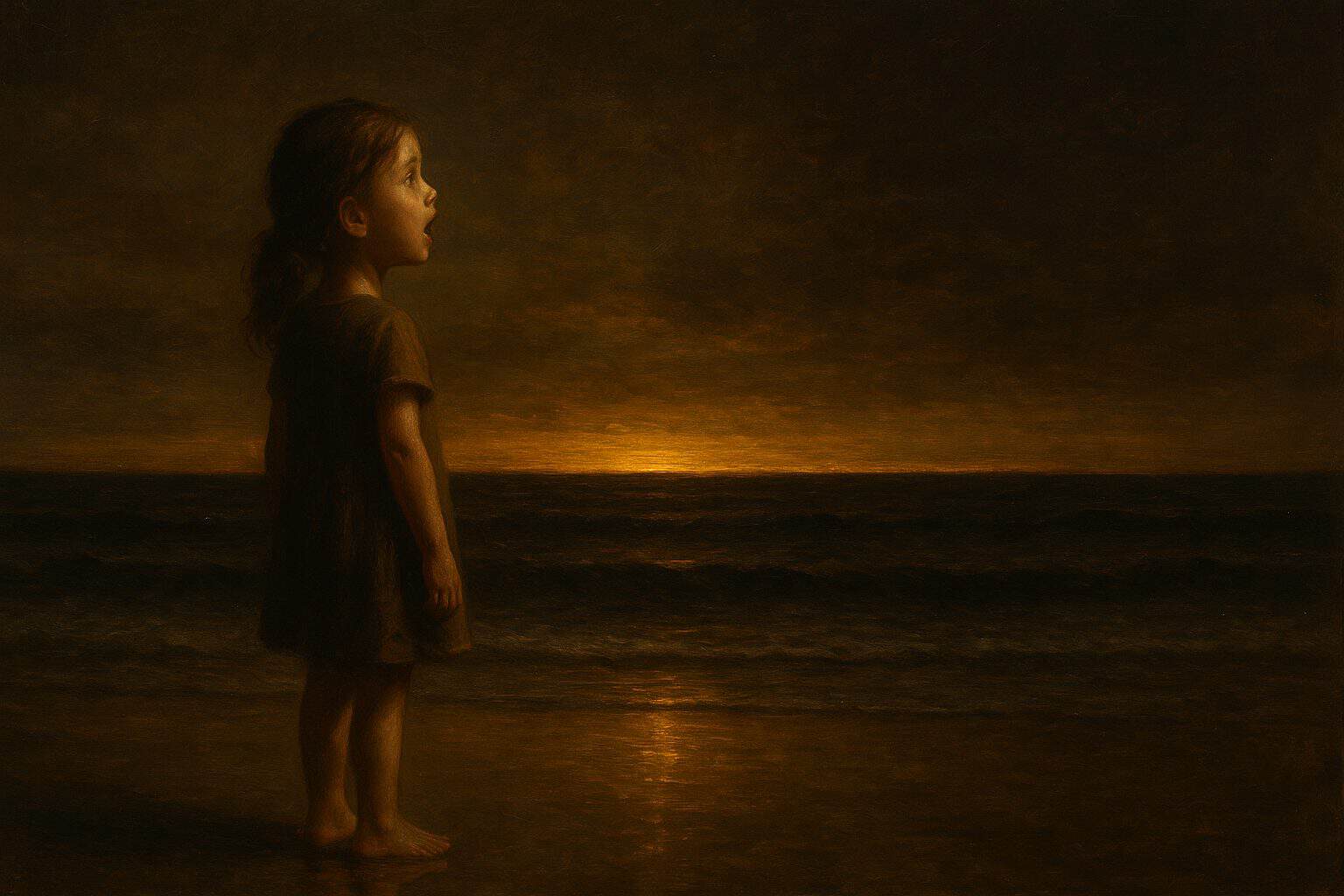
Where the finite reaches toward what exceeds it, and finds itself held.
The child stands at the ocean’s edge, watching waves disappear into that line where water meets sky. She cannot say what draws her gaze there, to that boundary that is no boundary, that limit that opens rather than closes. Her small body knows something her mind cannot yet name: how the horizon holds both ending and invitation, both the furthest reach of sight and the promise of what sight cannot contain.
The Line That Calls
We live toward horizons. Not metaphorically, but in the thick actuality of embodied existence. The businessman glancing up from his screen sees, through the twentieth-floor window, where the city yields to hills that fade into haze. Something in him loosens. The mother, exhausted from the day’s small wars, steps onto the porch at twilight and finds her breathing change as her eyes follow the street to where it vanishes between trees. These moments arrive unbidden—the body knowing before the mind what it means to stand at the edge of the given and feel the pull of what exceeds it.
If your only method of perception is through the limits of the flesh… then all you will be able to see is the flesh… How you look shapes what you see.
Yet flesh itself teaches us to look beyond flesh. The horizon appears first as a bodily phenomenon: the eyes strain slightly, the chest opens, the shoulders drop. We feel the horizon before we think it. Merleau-Ponty would recognize this pre-reflective knowing, how the lived body already understands what reflection struggles to articulate—that we are beings constituted by our reaching beyond ourselves.
The Structure of Longing
Watch how lovers walk together at sunset. They do not simply observe the horizon; they orient themselves toward it, their bodies turning to face that luminous edge as if it held something of their own future. Their joined hands point them toward what Augustine knew: we are creatures of restlessness, finding in every horizon both a promise and an incompletion. The horizon gives visible form to the heart’s native tongue—this language of “not yet” that makes us human.
In the memoir’s terms, desire requires an object outside itself to pursue, and the horizon offers the purest image of this structure. It cannot be reached, possessed, or consumed. It exists only in relation to our position, moving as we move, maintaining its essential distance while drawing us forward. Like the beloved who remains mysterious even in intimacy, the horizon preserves the space where longing lives.
The executive who built his empire stands on his penthouse balcony, looking toward the horizon. All he has achieved suddenly appears small against that line where earth meets heaven. He feels what Frankl would call the tension between what one is and what one ought to become—not as failure but as the very condition of being human. We perceive all things through our limits, with our limits, because of our limits, yet these very limits open us toward what transcends them.
Where Earth Admits Sky
The horizon is the nearest heaven we can grasp precisely because we cannot grasp it. It exists as pure relation, pure between. Stand on any hill, any rooftop, any shore, and you witness the same miracle: how the bounded earth admits the boundless sky, how they meet without merging, touch without possessing each other. This is what human existence feels like from within—this standing at the junction where finite flesh opens onto infinite longing.
The memoir speaks of new flesh reincarnating innate desire, of bodies that ground thoughts while anchoring the spiritual. The horizon makes this visible. It belongs entirely to earth—we see it only because we stand on solid ground, because our eyes are set at this particular height, because we are here rather than there. Yet it points beyond earth, beyond every here toward every possible there.
The Democracy of Distance
Every horizon is equally distant, equally near. The child’s horizon is as unreachable as the philosopher’s. The farmer watching dawn break over his fields stands at the same infinite remove as the mystic in contemplation. This is what the horizon teaches: that the infinite appears not beyond the ordinary but within it, not after the finite but through it.
MacQuarrie understood this ex-sistent structure—how we stand out into possibilities rather than possessing fixed essence. The horizon gives image to this standing-out. It shows how transcendence is not escape from location but the deepest truth of location itself. We are the beings who, standing in one place, see that place open onto everywhere else.
Concepts such as fact, truth, honor, loyalty, love… appear within the horizon of limitation.
The Wound That Opens
Sometimes the horizon appears as loss. The widow stands at the window watching the sun set on her first day alone. The horizon that once promised adventure now marks the boundary of a world that has become too large, too empty. She discovers what the memoir knows: how absence can become “a constant, torturous testament to an annihilated future.”
Yet even here, especially here, the horizon performs its essential work. It holds open the space where grief can breathe. It refuses the closure that would make loss bearable by making it small. The horizon insists that what is lost remains as vast as what might have been, that love’s infinity does not diminish when its object disappears beyond sight’s reach.
Fromm recognized this tragic emergence—how awareness creates unbearable separateness that drives our need to overcome isolation. The horizon manifests this separation not as wound to be healed but as the opening through which connection becomes possible. We reach toward horizons because we are the beings who know distance, who feel separation, who understand that love means standing apart enough to see the beloved whole.
The Daily Miracle
Return to the ordinary. The commuter emerges from the subway into unexpected vista—buildings parting to reveal the river, the bridge, the far shore fading into morning mist. For a moment, the horizon breaks through the habitual, and she remembers what she forgets daily: that she lives in a world that exceeds every frame, every comprehension, every attempt at capture.
This is what death teaches, what love teaches, what every authentic encounter teaches—that we are finite beings who carry infinity within us, not as possession but as orientation. The horizon gives us the image of our own existence: bounded creatures whose boundaries open rather than close, whose limits generate rather than prevent meaning.
The Gesture of Prayer
Watch how naturally the body assumes the posture of horizon-gazing. The head lifts slightly, the spine elongates, the breath deepens. We become, in these moments, what Moncrieff would recognize as symbolizing perception—our whole being participating in an aesthetic communion with what-is. The horizon does not explain or argue; it simply appears, and in appearing, it transforms the one who sees.
This is why sunset and sunrise remain the universal human ceremonies, why we build our cities toward views, why we climb mountains and seek shores. Not for the horizon itself but for what happens to us in its presence. We become, momentarily, as large as what we see. The infinite we cannot contain somehow contains us.
The memoir tells of flesh comforting flesh, of bodies grounding thoughts, of physical anchoring spiritual. The horizon reveals why: because transcendence is not escape from embodiment but embodiment’s deepest possibility. We see horizons because we have bodies, because we stand at this height, in this place, with these eyes. Yet what we see exceeds every body, every place, every pair of eyes that has ever looked.
The Promise That Keeps
Evening comes. Across ten thousand cities, on ten thousand shores, humans pause in their coming and going to watch day yield to night at that distant line. They do not know they are performing an ancient liturgy, older than temples, older than words. They are practicing what we are: finite beings in whom the infinite stirs, limited creatures through whom the unlimited appears.
The horizon promises nothing except tomorrow’s horizon. It offers nothing except the continuation of this essential human position—standing where earth meets sky, where the known touches the unknown, where what we are opens onto what we are not yet. This is enough. This has always been enough.
We are the beings who live toward horizons, who find in every limit an opening, in every ending a beginning, in every boundary a threshold. The horizon is the nearest heaven we can grasp because it shows us what we are: creatures of earth who carry heaven within us, not as achievement but as orientation, not as answer but as the question that keeps us human.
The child at the ocean’s edge does not need to understand what she sees. She only needs to stand there, small against immensity, and feel how the horizon holds her—holds all of us—in the tender space between what is and what calls.