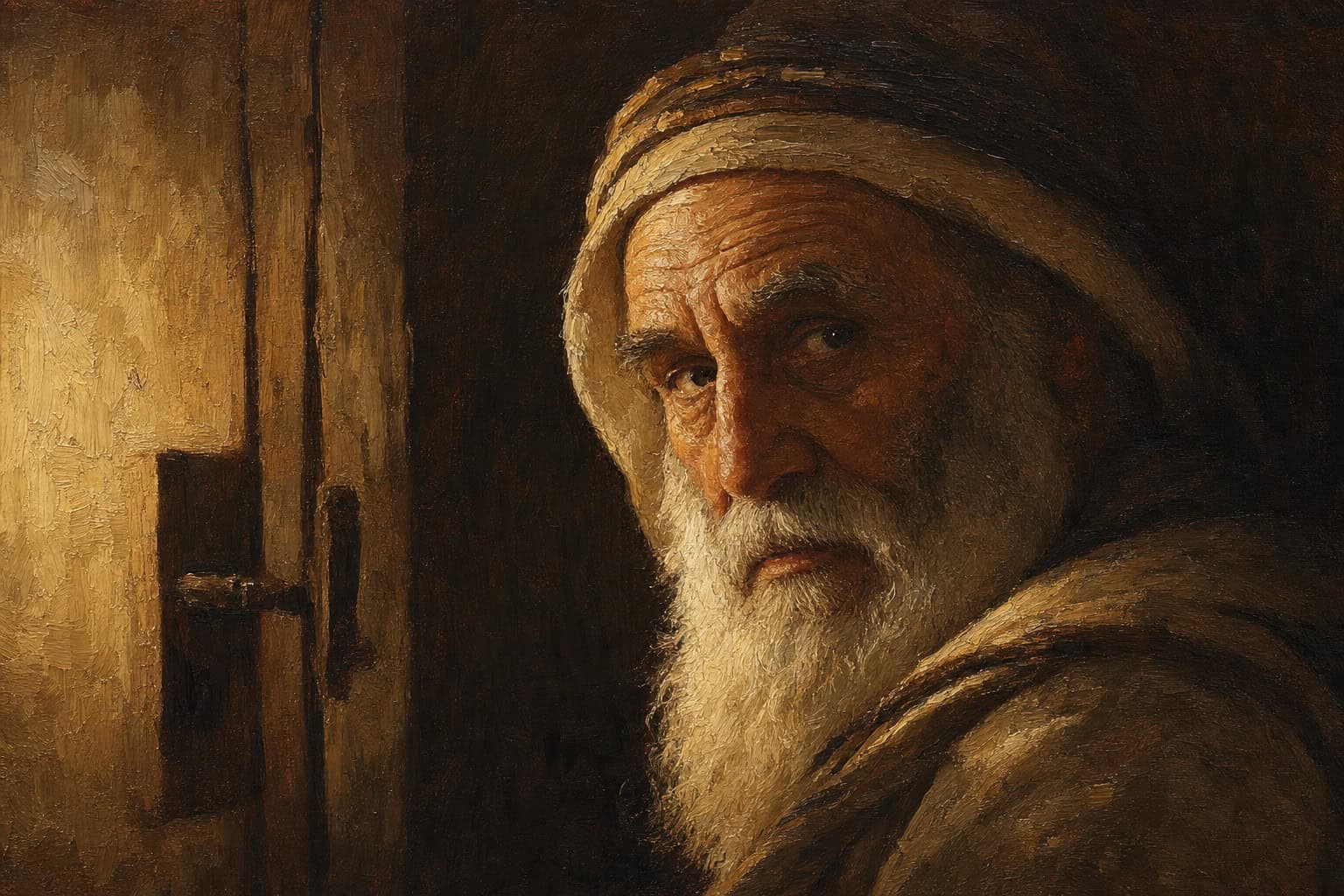
Why do people hide? A raw, honest look at the masks we build, the rules we invent, and the One before whom hiding finally stops.
The Knot That Tightens Before You Have Decided Anything
You hide because being seen costs more than you can afford. Think of the exact moment it happens in you: someone crosses closer than you meant to let them, their body moving into the small space you kept clear, and a knot pulls tight low in your gut, quick as a fist closing. Your face keeps its ordinary shape, jaw loose, eyes ready, but underneath it something scrambles to arrange itself, to decide which version of you should stand at the front and take the visitor. This is the small, daily labor almost no one names, and it happens faster than thought. Before a single word is spoken you have already run the numbers on what this person is allowed to know about you. You measure the distance between what you are and what you can afford to show, and you fill that gap with something manageable, something rehearsed, something that will not give you away. It feels like caution. It feels almost like kindness, a courtesy you extend to keep the encounter smooth. But sit with it honestly and you notice the strangeness of the timing: the hiding starts before any real threat arrives. No one has judged you yet. No one has even asked you a question. Still the guard goes up, fast and practiced, the way a hand rises against a thing thrown toward the face, an old reflex that does not wait for permission. The complication is not the person standing in front of you. The complication is the part of you that would rather manage a stranger than be known by one. You have a whole quiet system for this, don’t you, and you have had it so long you no longer feel it working. A tightness in the voice you did not intend and cannot fully hide. A joke deployed to change the temperature of a room grown too warm. A crudeness reached for on purpose, so the moment turns ugly enough that someone steps back and gives you air. We hide, at the very bottom of it, because closeness threatens to expose something we have not yet agreed to look at in ourselves. The other person is only the occasion, the trigger, the excuse. What we are truly guarding against is the sudden, unbearable clarity of being witnessed with no time to prepare our answer, caught mid-thought, mid-flinch, mid-truth. And so we keep the numbers running, keep the distance measured, keep the front of the face working smoothly while the true thing waits behind it, unnamed, uneasy, tightening like a fist that will not open. This is where the question of hiding actually lives. Not in dramatic secrets or buried crimes, but in the ordinary reflex to arrange yourself the instant before you let anyone near.
The Rules You Wrote to Keep Yourself Untouched
You build rules, and you tell yourself the rules make you good. Watch how it works in you when someone reckless, unsteady, half-lost to a bottle, comes toward you offering the very thing you once told yourself you wanted. You have a code ready, worn smooth from use. You will not take advantage of a person who is not in their right mind. You require full consent, genuine desire, unapologetic want and nothing borrowed from drink or from a wound too fresh to name. Said aloud, it sounds like virtue, and part of it truly is virtue, a real line you would be worse for crossing. But turn the rule slowly in your hand and the underside catches the light, and what you see there is harder to look at. Why do you require the other person to be clear-eyed and unapologetic in their wanting? Sometimes for their sake, honestly, to spare them a morning of shame. And sometimes, if you stop performing for yourself long enough to notice, for yours: because a foggy yes cannot feed you, cannot confirm the thing you need confirmed, cannot become the clean proof that you were desired and chose to refuse. The rule protects the other person and it protects your image of yourself, both at once, and you rarely admit the second half. This is the hardest thing about hiding: it hides even inside our morality, wearing its best clothes. We wrap the true motive in the language of principle, and then we believe our own wrapping, and the belief becomes sincere. A boundary can be an honest fence or it can be a beautiful mask, and from the outside the two look identical, and often from the inside as well. You reach for the vulgarity on purpose, calling it a shield, telling yourself an apology later is a smaller price than the chaos of a real encounter. Maybe that is even true. Or maybe the crudeness is one more way to stay untouched, to keep the situation toxic enough that no one gets close to the thing lurking under the code, the thing you built the code to keep quiet. The rules are real and they hold. They also let you avoid the harder question underneath them: what am I so afraid a person will find if I let them past the fence. We are so quick to admire our own restraint that we never ask whose image the restraint is really serving, or what it costs the one on the other side of it. This is hiding at its most sophisticated, the kind that wins the argument with itself before the argument has even begun. And the flesh, meanwhile, does not care about the code, does not read the rulebook. The body answers calls the mind spent years learning to refuse, a loyal traitor tugging toward what the intellect denies. So you hide behind the very lines you drew, and the lines hold, and you tell yourself you are safe, and you almost believe the story you are performing for an audience of one.
The Feint Inside the Last Embrace
The turn comes when the mask meets a thing that will not be managed. Picture the ordinary shape of it: a last hug, agreed on, safe, a small kindness meant to end the standoff before someone finally leaves the room. Just one more, and then the door. And then the hug is not a hug at all. It becomes a way in, a feint, a face thrust suddenly toward yours with an intent your rules had already forbidden and thought they had closed off. Now the whole careful structure meets its true test, because two things arrive in you at once and neither will wait its turn or ask your permission. Revulsion, yes, real and cold, a recoil in the chest, a push of the hands. And underneath it, unwelcome, a flicker you would give almost anything to disown, a heat that does not belong to the story you were telling. This is the moment hiding cannot survive. Not because someone else exposed you, though it felt like an ambush, but because your own body just told you something your mind had spent the whole encounter denying with such conviction. The code said you felt no lust here. The flicker says the code was managing a truth, not stating a fact. You wanted to be the one who refused. You wanted the refusal to prove you clean, to settle the matter of your own hunger once and for all. And here is the thing the refusal cannot prove no matter how firmly you hold it: that the want was never there in the first place. The awful gift of the moment is precisely this exposure, this stripping of the story you had been telling everyone including yourself.
We do not hide because we are seen too much; we hide because we have never once been seen without a plan.
Notice what the deeper hunger under all of it actually was. You thought you were lonely for a body, for a warm room, for a woman who might confirm some version of yourself you could not confirm alone in the dark. But run all the way down to the bottom of that ache and you find something older, homesick, and strange: a longing not for her at all, but for the one place where a word could finally be spoken with no strategy behind it. Every mask, every rule, every calculated crudeness is an admission that you have not yet found the room where strategy dies. The feint that breaks past your guard does not create the exposure. It only reveals that the exposure was always waiting, that the front of the face was always thin as paper, that the thing lurking underneath was never as hidden as you needed to believe. And in that flare of panic and revulsion and unwanted desire, the self you performed cracks down the middle, and something truer stands there, blinking, undefended, and for one terrible second, seen.
We do not hide because we are seen too much; we hide because we have never once been seen without a plan.
Standing in the Wreckage of a Story You Believed
After the mask slips, you are left holding the parts of yourself you filed away. The room has not changed at all. The same walls, the same closed door, the same ordinary evening that was supposed to stay simple and end quietly. But you have changed, or rather you have been made to see what was true the whole time, sitting there in plain sight. This is the real fallout of hiding: it does not end in relief, it ends in a mess you have to keep standing inside of. The rule you were proud of is still technically kept, still unbroken, and it no longer feels like virtue, because you have felt the want it was supposed to prove absent. The friend you told yourself you did not desire is now someone you cannot look at cleanly, someone your eyes will not settle on the same way. And the self you performed, the disciplined one, the one who was above taking advantage, that self is exposed as at least partly a costume you wore even when the mirror was the only witness. What do you do with that knowledge. There is no tidy moral here, no neat lesson that dissolves the discomfort and lets you sleep. You simply have to carry it into tomorrow. This is the honest weather of a soul that has been hiding a long time: the discovery does not liberate you into lightness, it drops you into truth, and truth at first tastes like loss. You lose the flattering picture of yourself. You lose the certainty that your boundaries were pure, that your restraint was clean. You lose the comfortable distance between what you are and what you show. Sit here long enough, in the quiet after she has gone, and a harder question surfaces, one you cannot answer by being clever or quick. Who was that person to you, really. What did you refuse to see about her, about the ache under her recklessness, about the thing she may have been confessing in the only broken language she had left that night. And what did you do with it, in the privacy of your own head, when you turned her into a complication to be managed rather than a person to be met and mourned. These are not questions that resolve into an answer. They are questions you live inside for years. The wreckage of a believed story is not a place to fix quickly and move past; it is a place to stand honestly, letting the false comfort drain out slow, letting the true weight settle into the bones. Grace, if it comes here at all, does not come as rescue from the mess or a clean exit from the room. It comes as a strange steadiness in the middle of it, a sense that you are not alone even in the ugliest square of the floor, that the exposure you dreaded might be, in some upside-down and unearned way, the very beginning of being loved without the costume on.
The One Face You Never Had to Manage
In the end, hiding is homesickness with the wrong address written on it. All those years you thought the problem was other people, their judgment, their misunderstanding, their power to shrink you if they saw too much of what was underneath. So you learned to control the sightlines, to be visible only where it was safe and invisible where it was risky, curating who could truly see you and who got only the front of the face. But the sheer exhaustion of it should have told you something long ago. A person who is only ever seen from behind a plan is never actually seen at all, and the loneliness of that is total, complete, unbroken, even in a crowded room, even inside a warm embrace, even in a bed with someone whose breath you can feel. What you were homesick for was never confirmation from a stranger, never the clean proof of being wanted. It was a face before which no strategy is needed, before which the numbers stop running. This is where the whole long ache finally points, though it takes a hard fall through wreckage to arrive anywhere near it. There is one who sees you before you arrange yourself, who was present in the exact moment of your panic and your refusal and your unwanted flicker of desire, not standing back to catch you in it, but there beside you to accompany you through it. Not to strip the mask as a punishment, but to be near while it falls of its own weight. The startling thing about that presence is its nearness in the very place you were most ashamed, walking with you inside the sin itself, not waiting for you at some clean exit down the hall. This is not a fix, and it does not pretend to be one. The evening is still the evening. The desires are still the desires, the failures still yours to carry into the morning, the questions still unanswered when you wake. But something has shifted in how you stand there among them. You begin to suspect that the exposure you spent your whole life dodging is the exact thing your soul was starving for, and that the only face safe enough to be seen by, fully, with no number run in advance, was turned toward you the entire time. This is why Confessions to the Empty Chair does what its title dares. It stops managing the sightlines. It sits down in front of the one seat where no performance is required and tells the truth it hid from everyone, including itself. If you have ever tightened before a person could get close, ever mistaken a mask for a virtue, ever felt the cold loneliness of being visible only on your own terms, you already know the room this book lives in. And you may find, as its narrator slowly does, that the end of hiding is not exposure at all. It is the strange, unearned mercy of being fully known and not once abandoned.