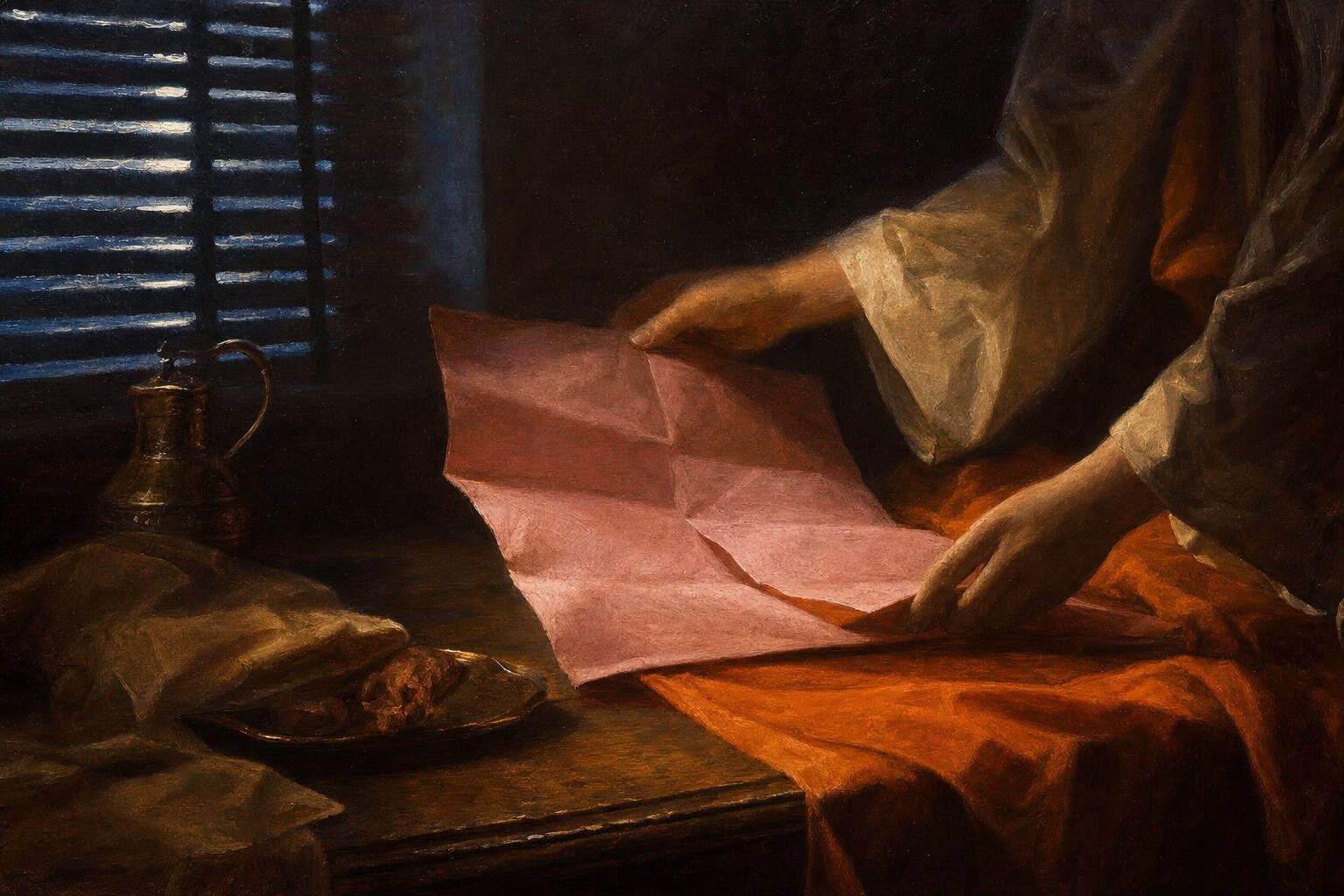
A slip of pink paper lies flattened under fluorescent light on the principal’s desk, no longer warm from his pocket — a boy learning how quickly the world turns an honest reaching into evidence, and how slowly it admits it judged him by his poverty.
Pink Paper Under Fluorescent Judgment
A slip of pink paper lies on the principal’s desk, no longer warm from the boy’s pocket but flattened under the hard wash of fluorescent light. He sits in the straight-backed chair that scrapes the linoleum, legs too short to plant his feet, watching adult hands unfold what he had folded with nervous care. His friend is beside him, trying to disappear into his own shoulders, both boys summoned from math like thieves, though only one shaped the looping letters now held at arm’s length. The soft curve of his handwriting looks different at this distance, strange and childish in the grip of authority. The principal pinches the edge of the note as if it might smudge his fingers, reading silently while the boy’s stomach slides down and down. The same ink that carried hope across a playground now feels like a stain on the desk, on his name, on the very space his small body takes up in that cold office.
An Unspoken Border Drawn Around Her Desk
Before the call to the office, the world had seemed simple: a girl at her desk, a boy with a pounding heart, a note carried across the playground like a fragile treasure. Only now does he learn there was a border around her, invisible but iron, enforced by last names and street addresses, by fathers’ professions and mothers’ careful friendships. Other boys have crossed that space all year with teasing and rough jokes, their notes and glances brushed away or laughed over by teachers who recognize their parents at parish dinners. His paper crosses the same distance and somehow travels a forbidden route. No one names it, but everyone acts as if a line has been violated, as if his desire has climbed a fence it was never meant to reach. In that office he begins to sense a map no one showed him, a territory where certain hearts may approach and others may not, no matter how clean their intentions.
Forced to Name What Was Safer Unsaid
The principal does not simply scold; he asks the boy to explain himself. Why he wrote it. What he meant. Each question drags private feeling into the open like clothes pulled from a drawer and hung under harsh light. The boy, cheeks hot, stares at his own small hands while he answers, trying to put words around something that had lived as a simple warmth in his chest. With every sentence, that warmth curdles. The more he speaks, the more his affection sounds like a scheme, his courage like a breach. His friend, who only carried the note, is pulled into the same grinding speech—why did you help, what did you think you were doing. They both learn that saying the truth out loud can make it sound wrong, that sincerity can be twisted by the frame that holds it. The office hums with the fluorescent buzz, a low drone under the more brutal sound of their own voices turning against them.
The world is quick to turn a child’s honest reaching into evidence against him, and slower still to admit it judged him by his poverty.
When a Child Learns His Heart Needs a Class Pass
Anyone who has watched a child return from school quieter than they left in the morning will recognize the taste of this scene. It is the flavor in the way they avoid eye contact at dinner, push food around their plate, offer only half-answers about what happened. Here, the lesson is not written on any syllabus: that warmth is allowed only from certain bodies, that innocence itself can be misfiled as threat when it comes from the wrong address. A reader does not need the same pink paper to know this script; it plays out in text messages exposed to group chats, in crushes mocked by teachers who should know better, in guidance counselors who smile differently at different uniforms. The boy in this office stands in for every child who has discovered that love needs permission slips, that even the smallest reaching out can be measured against family income or skin or accent. The knowledge settles in the body first, as a tightening in the chest and a new caution in the hands.
Ink That Hardens Into a Private Armor
Long after the principal slides the note into a folder and moves on to the next task, the boy’s body keeps replaying the moment the paper changed sides. He will remember the exact dryness in his mouth, the burn along his neck, the way the ink on that pink sheet seemed to turn from something soft into something brittle and dangerous. Later, when he writes stories and prayers and half-true essays, that memory will stand behind his shoulder, warning him about how far the line of his pen may run. Writing becomes a way to stay present without stepping too close, to let words take the risk his body has learned to fear. But the old question does not leave: if his desire was treated as contamination once, what will happen the next time he lets it show? The passage leaves him there, pen still in hand somewhere in the future, testing how much of his heart the page can hold without shattering in someone else’s grasp.