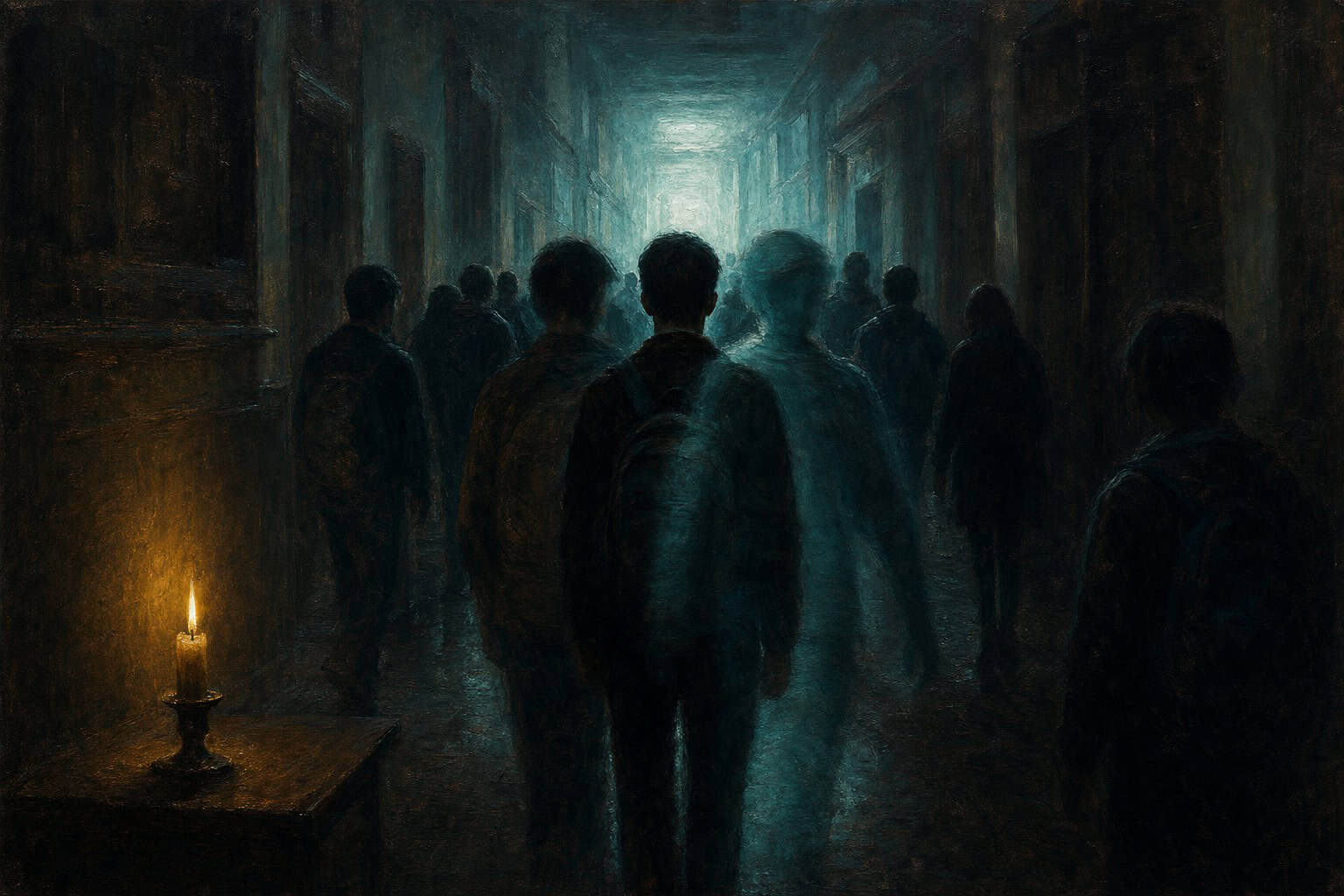
She drifts down the hallway with the ease of someone who never had to account for herself, and passes so close that her shoulder brushes the air where he stands — and he learns that being unseen can cut deeper than being hated.
Her Shoulder Brushing Air Where a Body Stands
She comes down the hallway with the easy drift of someone who has never had to account for herself. Books hugged to her chest, ponytail swaying, a light scent of shampoo and cafeteria grease trailing behind. He is close enough to feel the shift of air as she passes, close enough that her shoulder should graze his arm, but her gaze cuts straight through the space his body occupies. Not a flinch, not a stiffening, not even the quick flicker of eyes that decide he is beneath notice. Nothing. He stands there with blood in his veins, sweat on his palms, breath catching in his throat, yet he registers no more than a smudge on the tile. The impact lands not in his skin but in his gut: hatred, at least, would have meant there was a him to hate. This is a clean, antiseptic non-contact, the strange sting of being less real than the locker door she never has to dodge.
Cruelty at Least Leaves Fingerprints
The moment corners him into a brutal inventory. He has known hands that shoved, voices that mocked, eyes that tracked his every failed attempt to blend into the walls. Those assaults had shape and volume; they left marks he could trace with his fingers later, proof that he had occupied space long enough to be struck. Standing in Kate’s wake, he realizes this is different. There is no intention here, no malice to resist, nothing he can push back against. Her blindness is so complete it feels structural, as if the world has been built with apertures too narrow for his outline to pass through. The popular need their victims to act out their script; torment proves their own fragile power. But Kate’s smooth unawareness says something colder: some lives are so far off the map they never become options in another person’s story. He tastes metal at the back of his throat, the bitter knowledge that even his suffering depends on being perceived.
Learning to Move Like Smoke Down a Corridor
The hallway floor hums faintly underfoot, lockers rattle in the distance, a basketball thuds somewhere beyond the cinderblock wall. His body has been trained by years of small terrors to adjust to these sounds—step to the side, hug the edge, shrink the shoulders, keep the eyes low. Now, watching Kate’s unbroken stride, he feels an old instinct tighten: make yourself thinner, lighter, less of a target. But the scene exposes a harder truth. All that hiding was never what made him disappear; he was invisible before he ever learned to duck. His muscles still brace for impact that does not come, the flinch already halfway through his spine. The absence of collision becomes its own kind of blow. If hatred was a storm you could see approaching, this is fog seeping under the doorframe, soaking into clothes and skin until you cannot tell where the hallway ends and your own fading outline begins.
To be unseen can wound more deeply than to be hated; the body remembers every humiliation the mind is too proud to name.
Checking the Mirror Just to See If You Cast One
Anyone who has stood in a crowded cafeteria, felt the roar of voices, and realized not a single head will ever turn their way knows this particular burn. You start doing small, foolish experiments. Dropping a pencil a little too loudly. Clearing your throat when a group squeezes past. Even laughing at a joke you weren’t invited to hear, just to see if anyone’s face tilts toward the sound. When nothing shifts, the doubt slides inward. Maybe you misjudged your size. Maybe you take up less space than you thought. You go home and find yourself pausing in front of the bathroom mirror longer than usual, not out of vanity but to confirm there is, in fact, a body there. For those who have lived inside this quiet erasure, scenes like this one do more than stir old shame. They name, in plain flesh and hallway tile, why a soul marked early by darkness might later cling to analysis and cleverness: words at least leave a trace, even when eyes do not.
A Voice Whispering From Just Outside the Frame
There is a strange edge to this kind of disappearance. On one side lies the temptation to harden into pure mind, to live where text and thought cannot be ignored by eyes that never learned your outline. On the other side flickers a longing that refuses to die: to be felt in the air the way Kate’s passing stirs his skin, to be seen without first having to perform. Somewhere between those two, he stands in this corridor, suspended. The Church speaks of a God who counts hairs and sparrows, who cannot fail to notice a single soul. But the body remembers these early hallways faster than any promise of perfect attention. How does a person marked by this cold non-contact ever risk being touched without armor, ever open to a love that insists on the whole self, not just the clever voice? For now, the question hangs where he does, like breath that still hasn’t decided whether to fog the glass.