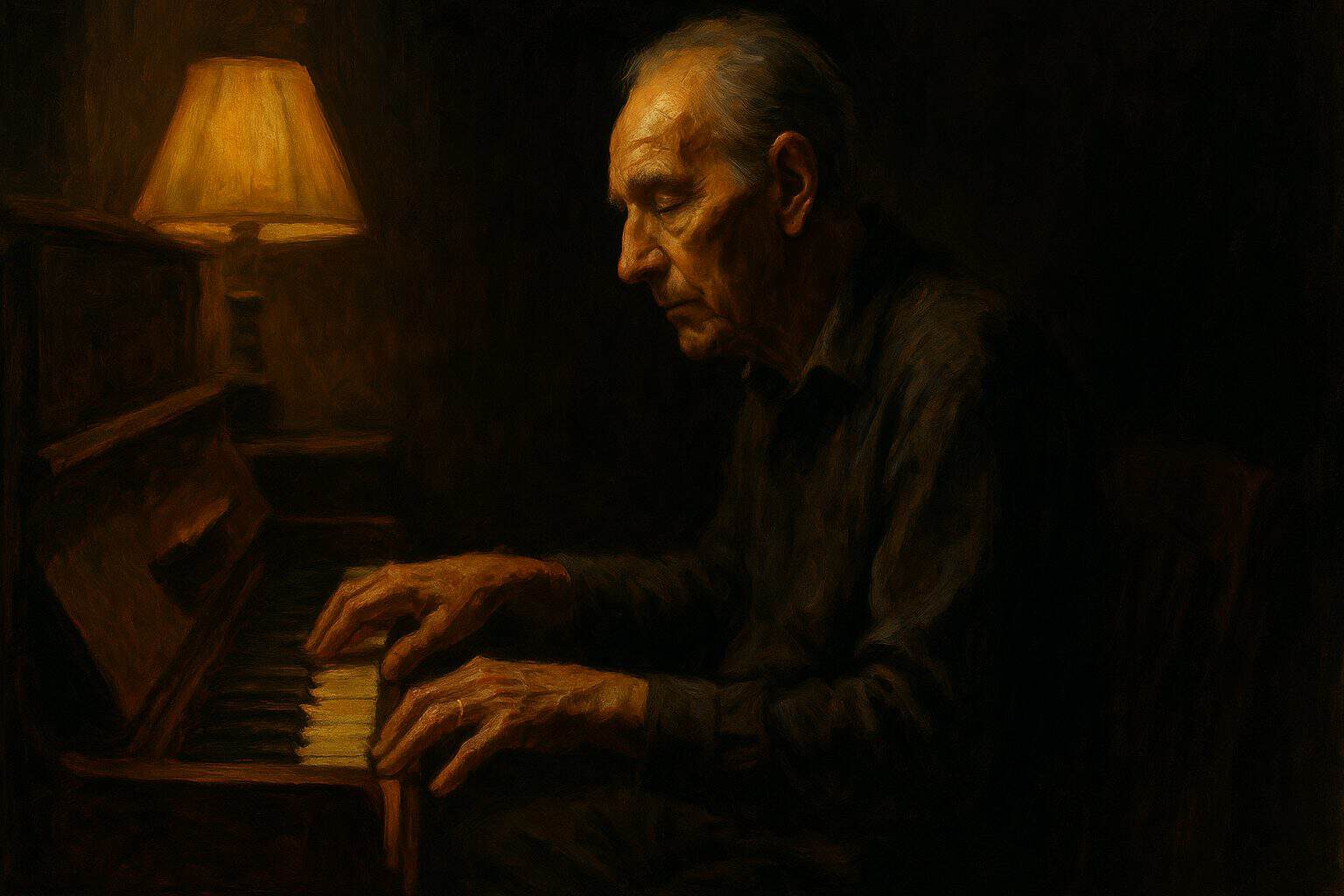
How the body keeps its own accounts, writing histories that thought cannot erase
The pianist’s fingers find their way across the keys in darkness. Not through conscious recall of each note’s position, but through something more intimate—a knowledge that lives in the tendons themselves, in the arc of the wrist, in the subtle adjustments of posture that precede the first touch. Watch closely: the body remembers its way before the mind catches up. The hands already know the opening phrase of the sonata while consciousness still searches for the title.
The Archive Beneath Thought
We speak casually of “muscle memory,” as if this were merely mechanical repetition, a kind of biological automation. But attend more carefully to how the body holds its histories. The way your shoulders still brace, decades later, when passing the corner where the accident happened. How your hand reaches for a light switch in the old apartment’s location, three moves and fifteen years gone. The body grounds our thoughts, as Anthony Adoré discovered—the physical anchors the spiritual. Unlike angels, we cannot feel without flesh.
This is not simple conditioning. Watch a mother’s arms form the cradle-shape months after the miscarriage, catching air where the weight should be. See how the widower’s body still curves around absence in sleep, maintaining space for what is no longer there. The flesh remembers not just actions but relations, not just movements but meanings. These are not habits we can simply decide to break. They are ways the body has become what it has lived through.
“My mind—the architect of my rules… stepped aside. But my flesh, that loyal traitor, answered her call.”
The body keeps its own counsel. It maintains its own fidelities, harbors its own wisdoms and wounds. Long after we believe we have moved on, processed, integrated, released—the body continues its secret correspondence with the past. Not as burden but as constitution. We are, quite literally, made of what we have touched and been touched by.
The Grammar of Gesture
Consider how learned movements become a kind of thinking. The surgeon’s hands that know the feel of healthy tissue versus diseased, discriminating through touch what no textbook could fully convey. The carpenter who can judge a board’s grain through the resistance of the plane, reading the wood’s history in the feedback through the tool. The mother who knows her child’s fever through a palm to the forehead, more accurate than any thermometer.
This is not mere skill or expertise. It is the body developing its own intelligence, its own modes of comprehension. As Merleau-Ponty understood, consciousness is not pure thought floating above flesh—it is the body’s way of being toward the world. The passions speak their own language, creating the fodder that reason must later digest. The body thinks in its own register, below the threshold of deliberation.
Watch a couple who has danced together for years. Their bodies converse in weight shifts and breath patterns, anticipating and responding before conscious intention forms. This is not telepathy but something more profound—flesh that has learned to think with and through another flesh. Touch becomes a separate dialogue, its own complete language, culminating in that sensuality where the spirit of each resonates in the flesh.
The Stubborn Testimony
But the body also remembers what we would forget. Adoré writes of his flesh as “that loyal traitor”—loyal to experiences the mind would disown, maintaining attachments the will has severed. After the relationship ends, after all the conscious work of letting go, the body still quickens at a familiar scent, still turns at the sound of footsteps that match a remembered rhythm.
This is not weakness or failure of will. It is the body bearing witness to what was real, what mattered, what marked us. The flesh refuses our revisionist histories, our cleaned-up narratives. It holds the whole truth—the desire alongside the decision to leave, the tenderness woven through the betrayal, the joy that persisted despite the pain.
“Anchor yourself in the tangible: the grain of the table under your palm, the rhythm of your own breath moving from belly, not throat.”
The body’s memory can become a prison. Trauma lives in clenched jaws and hunched shoulders, in startle responses that fire years after danger has passed. The body continues to flee what is no longer chasing, continues to brace for blows that will not come. Yet even this stubborn testimony serves a kind of truth—honoring the reality of what was endured, refusing to minimize what left its mark.
The Resurrection of the Particular
In the Christian vision that Adoré inherits, we are promised not escape from flesh but flesh transformed. “Ours is not to remain a disembodied soul in heaven but a reunited and purified body-soul in the New Jerusalem.” The body is not a temporary vessel but an eternal dimension of who we are. Every gesture, every habituated movement, every learned response participates in this destiny.
This transforms how we understand the body’s memory. Each skill developed, each capacity cultivated, each relationship that has shaped our flesh—all of this is not simply biological residue but part of what we are becoming. The individual calls each of their involvements back home to themselves, transcribing the legion of their social entanglements with their singular body.
Watch the grandmother teaching her granddaughter to knead bread, hands over hands, pressing the rhythm into young palms. This is not just technique being transmitted but a way of being in the world, a form of attention, a quality of presence. The memory in the muscle carries forward not just individual experience but cultural wisdom, generational knowledge, the accumulated grace of centuries.
The Dialogue of Development
The body learns through repetition, but not mechanical repetition. Each return is different, each practice session a conversation between what was and what is becoming. The violinist playing scales is not simply maintaining skill but deepening the dialogue between flesh and instrument, between intention and expression.
Joseph Lyons speaks of remembering-as-growth, where the lived body continuously develops by incorporating meaningful experiences that become integral to what the person is rather than what they possess. The body does not simply store the past but metabolizes it, transforms it into capacity, into readiness, into a way of meeting what comes.
This is why we cannot simply think our way out of old patterns. The body must learn new ways of being, must practice different responses, must slowly build alternative memories. The work is not erasure but overlay, not forgetting but learning to remember differently.
The Wisdom of Weariness
As we age, the body’s memory becomes more apparent. The knee that aches before rain, carrying the memory of an old injury. The back that stiffens in the cold, holding decades of labor. These are not just mechanical failures but the body’s autobiography, written in ache and limitation.
Yet there is wisdom here too. The aged body knows things the young body cannot—the weight of time, the cost of endurance, the price of presence. Adoré writes of feeling “a strange, terrifying relief wash over me. I did not have to calculate. I did not have to strategize. I simply had to be.” This is the gift hidden in the body’s accumulation of experience—the possibility of simply being present to what is, without the endless effort of becoming.
The Eternal Present of the Flesh
In profound moments—crisis, ecstasy, deep meditation—we sometimes experience the body’s memory not as past but as a kind of eternal present. All the selves we have been seem simultaneously available. The child’s wonder, the young adult’s vigor, the middle-aged person’s steadiness—all present at once in the flesh that has lived them all.
This is perhaps what resurrection might feel like—not the erasure of history but its complete availability, its full presence without the weight of chronology. The body that has learned love through a lifetime of touching and being touched, that has developed its unique ways of being present, of offering and receiving—this body, transformed but not replaced, continuing its eternal dialogue.
Augustine knew this restlessness, this movement between dispersal and gathering. The body scatters us across time through its memories, its habits, its learned responses. Yet it also gathers us, makes us whole, gives us the concrete reality through which we touch and are touched by the eternal.
The memory in the muscle is not mere biology but biography, not just personal history but participation in the larger story of flesh seeking spirit, spirit seeking flesh, the whole human being moving toward its completion. In each gesture learned, each skill developed, each capacity cultivated, we are not just maintaining the past but preparing the future—the future where every movement learned in love will find its perfect expression, where the body’s memory becomes the body’s glory.