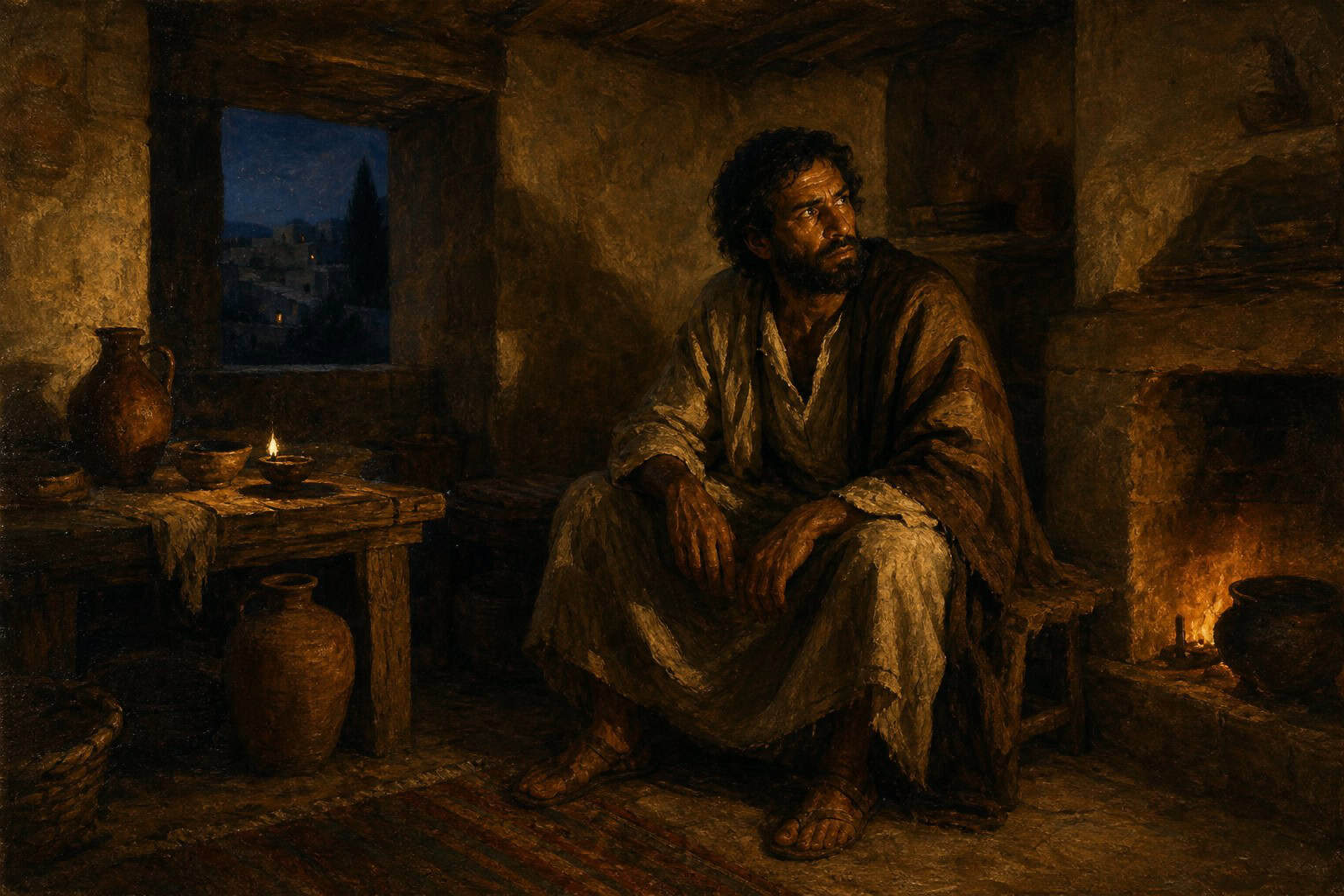
Why does a son need a mother? A raw meditation on the first face, the first hunger, and the body that remembers being held before it could name it.
A Voice Above Him Before He Had Words
Some song was playing the first time he felt safe, and he could not tell you a single word of it. In the stretches of Confessions to the Empty Chair where the older self sifts his own history, he does it with his ears rather than his eyes. A tune from one era smells of newness and machines; a tune from another aches with romance; a certain winter still sounds like cold and anger. Each note drags a whole season back, furniture and light and all. And beneath every one of those songs, older than any of them, sits a sound he cannot place, because he owned no words when he first heard it. A voice hummed above him. A pulse he had already learned by ear from the inside kept its rhythm near his cheek. This is where the question of why a son needs a mother has to start — not in duty, not in greeting-card warmth, but in the flesh that remembers being carried before the mind existed to keep the record. Long before the boy could name hunger, his belly knew the exact taste of relief arriving. Long before he could say the word afraid, his skin already knew the difference between being set down on a hard surface and being gathered up against a warm one. His mother was never an idea to him. She was the first weather he lived inside — a climate of near or far, warm or chilled, answered or ignored — and his small body learned to read that weather the way a sailor reads the sky. A man forgets he ever learned this language. He imagines he arrived already himself, a finished and sealed thing set down in the world. The truth runs quieter and cuts deeper. He arrived unfinished, a half-sentence, and the first hands to touch him started the words his whole life would spend itself trying to complete. When the narrator listens back through those stacked soundtracks, he is really straining for the earliest track of all, the one with no lyrics — the tone of a woman’s voice that told his nerves whether being alive was safe. To ask why a son needs a mother is to ask why any of us needs a first face at all. The answer here is not soft. It is load-bearing. He was assembled by being received, and every later thing — the armor, the appetites, the running — grew as a reply to how well or how poorly that receiving went. The song plays. The old kitchen comes back. And under the melody a hunger older than melody sits and waits its turn to be understood.
Bricks of Scripture Laid Against Something Nameless
Watch the young self in this book raise his walls. He sets verses in place the way a man lays brick, each line of holy text pressed carefully against a pressure rising inside him. He memorizes long passages. He arms himself before dawn. He is certain he is guarding the sacred against the flesh, faith against appetite, the clean self against the war in his blood. But the older narrator, turning back, sees what the boy could not: the height of a wall confesses the depth of the thing it fears. No one fortifies a border that nobody is trying to cross. So the sheer force of the young self’s spiritual armor becomes its own testimony. Something in him was cracking, or dreaded cracking, and he had no name for it. Here the mother comes back into the frame, silent and enormous. A boy received well at the start walks on a floor he never thinks about — a plain, unspoken certainty that he is wanted, that his hunger carries no shame, that his body has a rightful place in the world. A boy received unevenly walks on a hairline crack instead, and he spends his manhood laying stone across it. The scripture he stacks so frantically may truly be love of God; that must be honored. But it may also be a barricade against a wound he cannot reach, a wound shaped like the first arms that held him too little, too roughly, or held him and then let go too soon. This is not an indictment. Mothers are also human, also frightened, also left unfinished by their own mothers before them. Yet a son’s need does not shrink because the woman above him could not meet it. The need comes first. It is written into muscle and gut before it is ever thought. And when it goes unanswered, the boy does not stop needing — he learns to dress the need up as discipline, as piety, as terror of temptation. The fortress of memorized verses becomes a map of the precise spots where he was not held. The older self reads that map now with an unbearable tenderness. He is not angry at the boy for hiding behind the wall. He grieves that the boy ever had to. And he starts to see that his later hungers — for a woman’s nearness, for touch, for a body that would turn and answer his own — were never a separate story from this first broken-off sentence. They were the same sentence, still reaching for its end. The wall he built as a boy would one day stand in the same body as the desire he could never wall out, and the two would meet, and go to war, and leave him bleeding on both sides of a border he had drawn himself.
The First Body That Taught His Body to Reach
Consider how a man reaches for a woman — not the act, but the reach itself, the whole self tipping forward toward another. In this book the narrator watches his own reaching stall. His hand lifts and then halts halfway. The answer he expects from outside stays mute, and his body registers only its own walls closing in on it. The question underneath is where that reach was first schooled — or first startled. Long before eros, there was the earliest union any body ever knew: the infant laid against the mother, warmth against warmth, fed and quieted and kept. That was the first grammar of touch a man ever learned. It taught him that to press toward another body is either to be met or to be dropped. A son learns the very shape of longing from the first person who answered his cry or let it ring out unanswered in the dark. Here the reading must go carefully, and stay humble, because no person is a machine. You could name certain patterns — the old logic of nurture, the way survival wires an infant to cling, the way a grown man’s desire carries a low echo of that first bond. Those patterns light up one layer and no more. They do not lay a finger on the mystery of a living soul that felt these things from within, that suffered and chose and hoped against evidence. The mother was never a function. She was a whole consciousness the boy could not yet picture, a woman with her own appetites and dreads, taking up a child she may or may not have been ready to hold. And the man he became carries both truths in one chest: he was shaped by her as by weather, and she was a person as unfinished as he would become. When his adult desire finally moves toward a woman, it arrives thick with all of this. He wants union — the body’s honest longing for another body, the ache to be received entire and not sent back. But he also wants the oldest thing he ever wanted: to be held without being dropped, to reach and be caught. A woman senses this weight and is not always wrong to lean away from it, because a man who reaches for his mother inside a lover’s arms is asking her to carry a load she never agreed to lift. Man and woman fracture right here, in the gap between what desire wants now and what desire secretly remembers. The flesh pulls one direction, the soul another, and both motions expose a crack that was already there long before either of them arrived. The narrator does not solve this. He sits down inside it, honest and unsettled, and asks himself what he ever wanted from women that no woman alive could have supplied — because it belonged to the beginning, and the beginning was already gone.
Before a son can speak, his mother has already taught his body whether the world will catch him or drop him.
An Altar No Single Pair of Hands Could Keep Lit
In this chapter a man stands before a shared sacred space that has gone cold, and he has to name a brutal thing — not that a woman walked out, but that she declined the common labor the space demanded. Holiness between two people cannot be shouldered by one. He tended that fire alone and called his exhaustion faithfulness, and the book turns and asks whether it was love at all, or the old reflex firing again, the same boy still trying to earn a presence that would not consent to stay. This is the fallout of everything that came before. A son received unevenly grows into a man who over-tends. He keeps the altar burning by himself because somewhere deep down he learned that if he ever stops working, the other one will disappear. He mistakes his own depletion for devotion. He tells himself that if he simply gives more, prays harder, endures longer, the absent one will finally turn and meet his outstretched reach. And the woman across the cold hearth from him — she is no villain in this telling. She may have known, in her own body, that a fire fed by a single pair of hands is not a shared home at all but a standing demand. She may have refused the work precisely because the work was never truly mutual, because she felt herself being asked to be more than a wife — to be the answer to a hunger far older than any marriage vow. The two readings hold each other in tension here, and neither one is allowed to win. The man’s ache is real; his loneliness at the darkened altar is not something he invented. And her refusal may carry its own hard honesty, a woman quietly declining to be drafted into a role she never signed. The narrator swings the lens back onto himself and does not look away. What did he want from her that belonged to someone else entirely? What did he refuse to see about the mismatch between the size of his need and the fact of her freedom? He will not tie it off with a bow. That is this book’s discipline — it will not hand you a moral to make the grief easier to swallow. Yet even here, in the ash and the cold draft, something is present. Not a rescue. Not a repair. Only a nearness, low and quiet, walking beside him straight through the failure he cannot undo. There is no figure standing outside the ruined altar holding an answer. There is only a presence down in the ash, close to the man’s wet face, near him in the sin and the tiredness both. The striking thing is not that the dark lifts off him. It is that he is not alone down inside it, even now, with the woman gone and the last coal gray.
What the Grown Man Still Leans In to Hear
He is older now, and he is still listening for the first sound. That is the current the book keeps circling back into — that a man never fully leaves his beginning, that the boy who learned either trust or dread from his mother’s arms is still folded inside the man who reaches for a woman, stacks his verses like brick, and tends a dying fire alone into the night. To ask why a son needs a mother turns out to be the same as asking how a person becomes a person at all. The answer this book offers is neither comfortable nor clean. A son needs a mother because he is not born whole. He is born as a hunger wrapped in skin, waiting for another body to tell him whether the world will hold him or let him fall. Everything that follows — his loves, his defenses, his cold altar, his desire and the long war it wages against his faith — is the slow working-out of that first answer given him before he could speak. And yet the older self does not lay blame on the mother, or the wife, or even the boy he was. He has learned something harder than blame. He has learned that the crack he was handed can also be the seam where light works its way in — not as a tidy rescue, but as a slow, accompanied grief. He can see now that his mother was a woman as unfinished as he became, and his wife a soul with her own untouchable freedom, and himself a man who mistook need for love more often than he ever admitted. None of that is mended by the seeing of it. But it lives differently, held up in the plain light of honest sight, than it lived in the long dark of denial. Confessions to the Empty Chair makes the son no promise that his hungers will be filled. It promises only this much: that the hunger is real, that it began before memory could keep watch, and that there was never any shame in his having needed to be held. A man can burn his whole life mistaking that first need for a defect in his character. The book turns him instead toward naming it, grieving plainly where it went unmet, and noticing — without fanfare, almost under his breath — that God stands nearer to the raw wound than to any of the walls he ever built to hide it. The song still plays somewhere in the house. The old room assembles itself again around him. And a grown man leans forward, not to be cured of his beginning, but to hear at last the sentence it started in him, and to let it, finally, be true. That is where this chapter sets him down. Not repaired. Kept company. Which, in this book, is the deeper and rarer mercy.