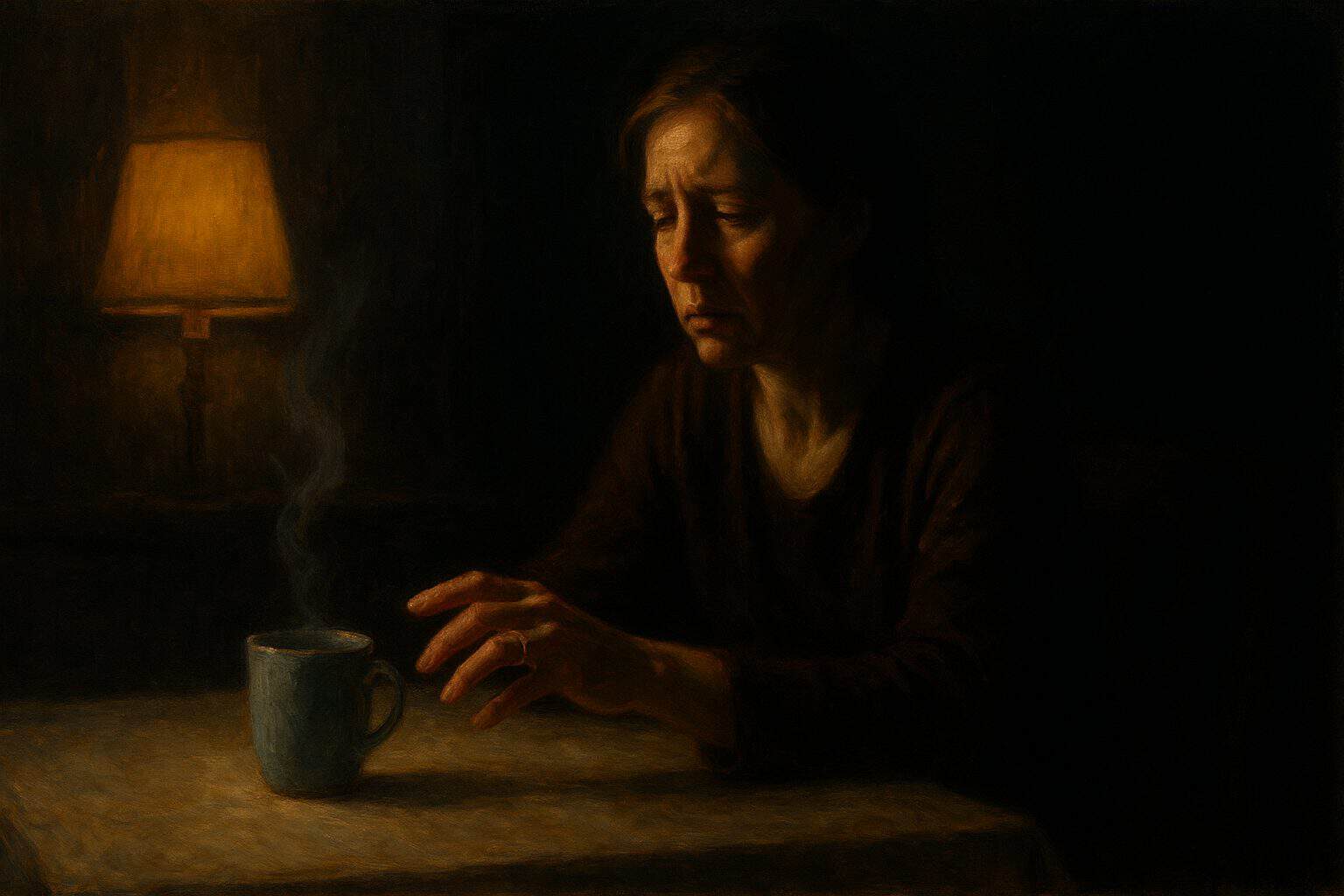
How the past seeps forward through flesh and feeling, staining every new encounter with the residue of what was
The hand reaches for the coffee cup in morning light. Simple gesture, repeated thousands of times. Yet today—this particular morning—the fingers hesitate mid-reach. Something in the angle of sunlight through kitchen window, something in the ceramic’s particular shade of blue, and suddenly another morning intrudes: different kitchen, different cup, different hand beside yours. The present moment splits. You are here, lifting this cup, and simultaneously there, lifting that one. The coffee tastes of both mornings now—this actual brew and that remembered one, bitter with ending.
The Seepage
Memory does not stay in its place. It leaks through the sealed chambers we construct, contaminating the pure present with its persistent residue. “From that moment forward,” as one discovers in the aftermath of betrayal, “I would never know whether the cigarette taste on Jane’s mouth was his or hers.” The contamination is complete: every kiss now carries the ghost of another’s mouth, every intimate gesture echoes with possible deception.
This is not simply remembering. This is the past actively poisoning the present, drop by drop, until we cannot taste anything untainted. The lover’s perfume on passing strangers. The particular tilt of laughter that freezes conversation. The song that transforms a perfectly ordinary Tuesday into an ambush of grief. These are not memories recalled but memories that invade, crossing the threshold uninvited, tracking mud through the carefully ordered rooms of now.
Watch how it happens. You are walking through the park, mind on tomorrow’s meeting, when a child calls to their mother in just that tone, with just that inflection, and suddenly you are seven again, calling for comfort that will not come. The present park dissolves. You stand between worlds—adult body in Tuesday afternoon, child-heart in Saturday morning forty years past. The contamination is total. Even when you shake your head, return to the path, the meeting, the adult concerns, something has been altered. The park will never be innocent again.
The Phantom Limb
“The memory burned: a phantom limb, a cruel brand searing the remembered sweetness against the mundane bitterness.” The contamination operates like phantom pain in an amputated limb—the presence of an absence that throbs with its own reality. The beloved who left still occupies space in the bed. The dead parent still sits in their chair. The friendship that ended still expects your call.
The deep scar on my heart, I was sure, would poison any new relationship with a bitter skepticism, undermining the very peace I longed for.
These phantom presences do more than haunt; they actively shape how we move through space. We step around the invisible chair. We leave room in the bed. We reach for the phone and stop, hand suspended in the geometry of loss. The contamination has reorganized the very structure of dwelling. Every room becomes a palimpsest—present furniture overlaid with ghostly arrangements, current inhabitants moving through crowds of the absent.
Consider how the body itself becomes contaminated. “My mind—the architect of my rules, the captain of my will, the guardian of my heart—stepped aside. But my flesh, that loyal traitor, answered her call.” The muscles remember embraces the mind has forbidden. The skin recalls touch the heart has renounced. Walking past their street, the legs want to turn. Hearing their name, the pulse quickens. The body carries its own memory, deeper than thought, more honest than intention.
The Solvent of Substitution
“With each new lover, Jeannètte’s hold on my spirit loosened. Their collective arousal became a solvent—diluting the poison of that singular rejection.” Here emerges one strategy against contamination: dilution through multiplication. If one memory poisons, perhaps many memories might neutralize. Each new kiss overwrites the old. Each fresh touch covers the bruise.
Yet watch what actually happens in this attempted cure. The new lovers do not erase the original; they become variations on a theme. Each face partially resembles that first face. Each voice carries echoes of that first voice. The multiplication does not eliminate the contamination but spreads it thinner, distributes it across more surfaces. Now every lover tastes faintly of that first betrayal, every embrace carries a homeopathic dose of that original poison.
The attempt to forget through replacement becomes its own form of remembering. The very effort to avoid certain streets, certain songs, certain names creates a negative space more present than presence. The contamination has simply changed form—from positive poison to negative space, from what is remembered to what must be actively forgotten.
The Archaeology of Hurt
“Experience carves out their presence in the world.” Each wound creates its own archaeology, layers of hurt settling into sediment, forming the bedrock of personality. The child who learned that love meant vigilance grows into the adult who cannot rest in embrace. The adolescent who discovered betrayal in a best friend’s whisper becomes the professional who trusts no colleague completely.
These contaminations run deeper than conscious memory. They have become the invisible structure through which all experience filters. “If ‘compassion’ passes through ‘pain and suffering,’ then one experiences ‘suspicion,’ and if ’empathetic understanding’ passes through ‘neglect and darkness,’ then one experiences ‘malicious intent.'” The contamination has become the lens itself. We no longer see the past in the present; we see the present through the past.
This archaeological contamination operates with terrible precision. “The enemy has studied you all your life and has vast knowledge of the human heart… He will customize your temptation just for you.” Whether we name this enemy as devil, trauma, or simply the accumulated weight of living, the mechanism remains: our specific wounds become the specific doors through which contamination enters. The person who was abandoned fears abandonment in every goodbye. The one who was betrayed finds betrayal in every inconsistency.
The Paradox of Healing
“What Lilith had used to damage me, Jeannètte now used to heal me. If Lilith made it possible for me to hate, Jeannètte made it possible for me to love.” Here appears the strange truth: sometimes healing comes through the very channel of wounding. The contamination itself becomes the medium of restoration.
This is not the simple story of redemption overcoming corruption. Rather, it reveals how contamination might be transformed without being eliminated. The wound remains but changes meaning. The poison becomes medicine in different doses. The very sensitivity created by hurt becomes the capacity for healing touch.
I forged this new protocol of deceptive power by translating the cuneiform scars she left on my heart into thoughts and then into words.
The scars become scripture. The wounds become wisdom. Not because pain inherently teaches—it often merely repeats—but because sometimes, in rare grace, the contamination itself becomes conscious of itself, sees itself seeing, and in that reflexive moment discovers the possibility of choice.
The Persistence of Poison
Yet we must not romanticize. “Lilith used the bodies of her followers to mar my soul, forever changing its shape.” Some contaminations do not transform into medicine. They remain poison, persistent and patient, waiting in the body’s cells, in the heart’s hidden chambers, in the mind’s unguarded moments.
These deeper contaminations—what tradition calls original sin, what psychology names trauma, what lived experience knows as the wounds that will not heal—these persist across years, decades, lifetimes. “Their sin broke the perfect balance of their passions, senses, emotions, intellect, and will, exposing them and their progeny to suffering and death.” The contamination passes between generations, inherited poison in the bloodstream of families, communities, cultures.
Watch how it works in the ordinary kitchen, the everyday conversation. The mother who snaps at her child in exactly the tone her mother used. The father who withdraws into work just as his father did. The patterns repeat with uncanny precision, as if the contamination has its own intelligence, its own will to persist. The children absorb what the parents thought they had hidden. The poison, building tolerance for its bitterness, reveals itself in word and deed.
The Impossible Purity
“This, then, constituted the true betrayal: not of some spoken promise… but of the perceived purity of that initial, unguarded… authentic desire.” The deepest contamination may be the loss of belief in purity itself. Once we have tasted the mixed cup—love braided with betrayal, joy shadowed by loss, triumph tainted with compromise—can we ever again believe in unmixed experience?
The child knows moments of pure joy, pure sorrow, pure rage. The adult knows only admixtures—happiness tinged with awareness of its passing, sorrow lightened by the knowledge of its eventual ease, anger complicated by understanding its sources. This is contamination as the very structure of maturity: the inability to experience anything without simultaneously experiencing its opposite, its context, its echo and shadow.
“Another piece of me felt guilty, as if betraying the holiness that Jeannètte and I forged over two years.” Even the sacred becomes contaminated. The holy moments carry within them the seeds of their own betrayal. The pure love contains the possibility of its corruption. The contamination is not something that happens to purity; it is what purity becomes when it enters time.
Living in the Contaminated Field
So we live in this contaminated field, where every present moment carries the residue of all past moments, where every new love tastes faintly of old loves and lost loves, where every joy anticipates its own ending. “In rebellion against our inevitable end, I resolved to enjoy the buffet of her body, savoring every crumb until the day came to slam the door.” The contamination of mortality itself—the knowledge of ending that flavors every beginning.
Yet perhaps this contamination is not only curse but also condition. Perhaps the purity we mourn never existed except in the imagination of innocence. Perhaps the mixed cup is the only cup humans ever drink from, and wisdom consists not in seeking purity but in learning to taste the complex flavors of contaminated experience—the bitter with the sweet, the poison with the medicine, the memory with the moment.
“My next act was a diplomatic necessity. I had to risk the new and fragile thing with Jane by dragging my transgression from the dark into the light.” Sometimes the only response to contamination is confession—not to achieve purity but to acknowledge mixture. To say: I am contaminated, you are contaminated, we contaminate each other, and yet we continue.
The Ongoing Seepage
The contamination of memory is not a problem to be solved but a condition to be inhabited. Right now, as you read these words, memories are seeping through—perhaps of your own betrayals given and received, your own wounds that will not close, your own attempts to forget through replacement, to dilute through multiplication, to transform poison into medicine.
The coffee cup waits on the table. When you reach for it, whose hand reaches with yours? What other mornings rise in the steam? What faces reflect in the dark surface? The contamination is complete and ongoing, the past forever leaking into the present, staining every new moment with the indelible ink of what was.
And yet you reach. Despite the contamination—or perhaps because of it, because the mixed cup is the only cup, because the contaminated life is the only human life—you reach. The coffee tastes of this morning and all mornings. The contamination continues. The day begins.