Where the body’s hunger meets divine thirst, and matter itself becomes the grammar of grace.
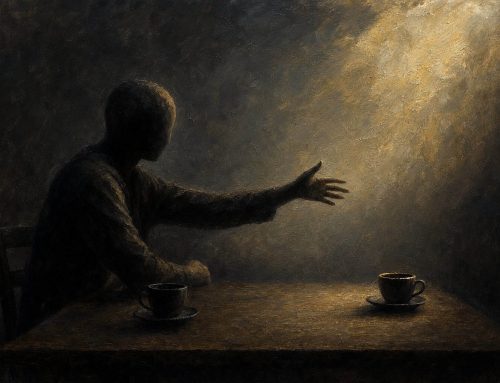
The hand reaches across the dinner table—not merely to pass the salt, but to brush fingertips in that fleeting electricity that speaks what words cannot. In that touch lives something Anthony Adoré knows intimately: how flesh itself becomes the vehicle of spirit, how the body speaks a language older than speech, how our very materiality opens onto the infinite. This is not metaphor but lived truth—that peculiar alchemy whereby skin meeting skin becomes a gateway to the soul.
The Grammar of Touch
Watch how it happens. Two people sit across from one another, conversation flowing about work, weather, the wine. But beneath the words runs another current entirely. The slight lean forward, the lingering gaze, the way fingers trace the rim of a glass—each gesture writes itself into the space between bodies, creating what Anthony calls “signals woven into glance, posture, and word.” The body knows before the mind admits. The flesh reads what reason will only later decipher.
This is not crude appetite but something far more mysterious. In Fractions of the Soul, Anthony describes how “touch becomes a separate dialogue… culminating in sensuality: the point in sex where the spirit of each resonates in the flesh.” Notice the precision here—not flesh versus spirit, but spirit resonating in flesh. The body becomes the very medium through which souls recognize one another.
Consider the lovers’ first kiss. Before lips meet, there is that suspended moment—bodies drawn by a gravity that seems to originate beyond either person. The slight trembling, the held breath, the way time itself seems to thicken. When contact finally comes, it arrives as revelation: suddenly the other’s entire being concentrates itself in the warmth of their mouth, the particular texture of their lips, the rhythm of their breathing. The kiss does not represent intimacy; it is intimacy made tangible, spirit taking up residence in saliva and breath and the soft collision of tongues.
The Eucharistic Structure
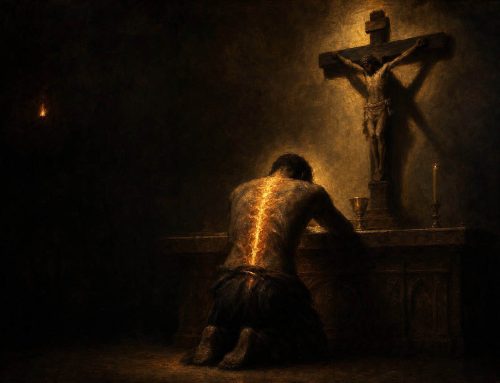
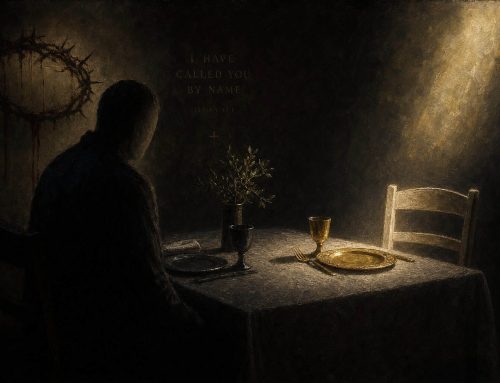
Anthony glimpses something profound in this fleshly communion, something that echoes through his Catholic imagination. When he writes of “the bread-body and the wine-blood shared with us,” he recognizes how the Eucharist itself proclaims flesh as the privileged site of divine encounter. God does not disdain matter but enters it, transforms it, makes it the very vehicle of salvation.
“I imagined sex as a physical manifestation of divine love, humanity’s way of doing honor unto and reaching toward the divine.”
This is not blasphemy but its opposite—the recognition that our bodily life participates in something infinitely larger than itself. The lovers’ bed becomes its own kind of altar where flesh offers itself to flesh in a gesture that mirrors, however imperfectly, divine self-giving. “God also created sex,” Anthony insists, “the private language we speak, and I came to believe He would, somehow, renew that too.”
Watch how this plays out in the phenomenology of desire itself. A woman “sends nude pictures and videos of herself masturbating to some and not others, and grants physical benefits to some and not others.” This selective unveiling is not mere transaction but a kind of embodied election—the body choosing its witnesses, flesh deciding where it will reveal itself as sacrament. Even in what might seem purely carnal, there operates a logic of gift and reception that echoes liturgical offering.
The Wound of Separation
But flesh as sacrament knows its own failures. Anthony describes with brutal honesty how “the act of penetration is not so much an accepting of the other’s soul in physical form into their own body as it is a masturbating with the other’s warm tangible parts.” Here the sacramental collapses into the mechanical. Bodies that should open onto souls become mere surfaces, warm objects for solitary pleasure.
This wound appears especially in what Anthony calls the beautiful and shallow—those whose “physical existence… beckoned suitors and ‘Alex-style’ suitresses alike, rendering dates and conversations among them hollow pleasantries before physical consummation.” When flesh becomes only flesh, when the body no longer serves as gateway but as barrier, the sacramental structure breaks down. Sex becomes mere friction, touch mere stimulation, the body a prison rather than a portal.
Yet even this failure points toward what flesh properly ordered might be. The very disappointment of purely physical encounter—its essential loneliness, its failure to satisfy the deeper hunger it awakens—testifies to flesh’s higher calling. We are disappointed precisely because we sense, however dimly, that bodies are meant to be more than bodies, that skin should open onto soul, that in the mingling of saliva and sweat something eternal should pass between persons.
The Discipline of Embodiment
Anthony discovers that flesh must be educated into its sacramental vocation. “The passions speak their own language,” he observes, “and create the fodder that reason must later digest.” But this is not simply a matter of reason dominating passion. Rather, it involves what Merleau-Ponty might call a kind of bodily intelligence—learning to read the subtle grammar of gesture, to distinguish between mere appetite and genuine desire, to recognize when flesh opens onto spirit and when it closes in on itself.
This education happens through practice, through what Anthony calls his “dialect” that “became a kind of ministry, a spiritual language that spoke fluently to the consenting feminine.” Notice the religious vocabulary—ministry, spiritual language. The body must learn to speak sacramentally, to offer itself as gift rather than demand, to receive the other as mystery rather than object.
Consider the difference between two kinds of undressing. In one, clothes are simply removed, fabric peeled away to reveal skin. But in another kind of undressing—slower, more attentive—each garment removed becomes a kind of unveiling, each newly exposed patch of skin a revelation. The body offers itself by degrees, and in that graduated offering, something more than body is given. The flesh becomes transparent to the person who inhabits it.
The Text and the Flesh
Paradoxically, Anthony discovers that sometimes flesh speaks most clearly when absent. “The text-based medium fostered a unique intimacy,” he writes, “built on the exchange of words and ideas, without the contaminating bias of physical appearance.” Here words themselves become a kind of flesh—material marks that carry spirit, visible signs that convey invisible presence.
“She signaled intimacy first not with her body, but with her mind imprinted upon words.”
In the love letter, the late-night text exchange, the carefully crafted email, we find another modality of flesh as sacrament. The words become the writer’s body, bearing their presence across distance, carrying their breath in the rhythm of sentences, their touch in the choice of adjectives. To read such words is to receive the other’s flesh in linguistic form—no less real for being mediated through pixels or ink.
This suggests that flesh as sacrament is not limited to skin and muscle, blood and bone. Rather, it names that fundamental structure whereby matter becomes the bearer of spirit, whereby the visible opens onto the invisible, whereby finite gestures carry infinite significance. The body is simply the most intimate instance of this structure—but the same sacramental logic operates wherever material reality becomes transparent to personal presence.
The Eschatological Body
Anthony’s Catholic imagination will not let him forget that flesh has an eternal destiny. “Ours is not to remain a disembodied soul in heaven,” he insists, “but a reunited and purified body-soul in the New Jerusalem.” The body is not a temporary prison from which the soul will eventually escape, but an essential dimension of human identity that will be transformed and glorified.
This eschatological vision changes everything about how we understand flesh in the present. Every touch becomes a rehearsal for resurrection, every embrace a foretaste of the communion of saints. The body’s hungers point beyond themselves toward a final satisfaction that will not negate flesh but perfect it.
In the marriage bed, in the Eucharistic feast, in the simple gesture of one hand reaching for another, we glimpse what bodies are meant to become—not discarded husks but glorified vessels, not obstacles to union but the very medium of eternal communion. “The place of their bodily union,” Anthony writes, “is also the gateway for channeling the creation of new souls, hence each is drawn there in the flesh.” The body becomes the site where time touches eternity, where new life emerges from the collision of finite flesh.
The Ministry of Flesh
What Anthony ultimately discovers is that flesh itself can become a form of ministry. Not in some crude or profane sense, but in recognizing that our bodily life is always already theological, always already implicated in questions of ultimate meaning and value. How we touch, how we withhold touch, how we offer our bodies and receive the bodies of others—these are not merely private matters but participate in the grand drama of creation, fall, and redemption.
“Genuine desire is not always self-serving,” Anthony learns; “it can be an instrument for peace.” When flesh learns its proper vocation—not as master but as servant, not as end but as means, not as idol but as icon—it becomes capable of mediating presence in ways that pure spirit never could. For we are not angels but embodied souls, and our path to the divine runs necessarily through skin and synapse, blood and bone.
The woman who “involves herself with others and takes what she can from them, and brings their fruits to her partner’s table and prepares the banquet of her body” enacts a strange eucharist—gathering the gifts of many into an offering of one. Even in what might seem like betrayal or promiscuity, Anthony perceives a fumbling toward communion, a hunger for the feast that only flesh can provide.
The Reverent Flesh
In the end, flesh as sacrament demands a particular kind of reverence—not the reverence that refuses to touch, but the reverence that touches knowingly, aware of what is at stake in every caress. It requires recognizing that in the other’s body we encounter not just tissue and fluid but a living tabernacle, a site where the infinite has taken up residence in the finite.
This reverence shows itself in countless small gestures. The way a husband’s hand finds the small of his wife’s back in a crowded room—not possessive but protective, not grasping but gathering. The mother nursing her infant, flesh nourishing flesh in an act that is simultaneously animal and divine. The friends who embrace after long absence, bodies remembering what minds had almost forgotten about the shape and weight of love.
Anthony knows that “the spirit of one who mingles his soul with another through flesh—that spirit of friendship is different, is it not?” Different because it has submitted to the discipline of distance and proximity, different because it has learned to speak through skin, different because it has discovered that souls are not abstract entities but are always and everywhere implicated in the fate of flesh.
To live flesh as sacrament is to inhabit this difference—to move through the world aware that every body we encounter is potential theophany, that every touch might open onto transcendence, that in our very materiality we carry the possibility of grace. It is to understand that we are neither pure spirits trapped in flesh nor mere animals with delusions of grandeur, but something more mysterious—embodied souls whose flesh itself participates in the sacred, whose bodies are not obstacles to the divine but the very medium of its manifestation.