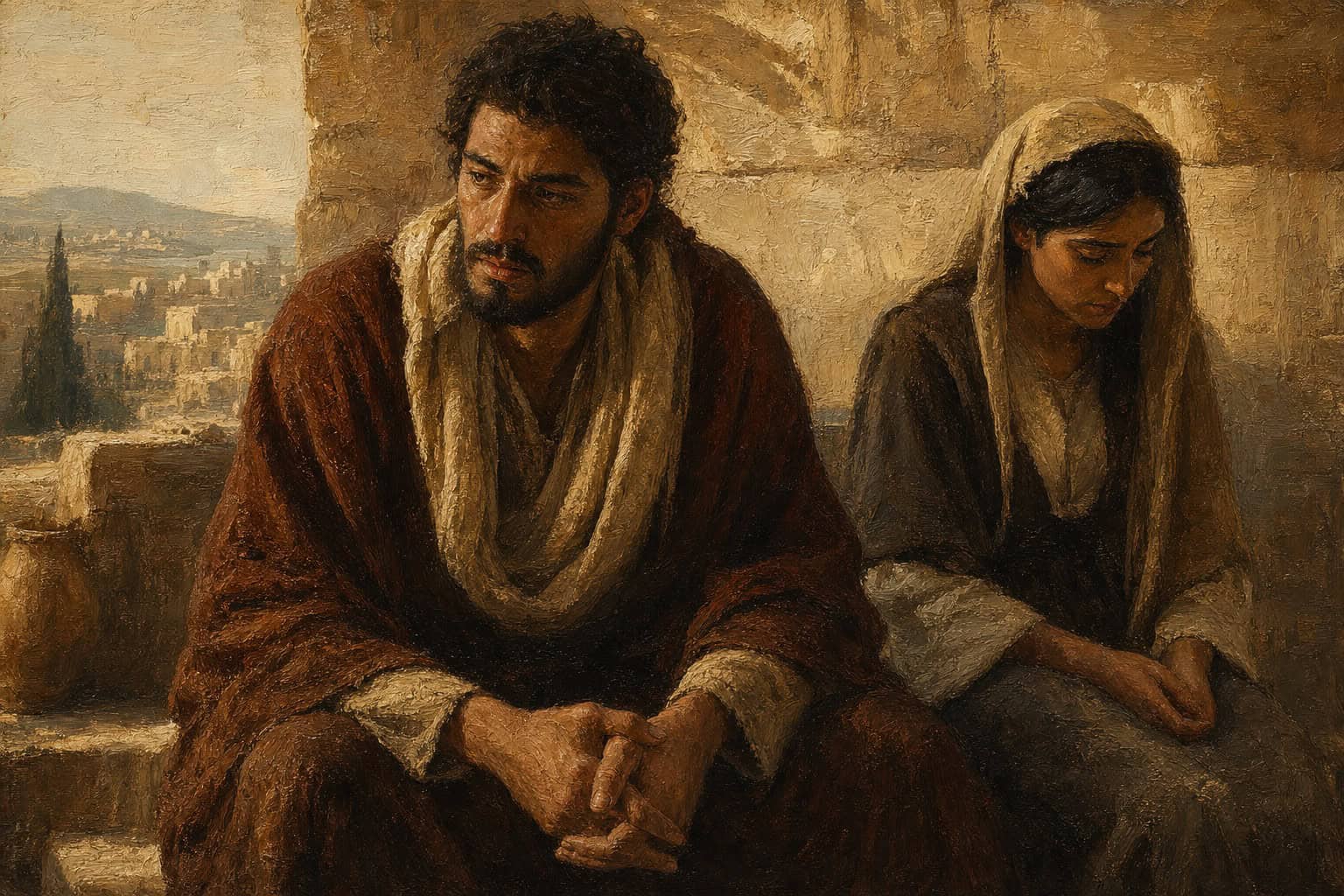
What is true surrender? A raw reading of a bench, an accusation, and a body that answered older laws than the will chose.
Painted Wood in Flat Daylight
What is true surrender? Not the polite word people use for a lost argument, but the thing itself—the giving of a self that cannot be handed back once it leaves you. Chapter twelve of Confessions to the Empty Chair sets that question down on a hard wooden bench in ordinary daylight, two people sitting close and no longer touching. Angela is there beside him. She has come to say something, and the narrator feels it approaching the way you feel weather change before the sky breaks. The bench is public, plain, slats of painted wood warmed by afternoon sun, the kind of place where nothing large is supposed to happen. That is part of the cruelty here: the setting refuses to match the size of what is about to be spoken. He remembers her body next to his, the old warmth of it, a closeness that once felt like proof of something good between them. Now that closeness has curdled into evidence. She has not come to remember with him or to soften anything. She has come to name what he did and to place that name in his hands so he must carry it out of the park with him. The narrator, older now, looking back on the young man he was, does not flinch from the memory. He sits down inside it and lets it accuse him. He does not rush ahead to the part where he can explain himself, where he can reach for context and mitigating detail. He knows that any man in his seat wants to explain—wants to insist it was mutual, wanted, chosen by two people equally. But the bench does not care what he wishes were true. Angela is about to speak a sentence that will not let him hide behind the small comfortable word we. So the scene begins in stillness, two figures on painted slats, the space between them widening even as their shoulders nearly touch. This is where the book presses its hardest question about surrender. Was anything actually given here, freely, from an open and knowing hand? Or was something quietly taken, and then dressed afterward in the borrowed language of a gift? He does not answer yet. He lets the quiet hold, because he already senses the answer will cost him something he has spent years refusing to pay. And the reader sits down beside him on that warm wood and waits, uneasy, for the first word to land.
The Story That Lets a Man Sleep
For a long time the narrator has told himself a story he could live with. It was shared. She wanted it too. Nobody was forced, nothing was cruel, both hands reached at once. This is the kind of story that lets a man close his eyes at night without hearing anything in the dark. On the bench, that story starts to wear thin, the way cloth rubbed too long at one spot goes gray and then lets the light straight through. Angela’s presence alone is enough to strain the fabric. She has not raised her voice. She has not wept, not yet. She has simply come and sat down, and her coming is itself an argument he cannot answer with any of his practiced words. The narrator, remembering, turns the hard lens on himself and does not spare what he sees. He asks who Angela really was to him back then, when it happened. Was she a whole person with a future he could have pictured, a husband waiting somewhere in her private hopes, a life she was carrying carefully like water in cupped hands? Or was she a chapter in his own education, a proof of his charm, a lesson he pocketed and walked past? He suspects the ugly answer and makes himself sit with it. He remembers how he had shaped himself into the kind of man who could take what seemed offered and feel he was owed it. He had learned, from earlier teachers of his own appetite, that a soft yes could be treated as a full one, that a girl’s hesitation could be read as invitation if he simply decided to read it that way. The tension in the scene rises not from any threat or raised hand but from the slow collapse of a lie he has been leaning his whole weight against. Every second she sits there quietly, the word mutual loses another thread. He finds himself wanting her to say something he can argue with. He wants an exaggeration, a false note, a raised voice, anything that would give him a foothold to defend himself and walk away whole. But she gives him nothing to fight against. She is calm, and her calm is far worse than fury. The narrator watches his younger self through this and cannot make himself look away. He sees the appetite that had dressed itself up as connection and tenderness. He sees how easily desire renames the very person it uses, turning a girl with a future into a moment he could keep for himself. This is the ache of the cast-out man, the one who cannot walk back to the version of himself who was innocent, because he was never as innocent as the story claimed. The past does not stay behind him. It sits on the bench in the present tense, breathing, waiting to be answered—and he has no answer ready in his mouth.
One Verb With a Hand on the End of It
Then she says it. She tells him she was a virgin, and that now she cannot bring that to the man she is going to marry, and that he took it from her. In one plain breath she reshapes the whole of it. What he had quietly filed away as an encounter, maybe even a fond and flattering one, is recast in front of him as a theft. He is no longer the partner in a shared and mutual moment. He is the one who took. The word she chooses is not accident, not mistake, not something soft and forgivable. It is took—an active verb with a hand on the end of it, a verb that reaches and grips and carries away. The narrator feels the ground shift beneath the bench. This is the turn the whole chapter has been leaning its weight toward from the first sentence. Something Angela owned, something she had kept whole for a covenant she had not yet made, is gone now, and she names him aloud as the man who removed it from her. He cannot say we anymore. She has reached into his mouth and taken that word out. She has stood in front of the comfortable story and pulled it down to the bare frame, and now the frame stands there, ugly and true, between them. Here the older narrator finally sees what the young man could not: that surrender is not the moment the body gives way. The body gives way for many reasons—some of them fear, some of them the raw hunger to be wanted by someone, some of them the plain confusion of being young and told that this, right here, is what love feels like. Real surrender is deeper than that, and more terrible to face. It is the moment you discover you wanted the fall, that some hidden part of you savored it and leaned toward the very thing you had sworn you would only endure. That is the recognition that damns a man, not the act itself. Surrender is not the moment the body yields; it is the moment you learn you wanted to. He had surrendered, yes—but not to her, and never to love. He had surrendered to the man he was becoming, the one who could take a thing and call the taking a kind of giving. Angela’s single sentence forces him to see that his ease was bought with the price of her covenant. She had guarded something meant to be given once, freely, whole, to a husband whose face she could already imagine. He had treated it as a thing lying out in the open, available to any hand quick enough. Now she stands in the ruin of that plan and names the one whose hand it was, and he knows, in that instant on the warm wood, that she is right about him.
Surrender is not the moment the body yields; it is the moment you learn you wanted to.
Cold Settling Into a Room After the Fire Dies
A word like that does not fall and go quiet. It rings on and on. The narrator sits with the accusation and it will not let him stand up clean. He cannot un-hear took. He cannot argue it down or trim it to a shape he can carry lightly. The self-hatred that had lived in him for years, the disgust he could never quite reach with his own hands or name with his own tongue, now finds its exact shape in what Angela has just said aloud. He begins to understand something he had hidden even from himself all this time: that the cruelties he committed against other people were often crooked attempts to punish something in himself he could not otherwise touch. When a man cannot bear his own weakness, he makes other people carry it for him. He turns his private self-disgust into a stage and casts the people near him in the role of his shame, then makes them pay for it. Angela was such a stage, though he would never have admitted it back then. He used her to prove something to himself about himself, and the proof cost her a gift she can never restore to anyone. The falling action of the chapter is not loud or dramatic. It is the slow settling of a hard truth down into the body, the way cold creeps into a room after the fire has burned itself out and the last log has gone to ash. The narrator, older, holds the sharp questions in his open hands and refuses to close them off with a tidy show of repentance. Has he actually changed, or has he only learned how to feel worse about the same face in the mirror? Is grief the same thing as amendment, or only its cheaper cousin? He does not know, and he sits inside the not-knowing because it is the honest place to sit. And yet, even here, in the ash and the cold, something quiet moves through the wreckage of him. This is not a book where God arrives on cue to fix the scene and lift the shame away like a stain from cloth. God does not erase what happened on that bench, and does not pretend it away. But the narrator senses, faintly, that he is not alone in the seeing of it. There is a nearness in the dark of him, a company that neither excuses what he did nor turns and flees from it. God is present in the tear he cannot quite manage to cry, walking beside him inside the very sin he is at last naming out loud. This is the strange and stubborn mercy of the book—not a rescue, but a companionship. Not a swept-clean floor, but a presence that chooses to stay in the mess with him. He does not feel forgiven. He feels seen, which is harder to bear and, in its own way, far more real.
A Stone He Refuses to Have Lightened
So where does it settle, in the end. The narrator finally rises and leaves the bench, but the bench does not leave him; he carries it out into the rest of his life. He carries Angela’s sentence like a stone lodged in the chest, and he does not want it lightened by any cheap consolation offered too soon. There is no undoing available here. What was taken cannot be handed back, and that is the plain, awful sum of the thing. She will marry the man she loves, and she will bring to that covenant a wound his hands made in her years before he ever knew her husband’s name. He will live the rest of his days knowing it, hearing that one verb whenever the memory surfaces. This is the exile the whole book keeps circling and returning to—the sheer impossibility of walking back to the man he was before he learned what he was capable of doing to another soul. The past does not release its grip on him. It presses forward into his present and throws its shadow across every intimacy that comes after. And yet the reflection does not close in despair alone, because the narrator has finally learned the one thing the scene was built to teach him. True surrender is not the softness of the body giving way in a dim room. It is the honesty of the soul standing in daylight. He had surrendered to his own appetite once and called the surrender love. Now, on the far side of Angela’s plain accusation, he is asked to surrender in a wholly different key—to give up the comfortable story, to give up the word we, to give up the flattering picture of a shared and equal moment that never was. This second surrender is the harder one by far. It asks him to hand over not his innocence to a lover but his self-deception to the truth, to set it down on the ground and walk away from it empty-handed. He is like a man summoned out of a familiar life into a country he did not choose and cannot yet see, asked only to trust the voice that called him. Whether he can actually do it, the chapter refuses to promise. That refusal is the integrity of this memoir: it will not let him off the hook, and it will not let you off either. It offers no absolution you have not first earned by looking straight at the thing. What it offers instead is the terrible clarity of a woman on a public bench who spoke a single sentence and made a man see himself whole. If you have ever felt your own body betray your deepest vow, or watched your cruelty toward another person turn out to be your buried cruelty toward yourself, this chapter is waiting, its eyes open and unwilling to blink. It will not comfort you with a lie. It will keep you company in the truth.