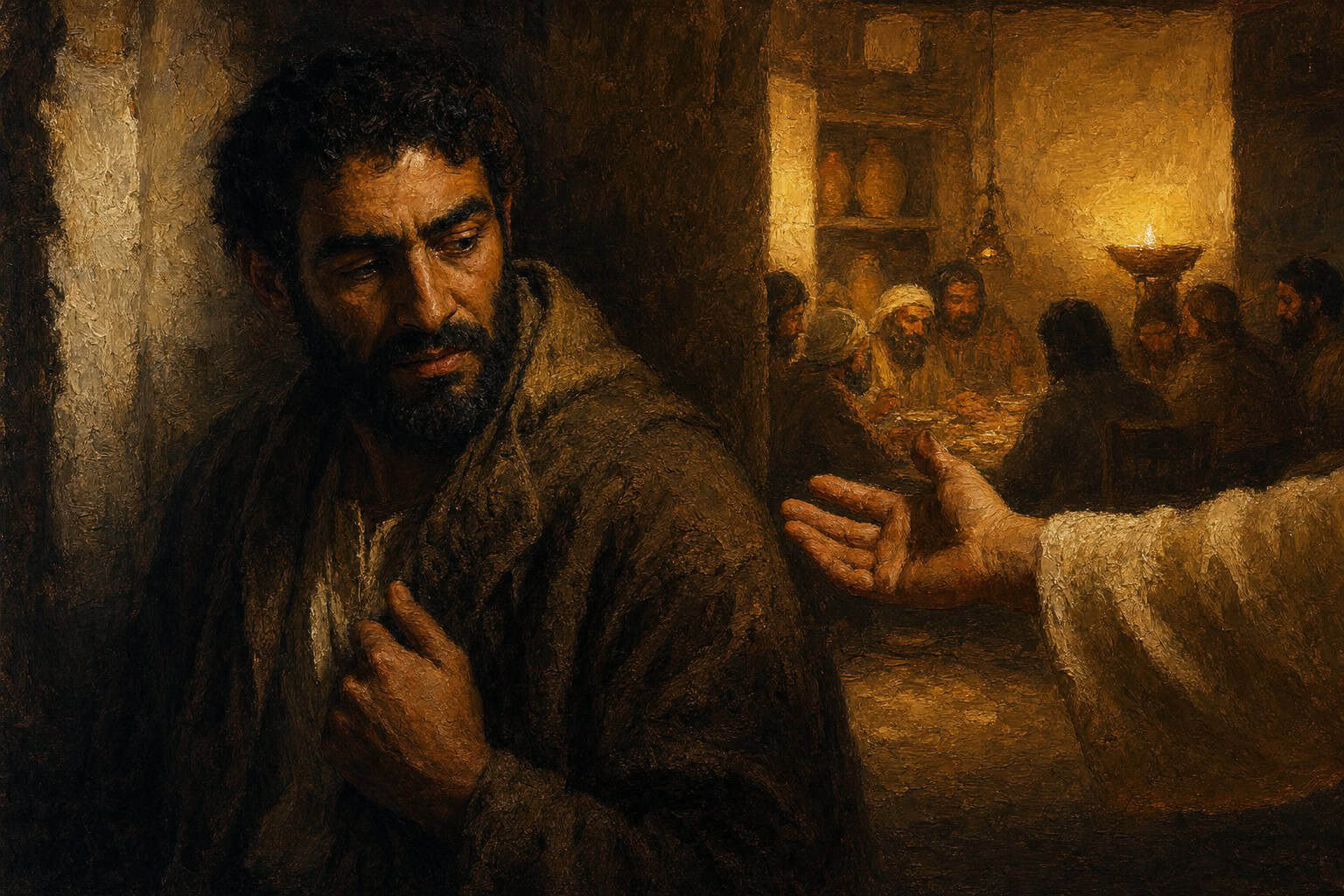
You fear that trying is the first step to failure. Here is why the attempt itself is already a mercy—and never the disgrace you dread.
The Cold Hand That Closes First
You know the ache before the words even come. Someone opens a door you have wanted all your life, and instead of joy you feel a cold hand close on your stomach. The invitation is real. The people inside are the ones you have watched from a distance, learning their gestures, memorizing the way they hold a glass without spilling a drop. Now you are asked in, and your first thought is not gratitude. Your first thought is that you will be found out. You tell yourself that trying is the first step to failure, because if you never step across the sill, you never have to watch yourself fall short. This is an old logic, and it feels like wisdom. It wears the mask of humility. It whispers that staying small is safer than reaching and being seen to reach. Sit with it honestly, in your own skin, at the edge of some ordinary chance you have been handed. Feel how the fear runs ahead of the fact. You have not tried yet, and already you have written the ending, and the ending is your disgrace. You do this in small rooms and large ones. You do it before the phone call, before the interview, before the moment you almost say what you mean and then swallow it back down. The heavy old thing you drove up in—your history, your family, your accent, the shoes that do not match the others—sits parked outside like a confession you did not choose to make. You feel it before you speak a single sentence. And so you decide, quietly, that the attempt itself is the shame, that to want and to strive is somehow more embarrassing than to have never wanted at all. Notice how much comfort there is in this decision. It lets you grieve now, before anyone can judge you. It lets you be the first to mock your own reaching, so no one else gets the chance. You have practiced this so long it feels like a personality. But it is not who you are. It is a habit you built out of old bruises. This is the first lie you must name plainly, out loud, in the mirror if you have to. Trying is not the first step toward failure. Trying is the first step out of the crouch you have lived in for years. The crouch felt like protection. It was a prison with soft walls and a familiar smell. You will not know which it is until you stand, and standing is the thing you keep refusing to do, because it exposes the whole length of you to a gaze you cannot control or predict or talk your way past.
The Sentences You Count Behind Your Teeth
Watch what your body does when you decide to try something that matters. Your shoulders climb toward your ears. Your breath goes shallow and quick. Your palms turn damp before you have touched a thing. You rehearse the sentences before you speak them, running them behind your teeth like a man counting coins he is afraid to spend. This rehearsal is the real labor, and it exhausts you more than the thing itself ever could. You are not living the moment. You are managing it. You have built a second self to send into the room in your place, a polished stand-in who smiles at the right times and never once lets anyone see the raw want underneath. And the whole time you are calculating, you tell yourself the calculation is what protects you from failure. It does no such thing. It only guarantees a smaller, quieter failure—the failure to ever be actually present, to be met, to be touched by anything that was not first approved by your fear. Think of the last time someone reached toward you before you were ready. A warm hand landing on your shoulder. A directness in a stranger’s eyes that skipped every careful step you thought the moment required. Remember how it startled you. Remember how a part of you wanted to coil away and guard the armor you had spent so long buckling into place. Remember, too, the strange relief that flickered beneath the alarm, faint and terrifying. Someone had stepped past your strategy. Someone had refused to stay at the fixed distance where your performance actually works. In that instant you did not have to calculate. You did not have to plan your next line. You only had to be there, unfinished, in your actual body, breathing in the middle of the room. This is the real terror you have been avoiding all along when you say trying leads to failure. The terror is not that you will fail at the task. The terror is that you will be seen while trying—seen in your reaching, your unsteadiness, your plain and naked wanting. You would rather stay in the shadow at the edge of the party, half hoping to be found and half dreading the finding. You have made your loneliness into a fort and then complained, night after night, about the cold that lives inside it. And every single time you refuse to try, you tell yourself it was prudence. It was not prudence. It was the fear of being loved in the middle of your effort, before you had earned the right to be loved by finishing first and finishing flawlessly. You wanted to be admired for the result. You could not bear to be received in the mess of the attempt itself, where you are still shaking, still hoping, still holding your breath.
The Grip You Do Not Have to Earn
Here is the turn your fear cannot survive. You have believed, deep in the bone, that everything must be earned before it is ever given. The reward comes only after the flawless performance. Mercy waits behind a closed gate, and the key is your success. So of course trying feels like the first step to failure, because in your private ledger nothing is granted until the whole account balances, and the account never balances, and so you never begin at all. You keep the book open and the pen ready and the door of your own chest firmly shut. But grace does not keep your books. It does not read your ledger. The most important things that have ever come to you did not arrive because you calculated your way toward them or paid the exact right price. They arrived before you were ready. They came while your hands were still hovering, unsure whether the moment was permission or performance, whether you were allowed to want it. The invitation itself was already the gift, offered long before you proved one single thing, and you nearly turned it down because you could not believe a good thing would ever come to you unearned. This is the wound sitting underneath the fear of failure. You do not trust that you can be received exactly as you are—mid-attempt, imperfect, breath uneven, still reaching. You think love is a wage owed for work completed. It is not a wage. It is a leading. Someone whose steadiness becomes a kind of gravity can pull you into a step you did not choreograph, and the whole exhausting machinery of your self-protection simply goes quiet, not because you defeated it but because it became irrelevant in a single instant. You did not earn that. You could not have. That is precisely what makes it mercy and not payment. And the strange thing is that the mercy does not first remove your trembling. It comes down into it, meets you shaking, and does not ask you to stop.
You call the attempt your failure so you can grieve before the verdict arrives, but grace does not wait for you to succeed.
What the Silence Does When You Finally Move
So you try. Not perfectly. Not with the polished stand-in you built for exactly this occasion. You step forward with your real, unsteady body, and the first thing you notice is that the sky does not fall. The people do not turn as one to laugh. The catastrophe you rehearsed a thousand times does not arrive. What arrives instead is something plainer and harder to bear—the quiet after the leap, the odd emptiness where your fear used to live and work. You had believed the fear was doing something. You had believed it kept you upright. Now it is simply gone, and you stand there feeling almost hollow, unsure what to do with hands that are no longer clenched. This is the fallout no one warns you about. Trying does not fail you. It undoes you in a gentler way. It strips off a layer you thought was your skin and turns out to have been a coat you were wearing to keep from being touched. And for the first time in years you feel the burden of performance slide off with it, and the lightness is dizzying, almost frightening, because you do not know who you are without the weight. You catch yourself grieving the crouch. You miss the fort, even as you stand in the open air you fought so long to reach. This is honest, and you should not rush past it. The old defense had a cost, but it also had a comfort, and letting it go feels less like victory and more like a small death. You keep waiting for the punishment, the proof that reaching was arrogance. It does not come. What comes is a rest you did not schedule and cannot account for. You still ache. The unbelonging did not vanish. The heavy old history still sits parked outside where you left it. But somewhere in the middle of the attempt, something steadier than your fear began to hold you up, and it did not ask you to be finished before it did. You spend the days after turning it over, distrustful, poking at the peace to see if it is real. You have been so long in the business of earning that a gift you did not buy feels like a trap. It is not a trap. It is only the first evidence, faint and unmistakable, that the ledger was never the true accounting of your life.
The Match That Was Already Struck
You will still be afraid. Naming the lie does not kill it. Tomorrow the cold hand will close on your stomach again before some new door, and you will feel the old pull to write the ending in advance and call your retreat wisdom. But something has shifted, and you cannot fully unshift it now. You have felt, once, the difference between managing a moment and being present in it, and the difference will not let you rest as easily inside your fort again. You know now that trying is not the first step to failure. It is the first step into being seen, and being seen is the one thing you both crave and dread with your whole trembling body. Here is what you carry forward. The mortality of it all makes the trying urgent, not shameful. You have a limited number of nights to step into rooms, a limited number of chances to reach toward another and let your hand be met. You will not get an infinite supply of moments to be present. To hoard your attempts, to save yourself for a flawlessness that never comes, is to arrive at the end with a full ledger and an empty life. The crouch is not neutral. It costs you the very days you were given. So try the thing badly. Speak the sentence you have been counting behind your teeth. Let the coat slide from your shoulders and stand there in your actual skin, unfinished, wanting, unsure whether you are allowed. You are allowed. The permission was granted before you asked. The invitation was the mercy, and it did not wait for you to deserve it. If you want to sit longer with the ache and the strange grace hidden inside it, that is the well Confessions to the Empty Chair was drawn from—not a map out of the dark, but a hand that stays in it with you. The match was struck long before you learned to be afraid of the light. Walk toward it while you still have feet that move.