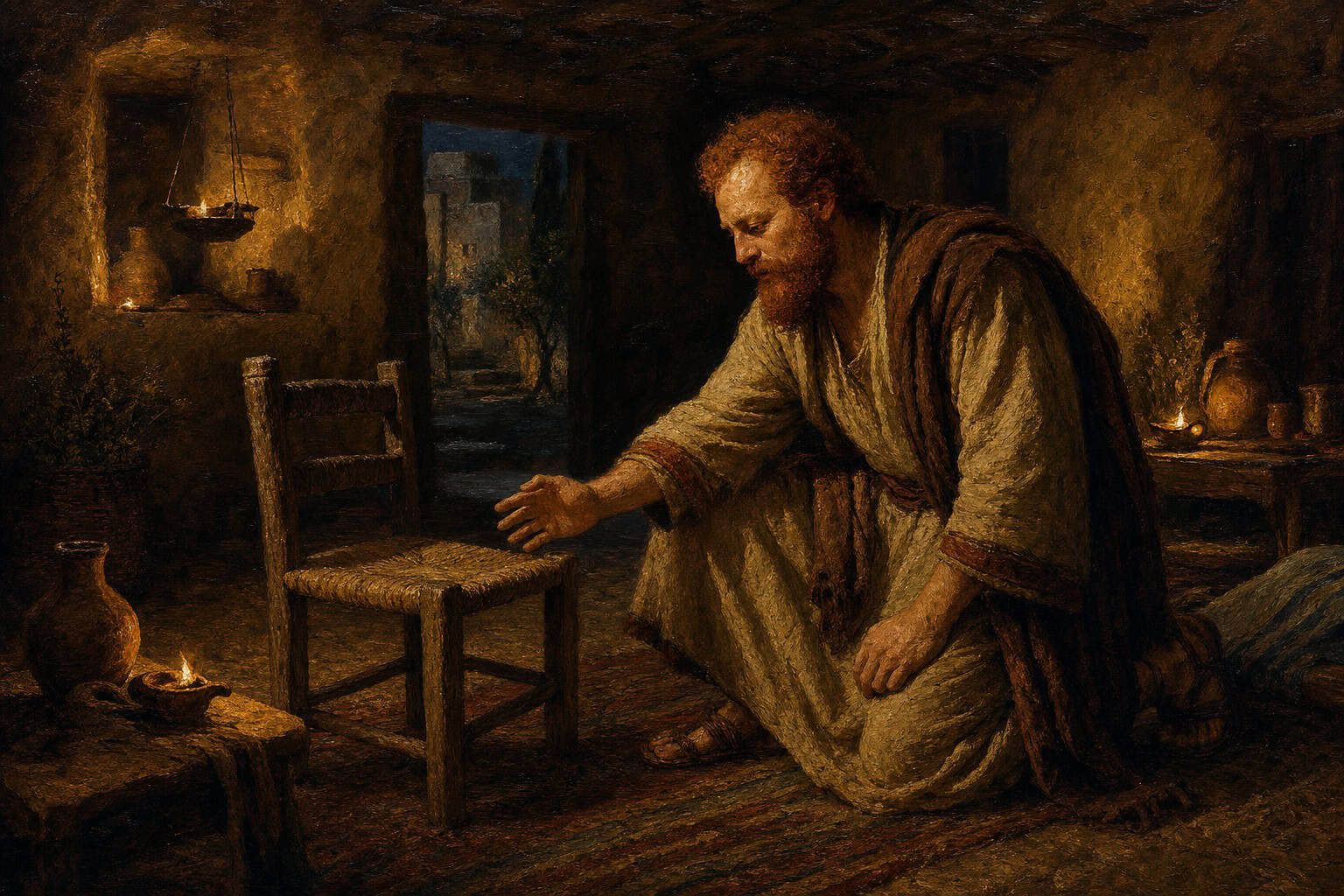
You want the real reasons for a breakup. Not the ones she gave you. Here is what her silence, her hesitation, and her stated rules were actually telling you.
The Hand That Slid Back in Silence
You still feel the exact motion in your own body, and I want you to stop running from it long enough to feel it clean. Not the argument. Not the letter. Not the day she finally said the words out loud, if she ever did. It came earlier than that, and it was small. It was physical. Her body sliding back from yours in a quiet that landed like a slap you never saw a hand raised to give. You had walked what you believed was a shared path, step after patient step, and you were certain the two of you were walking toward the same place at the end of it. When that place finally stood in front of you both, warm and near and undeniable, she did not lean into it. She scooted away. And the part you replayed for years, the part that kept you up staring at the ceiling, was that she did it without one word to cushion the blow. You wanted a reason. You went hunting for one the way a man pats down every pocket for keys he already dropped in the street. So let me give you the tenderness I owe you now, boy: the reason you were hunting for was not the reason that mattered. You thought her pause meant you had fumbled something in that moment, some clumsiness of touch, some bad read of the timing. You had not. Her body was telling the truth long before her mouth would ever get around to it, and you refused to read that truth because reading it meant ending things you were not ready to end. I will not pretend the confusion was your fault. But I will tell you the confusion was answerable, and the answer sat in your own two hands the whole night. The flesh knows before the mind will admit. Her turning away was not an accident of that one evening. It was a verdict she had been quietly writing for weeks, maybe longer, in a language her shoulders and her spine spoke fluently while her clever mouth stayed diplomatic. You wanted her to be a woman who would say it kindly, out loud, with reasons you could file away and understand. She was not that woman, and she was under no obligation to be. The reasons a thing ends are rarely the reasons anyone speaks. They live in the body’s small retreats, in the half-second before a hand meets a hand and then decides not to, in the quiet accounting a person runs about whether you are worth the risk of being known. You felt every ounce of it under your skin. You simply did not want to believe what your own body had already told you was true.
The Fortress the Clever Mind Became
I loved her mind, and I need you to hear how badly that admiration turned against you. You had spent long evenings pulled toward the sharpness of her thinking, the way she could turn a subject over in her hands and find the exact seam where it came apart. You thought that mind was a gift she was slowly offering you, breadcrumb by breadcrumb, a trail leading somewhere warm. Then desire arrived, plain and embodied and impossible to think your way around, and you watched that admired mind do the one thing you never braced for. It shut. The very cleverness you had praised became a wall, laid brick by careful brick, against the closeness that same cleverness had summoned into the room in the first place. She pulled back into analysis. She started weighing circumstances aloud, sorting factors, naming conditions. She took a warm moment and turned it into a cold examination, and you stood there feeling less like a man being welcomed and more like a specimen pinned under a lamp. Let me name the wound without flattering you and without shaming you either. You wanted her body offered as a gift, freely, no ledger kept. What arrived instead had the texture of a test. Her hesitation was not innocence, though you kept trying to call it shyness so you could keep waiting. It was calculation, and some low honest part of you already knew that. Here is the cruelty of it, said plainly. Desire that is real does not stop to interrogate itself. It flows. It forgets to be careful. It loses track of the argument. When a person pauses to run the numbers at the precise instant passion should be carrying them past all numbers, the pause itself is the answer you were begging her to speak. You were not being drawn nearer. You were being measured. And now the harder thing, which I say gently because I have carried it longer than you have yet: you liked being tested, a little. You believed that if you passed enough of her hoops, cleared enough of her indeterminate hurdles, you would finally earn what should never be earned in the first place. Love is not a qualification you complete. Desire is not a certificate handed out for good conduct. You told yourself your patience was devotion, and it was, in part. It was also a refusal to hear the word no in any form softer than a door slammed in your face. I do not condemn the boy who waited in that room. He was hungry and lonely and stubborn with hope, and none of those are sins. But he needs to hear it: a mind used as a fortress against you is not withholding an answer. It is the answer. The inner rooms of another person do not open to cleverness, and they do not open to endurance. They open to a desire that does not first need to make sure of you. Hers did not open. That was the reason. It was always the reason.
The Fence Built for You Alone
Now I have to hand you the thing that will hurt most, and I refuse to walk around it to spare either of us. Her rules were never universal laws. They were a fence, and the fence had been built only for you. You believed her principles were sacred and fixed, stitched into the fabric of who she was. So you honored them. You bent your whole shape to fit them. And then, in time, you watched those same unshakable principles dissolve like a spoon of sugar in warm water the instant another man came and stood where you had stood so faithfully. The boundaries that had been iron for you went soft as wax for him. This is the real devastation, boy, and it is not the one you had braced for. You had prepared yourself for the pain of rejection. That much at least has a clean edge you can grip. What actually broke you was quieter and worse: the discovery that you had been living inside a separate category the whole time, governed by separate laws, laws that applied to no other man alive. The hoops were never her values. The hoops were the machinery she used to manage a man she did not want and had not yet found the nerve to release. I know exactly how this lands, because it landed in my own chest like a stone dropped down a well with no floor to it, falling and falling and never striking bottom. You did not fail her tests. The tests existed because she had already decided, somewhere she never showed you, that you were the sort of man who gets handed tests. The one who lights the real fire in a woman is never handed a syllabus. He is simply wanted, wordlessly, before he has proven anything at all. So here is the mercy I can carry back to you across all these years. Being sorted out of her life is not a statement about your worth in the eyes of God. She sorted you into a category with her own broken instrument, but her sorting was not the last word spoken over your soul. It felt like the last word. It felt like a sentence chiseled into stone at the mouth of a tomb. It was not. A person can measure you with the wrong ruler entirely and still walk off certain the measurement was fair and final. Her certainty was not the truth about you. The gate that swung open for him while it stayed bolted against you told the whole story of the fence, and none of the story of your body being unfit for tenderness. You were not too little. You were simply kneeling in the wrong garden, casting good seed onto ground that was never going to take it. And God saw you there in the dirt, knees soaked through, and He did not laugh at the sight of you.
Her rules were never laws of love; they were the fence built only for you, and its gate opened for someone else the moment he arrived.
Bones Laid Down as Somebody’s Altar
The reason it ended, then, was not a flaw you could have gone back and repaired. Hear me say it slowly, because you spent years believing the exact opposite with your whole aching chest. You believed that if you had only waited longer, argued cleaner, become somehow more, the fence would have come down and the gate would have swung. It would not have. And the moment you let that land, a stranger and more terrible thing swims into view, and I will not shield you from it now. Your grief became useful to someone else. Your devastation did not simply dissolve into the air over the city. It settled and hardened into a foundation stone. The suffering you carried out of that room, the nights your body would not let you sleep, the way your own skin still flinched months later when someone said her name in passing, all of it was quietly converted into the soil another life took root in. You were metabolized. Not forgotten, which would have been the kinder fate, but absorbed, broken down, turned into the unnamed nutrient that fed a happiness you were never asked to share. Your bones were laid down as the altar, and no one ever thanked the bones for holding the weight. This is the part of the wound that felt like blasphemy just to say out loud, so I say it here for you and take the blasphemy on myself. It is one thing to lose. It is another thing entirely to sense that your losing was the very thing that made her winning possible, that your pain was the hidden purchase price of a joy you were locked out of. I watched it happen from the outside and I could not un-watch it. I wanted to be angry, and I was, but underneath the anger ran something quieter and more honest: a plain bewilderment that so much of me could be poured out building a house I would never once step inside. And yet. I will not leave you in the ash pretending God had wandered off. He had not. He did not come down and undo it, did not rewrite her choices or press her heart into your hands against its will. That rescue did not come, and I have made a hard peace with how rarely it ever does. What came instead was so quiet I nearly walked past it. He sat down in the ruin beside me. He was down in the tears, not hovering somewhere above them. He did not lecture the boy who had thrown himself away on rocky ground. He stayed. He walked with him through the confusion, through the hunger, through the exact hour of his humiliation, and He did not once flinch from the mess of it. That nearness was not a fix. It was companionship inside the thing that stayed unfixed, which is, I have slowly come to believe, most of what grace actually turns out to be.
Pouring Wine for the Living
So what do you do with the reason, now that you finally hold it in your hands. You hold a funeral for a woman who is still breathing somewhere across the same city. This is the strangest labor grief ever set in front of me, and I hand it to you gently, not as an order barked from a distance. You cannot bury a body that still walks and eats and laughs at other people’s jokes. You cannot say your goodbyes at a graveside that does not exist anywhere on the earth. So you learn to pour out the wine anyway, to mourn a person who never died, to grieve a love that ended without granting you even the small mercy of a body to weep over. It is disorienting in the flesh. Your hands keep expecting her to still be reachable, because the body keeps its own calendar and remembers what the mind was ordered months ago to release. You will reach for the phone before you catch yourself. You will rehearse whole conversations in the shower that will never once be spoken. The attachment lingers in your very skin like a squatter camped in a house whose owner packed up and left long ago, the flesh stubbornly keeping a bond your reason has already signed away. This is not weakness in you. This is what it is to be a creature stitched of body and soul at once, and the two of them do not always grieve on the same schedule. Here is where I set down my hard-won word to you, and it is not a triumphant one, so do not brace for trumpets. You will not be handed the closure you keep craving, because closure was never hers to give and was never yours to demand at the gate. The reasons the thing ended were real, and they were mostly about her fear, her sorting, her fence, and only partly about you at all. But the part that was about you is the part I am asking you to hold now with tenderness instead of the old contempt. You loved a body that was busy measuring you. You waited faithfully at a gate locked against you alone. You gave your good seed to stony ground because you had not yet learned to recognize the soil that could actually receive it and hold it. None of that makes you a fool. It makes you a man who was learning, at a brutal price, what love is and what it plainly is not. And the God who sat with you in the ash is the very same God who will, in His own slow time, walk you out of that garden altogether, not because He patched it up, but because He never once left your side while it burned down around you. That is the reason underneath all the reasons you kept digging for. You were not alone in it. You only felt alone. And what you feel is not always the last thing that is true. This is what Confessions to the Empty Chair keeps circling back toward, and what I would say to my younger self if he would only stop pacing long enough to sit and hear it.