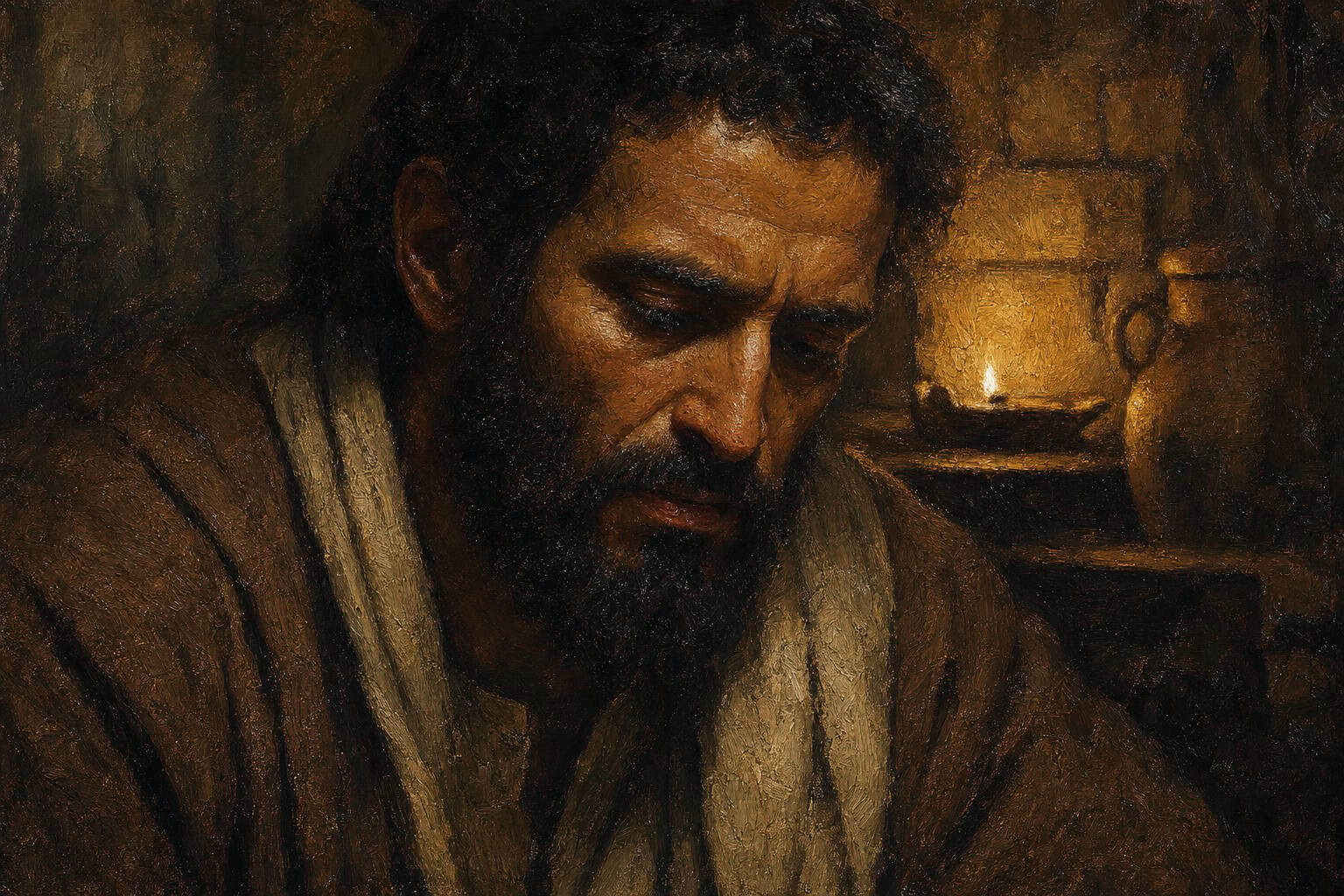
If you try to fail and succeed, the loss cuts twice. A hard, honest look at the traps we build to lose on purpose – and what breaks through.
The Ledger Written in Skin
You aim at losing, and the arrow lands. That is the strange grief you carried when you typed your question into the machine and waited: you tried to fail, and you succeeded, and now the win of your own defeat sits in your hand like a coin minted in a country that no longer exists. In Chapter 10 of Confessions to the Empty Chair, a man does this with the whole of his love life, and he does it with the cold care of a clerk balancing accounts late at night. He keeps a ledger, though it is not kept in ink. It is kept in bodies. He arranges his affairs so that no one woman can ever hold more than a fraction of him. Two, three, a rotation with its own quiet math – the spread is deliberate, and he knows to the ounce how much of himself each one is allowed. If no single face becomes the sun, then no single leaving can plunge him into night. He names this prudence. He believes it is a kind of wisdom won the hard way. He moves like a man who has walked every road the enemy might come down and set a guard at each one, and here is the thing that hooks in the throat: the plan works. He is never destroyed the way he most dreads. He never lets one person become the whole weather of his heart. The loss he built his whole life to prevent, he does prevent, cleanly, completely. But while he is busy winning that war, another thing dies without a sound. The very wall that keeps out the great wound keeps out the great gladness that only lives on the far side of risk. He has traded the terror of being left for the certainty of never being reached at all. He is safe the way a man locked in a dry cellar is safe – guarded, unrained on, and slowly forgetting what wind on the face feels like. The scene sits deep in the book’s long middle, where the narrator has begun peeling back his own defenses to count what they cost him, and he does not spare himself in the counting. He puts the blunt question to his own chest: did I shield my heart, or did I bury it while it was still beating? You feel the cold of it come off the page. A man who won every game he set up to win, and lost the single thing all the games were built to keep. That is where your question meets his, and neither of you is laughing.
The Woman Who Had Once Read His Mind
Into this careful ledger walks a rupture he never budgeted for. There had been a woman, and she had done the one thing his whole system was designed to make impossible – she had seen him. Not the body first. The mind. The strange interior country he almost never opened to anyone, the rooms behind the rooms. She had met him there, in the place where he was most himself and least defended, and for a season he was known, actually known, and the being-known undid the whole arithmetic at a stroke. You cannot dilute a person who has read your soul by adding more strangers to the count; she stood outside the math entirely, a single figure the ledger had no column for. And then, without warning, she rewrote the terms. What had been a meeting of two spirits she reduced, suddenly, to a matter of the flesh – as though all that seeing had only ever been the polite front for a transaction, a bill she now presented. He describes the shock of it with a precision that stings the reader who has felt it. This is a betrayal, he understands, that runs deeper than any unfaithfulness of the body could. A stranger who never grasped him could not have cut him here; there was no soft place in him a stranger could find. But she had grasped him. She had held the true thing in her two hands and then set it down like a cup she had decided was empty. The worst disappointments do not come from those who never understood us. They come from the ones who did understand, and then chose to forget. Sit inside the particular cruelty of that. To be seen and then unseen by the very same eyes is to be told the seeing itself was an error, that the man you became under that gaze was never worth the keeping. And the narrator, to his credit, turns the lens back on his own face. Did he ask too much of one woman’s attention? Did he make her gaze into an idol, so that the smallest faltering felt like being cast out of the garden? He does not let himself off the hook, and he does not let her off either. Both things stay true at once – his hunger and her failure, his idol and her cruelty. Here the full ache of the cast-out enters the room. He had raised every wall precisely so this exile could never happen to him again, and it happened anyway, through the one gate he had left standing open because he could not bear to close it. The lesson lands with the flat weight of a stone set on the chest: the wall against loss is only ever as strong as the single exception you let yourself love, and love, patient and merciless, always finds the exception.
The Amputation He Wore as a Medal
Now the turn, and it turns inward, into the place he least wants to stand. In the wreckage of that reduction, he catches sight of something in himself he has long carried as a private pride. Over years, over many beds, he has trained himself to sever the act of the body from the movement of the heart – to be fully present in the flesh and wholly gone in the soul, a man who can lie beside someone and be a thousand miles inland. He is not alone in this skill. The battle-worn men he knows wear the same trick like a decoration pinned to the chest. They talk about the power women hold over men with a curl of contempt in the mouth, as though needing another person were a sickness they had managed to burn out of themselves. They call it strength. They call the numbness mastery, and they toast to it. But the narrator, catching his own reflection in their hard faces across the table, sees the lie underneath the medal for the first time. The contempt is not strength at all. It is terror dressed in strength’s clothes. The scorn heaped on a woman’s hold over a man is only the dread of ever again needing anyone that much, ever again standing that exposed. What these men have done, what he has done, is not conquer the heart. It is cut a living piece of it away and then stand back to admire the smooth place where feeling used to be, mistaking the scar for a healing. This is the deepest failure hiding inside his glittering success. He set out never to be devastated, and he built, with great skill, a body that can no longer be devastated – for the plain reason that it can no longer be reached at all. He did not win peace. He won a numbness he called peace so he would not have to grieve what it cost. And the winning is complete, and the completeness is the horror of it, because a man who cannot be touched cannot be warmed either, and the cold he thought he had defeated turns out to be the very thing he has been busy manufacturing all along.
What we call strength is often just scar tissue grown so thick we can no longer feel what touches us.
The Starving Behind the Wall
Once the narrator sees the scar for what it is, he cannot unsee it, and the seeing is its own species of darkness. There is no rescue in this stretch of the book. No sudden hand reaches down to lift him clear of the ruin he engineered. Grace, when it arrives here, does not arrive as an exit. It arrives as company. He is left sitting in the dry cellar of his own defenses, and the presence he half-expected to come as an accuser comes instead only to stay – quiet, close, in the room with him and his failures, drawing up a place beside him. This is the harder mercy, and it is the truer one. The silent heavens do not reward his cleverness with an answer. The whole intricate machine he built to master his fear is shown, plainly, to be a false wall, an empty gesture flung up against the mere possibility of being hurt. And behind that wall, all along, was the one thing the wall was hiding from him too: he was starving. The bodies he gathered to spread out his need did not feed the need. The numbness he cultivated so carefully never calmed it; it only muffled the sound of it, the way a thick blanket muffles a man crying out. His careful, defended life shows itself as an empty gesture, a boundary he drew against communion that succeeded at nothing except keeping communion locked outside in the cold. He questions himself here without relief. Was each arrangement a small blasphemy – a way of trusting his own arithmetic further than he would trust any living, breathing love? Did he raise a fortress out of his own cleverness because surrender frightened him worse than a lifetime of loneliness did? He does not answer it cleanly, because there is no clean answer waiting to be found. The fallout of this chapter is not a tidy lesson learned and shelved. It is a man sitting in the wreck of his own winning, feeling for the first time the full size of what the winning cost, and discovering that the only warmth in the whole cold room is a presence that does not lecture him about the cold. The dread of standing outside all belonging does not lift off him. It is real, and it stays. But he is not alone in it. Someone has sat down in the dark beside him and is not leaving. That is not the healing he wanted. It is not the rescue he would have designed. It may be the only healing that could ever reach a man who had trained himself so thoroughly, so proudly, to be unreachable, a man who had bolted every door and then wept because no one came in.
The Hinge He Had to Stop Guarding
So come back to your question, the one that carried you here: if you try to fail and you succeed, what then? The book hands you no trick to run the tape backward. It hands you a mirror instead, and holds it steady. To succeed at failing is only proof that your fear was a competent builder – that you can, in cold fact, raise the very loss you dreaded plank by plank and then move in and live inside it. But the walls that keep devastation out keep everything out, and a life sealed tight against wounding is a life sealed just as tight against being loved. The intricate math of intimacy the narrator worked out to protect himself became the iron bars that real connection could no longer squeeze between. That is the quiet horror sitting under every clever defense a frightened person ever built. And yet the chapter does not shut in that horror, though it refuses to pretend the horror has vanished. What breaks in is smaller and stranger than any rescue. It is the discovery that the scars, thick as they have grown, are not the last word spoken over him. The wounds he had made into a self – the injuries he had half begun to worship, treating his own brokenness as the truest and most permanent thing about him – begin, slowly, under a patience not his own, to change. Not erased. Not explained away, not argued out of existence. But turned, tilted, so that a thin warmth passes through the very places where before there was only the dull grind of severance. He does not manufacture this turning. He consents to it, in the dark, with no consolation offered and no proof handed over first. That bare consent, given blind, is the whole hinge on which this book swings. If you have won your own defeat, Confessions to the Empty Chair will not clap you on the back and it will not lie to you about the cost. It will lower itself down beside you in the room you built with your own two hands, and it will point, without hurry, at the one plain thing you never made and never guarded – because you would have to loosen your grip long enough to see it was there the whole time. What waits past it, the narrator will not sell you cheap. You have to walk the rest of the chapter at his shoulder before you feel it give.