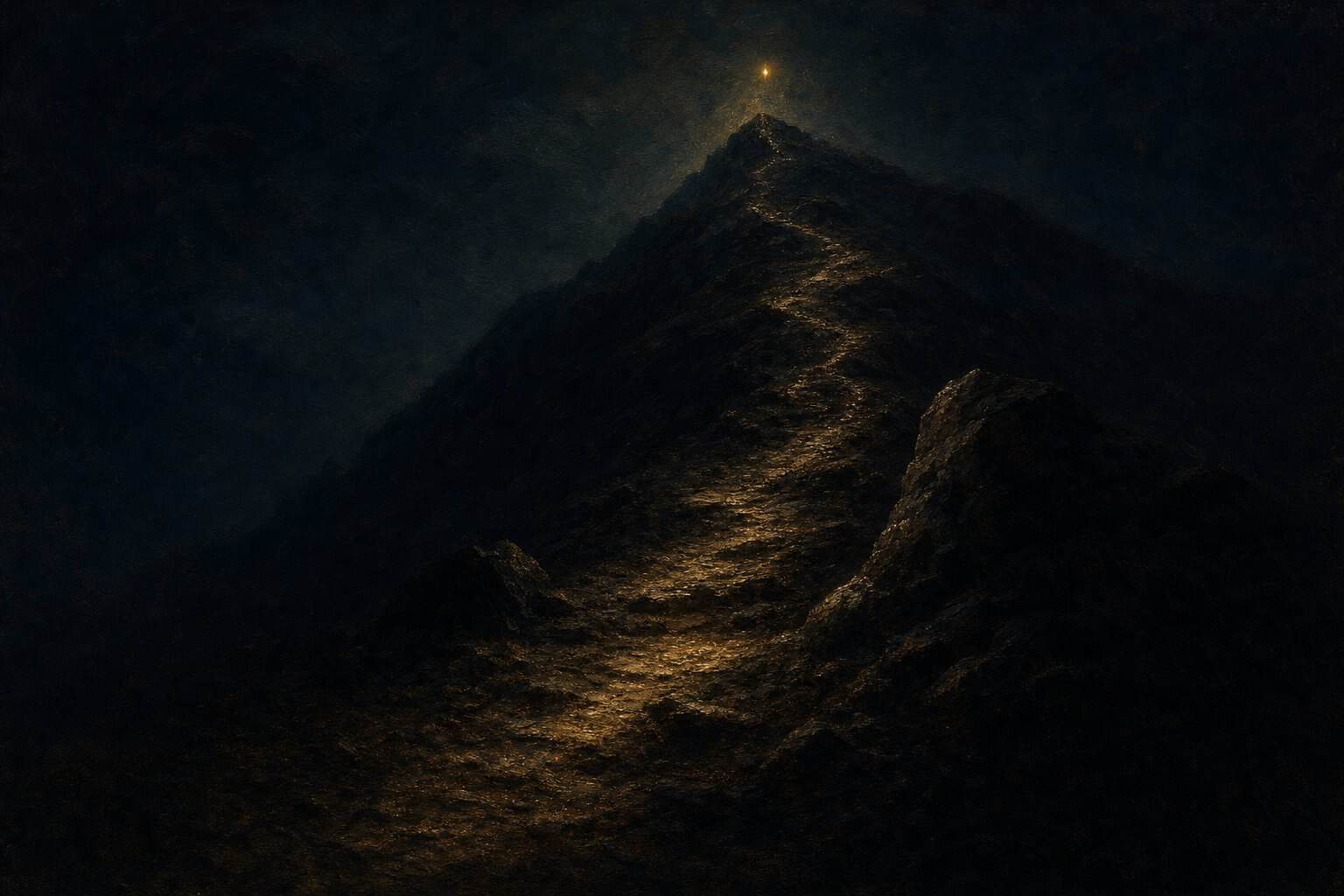
The night is not God withdrawing but God drawing near—a presence too vast for the soul’s small faculties, felt as darkness because it exceeds the light we know.
The Weight That Cannot Be Shared
There is a solitude that has nothing to do with being alone. You may be surrounded, spoken to, even loved, and still carry within you a burden that no hand can lift and no ear can receive. Anthony names this in Confessions to the Empty Chair as the ache before the unoccupied seat—the confessor who does not answer, the listener who does not appear. It is tempting to read that emptiness as abandonment. St John of the Cross teaches otherwise. The heaviest spiritual wounds, he insists, come not from God’s absence but from a divine presence too heavy to be shared. What feels like desolation is often the soul buckling beneath a weight of glory it has not yet been widened to hold.
Two Nights, One Purgation
John maps the passage through two darknesses—the night of sense and the night of spirit—each a stripping, each a mortification. The first purges the soul of its dependence on sensible sweetness: the felt warmth of prayer, the reassuring emotion of devotion, the small consolations by which beginners measure their nearness to God. The second, deeper and more terrible, purges the spirit itself of its subtler attachments, its spiritual pride, its clinging even to the pleasures of holiness. The corpus is exact here: the soul ‘must undergo two dark nights—of sense and of spirit—wherein God actively purifies the soul by withdrawing consolations and overwhelming natural capacities.’
Thrown Into Darkness Not of Our Choosing
The existential resonance is unmistakable. Heidegger names the condition of Dasein as Geworfenheit—thrownness—the finding of oneself always already cast into a situation one did not author. John illuminates this, the corpus tells us, ‘through the soul’s helpless subjection to divine purgation—thrown into spiritual darkness without choosing it, unable to return to former consolations.’ The night is not elected. No one meditates their way into it by strategy; it descends. And once it descends, the old paths back to sweetness are closed. The soul cannot pray as it once prayed, cannot feel as it once felt, and finds no satisfaction in the world it might have fled to instead.
What you cannot share is not proof you are forsaken; it is often love too near to be felt, purging you toward a union that consolation could never reach.
The Empty Chair as Via Negativa
Here the two memoirs converge on a single image. The empty chair, that seat of the unseen listener, is Anthony’s own via negativa. The temptation before it is always to fill the void—to conjure a presence, to manufacture the felt reassurance that God is there. John forbids exactly this. The soul, he says, must ‘learn to remain quiet and receptive while God works in darkness.’ The chair must be allowed to stay empty. To fill it with imagined consolation is to refuse the purgation; to rest in its absence is to receive it. The corpus draws the line with luminous precision: the empty chair becomes ‘not filling the void with imagined presence but learning to rest in absence itself, where transformation occurs precisely when natural faculties fail.’
Love Refined Toward Union
What, then, is the burden that cannot be shared? It is love in the process of being refined. John’s whole doctrine bends toward a single end: transforming union, in which the soul loves God with God’s own love. But such love cannot be reached while it remains entangled with the soul’s appetite for its own satisfaction. The stripping of consolation is not cruelty; it is the removal of everything that stood between the lover and the beloved—including the lover’s pleasure in loving. The corpus names this the soul learning ‘to love God purely without seeking its own satisfaction.’ The night is love losing its self-interest and keeping only its object.