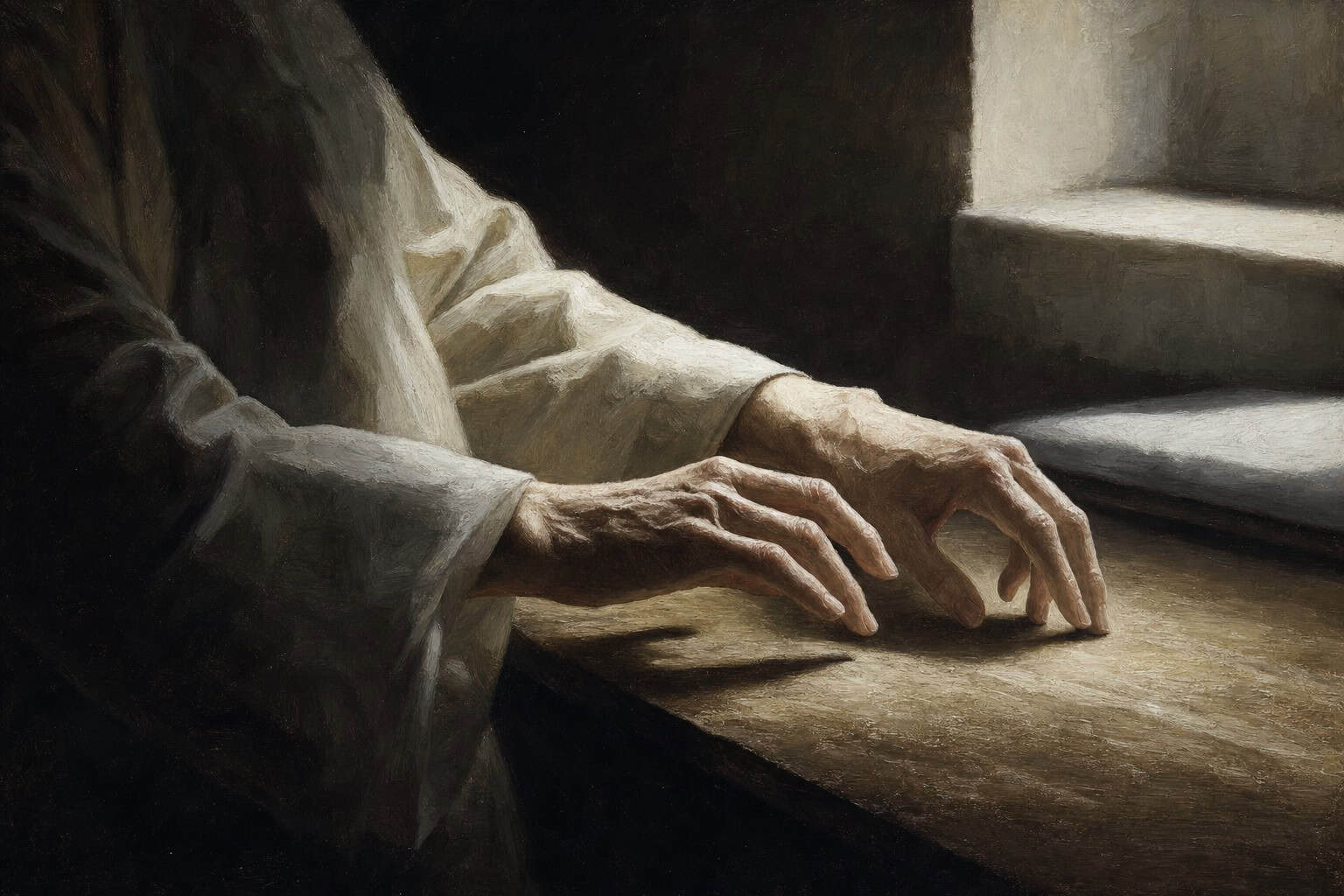
His palms search the grain for the cold seam beneath the warmth — the practiced hands of a man who always feels the leaving coming while the love is still in the room.
Hands Hovering Above the Table
His hands hover over the table as if feeling for seams in the grain, seeking that faint line where warmth gives way to cool. This passage stays close to one repeated act: searching for the instant a woman’s bright interest tilts, almost invisibly, toward retreat. Her face is still turned toward him, her lips still curved, but he is watching something else entirely—the slackening in her shoulders, the small pause before she answers, the way her fingers loosen around her glass. He is not guessing; he is tracking, like someone running fingers along a scar he knows is there, even when others do not see it. The scene lives in these micro-movements, the table between them becoming a quiet instrument that registers every shift in pressure. Before any goodbye is spoken, he has already marked the boundary in his body: the moment the air over the wood changes, and he knows he has entered the country of leaving again.
Drinking Faster Because the Glass Is Small
In this moment he makes a choice that would confuse most people: he leans in harder because he knows it cannot last. The knowledge that every human bond is finite does not cool his blood; it brings it to a boil. Where others reduce the pour to avoid pain later, he drains the glass more quickly, convinced that the brevity is exactly what makes the drink worth taking. The chapter lets this logic stand in its full severity: if endings are built into every story on earth, then timid engagement is not wisdom but refusal. He speaks more honestly, loves more fiercely, not because he believes this will save the relationship, but because he refuses to collude in his own half-life. The reckoning here is that time’s limit is not a reason to numb desire. It is the very reason to stop rationing himself like a man afraid of thirst.
Feeling for Cracks in Her Voice
As he burns brighter, another habit tightens: he listens for cracks in her voice the way a mechanic listens for trouble in an engine. Leigh laughs, answers, leans in, and yet his attention is split. Part of him is present to her words; another part is already out ahead, scanning for the first sign of withdrawal. He notices when her laugh lands a fraction late, when her gaze slices past him to the window before coming back, when the warmth in her tone flattens by a hair’s breadth. This is not simple paranoia; it is a skill learned in the hard school of repeated loss, and now it runs on its own. The pressure of the passage comes from that double movement: he is choosing intensity while simultaneously preparing for departure, feeding the fire and measuring the escape routes at once. Every shared joke contains its own forecast, calculated from the tiny fractures only he seems to hear.
The wounded heart becomes a cartographer of abandonment, memorizing the exact borders of a rejection long before it fully arrives.
When Your Heart Becomes a Seismograph
For anyone who has been left once too often, his behavior is not strange; it is familiar. The heart becomes a seismograph, registering tremors in others long before they call them doubt or boredom or fear. You notice the delayed replies, the faded warmth in a touch, the subtle way someone begins to speak about you in the past tense while you are still in the room. This passage names that alertness not as a quirky trait but as a whole way of moving through love: you believe endings are guaranteed, so you train yourself to predict the first crack. Yet that same training makes it almost impossible to rest in another’s presence. You sit across your own table—on dates, at family dinners, even in prayer—with part of you already flinched for impact. The question underneath for an ordinary life is cruel and plain: how do you stop living like a disaster you must forecast?
The Last Straw Set Down With Care
He does not wait for life to surprise him; he brings the strain himself, laying it gently across the table like one more straw on an already loaded back. A harsher truth, a more unfiltered glimpse of his devotion to God, an admission of the dark seams in his history—each is placed with deliberate care, then left to sit. He watches Leigh’s response as closely as he watches his own pulse: does her hand stay on the table, or does it retreat to her lap; does her breathing hold steady, or does it shallow by one small notch. This is how he tries to outrun the familiar script of being blindsided—by forcing the tension early, by discovering in advance which part of him is “too much.” The passage refuses to tell us whether the structure will snap or hold. It leaves us with his fingers resting on the table’s edge, feeling for the vibration that will tell him what kind of weight this love can bear.