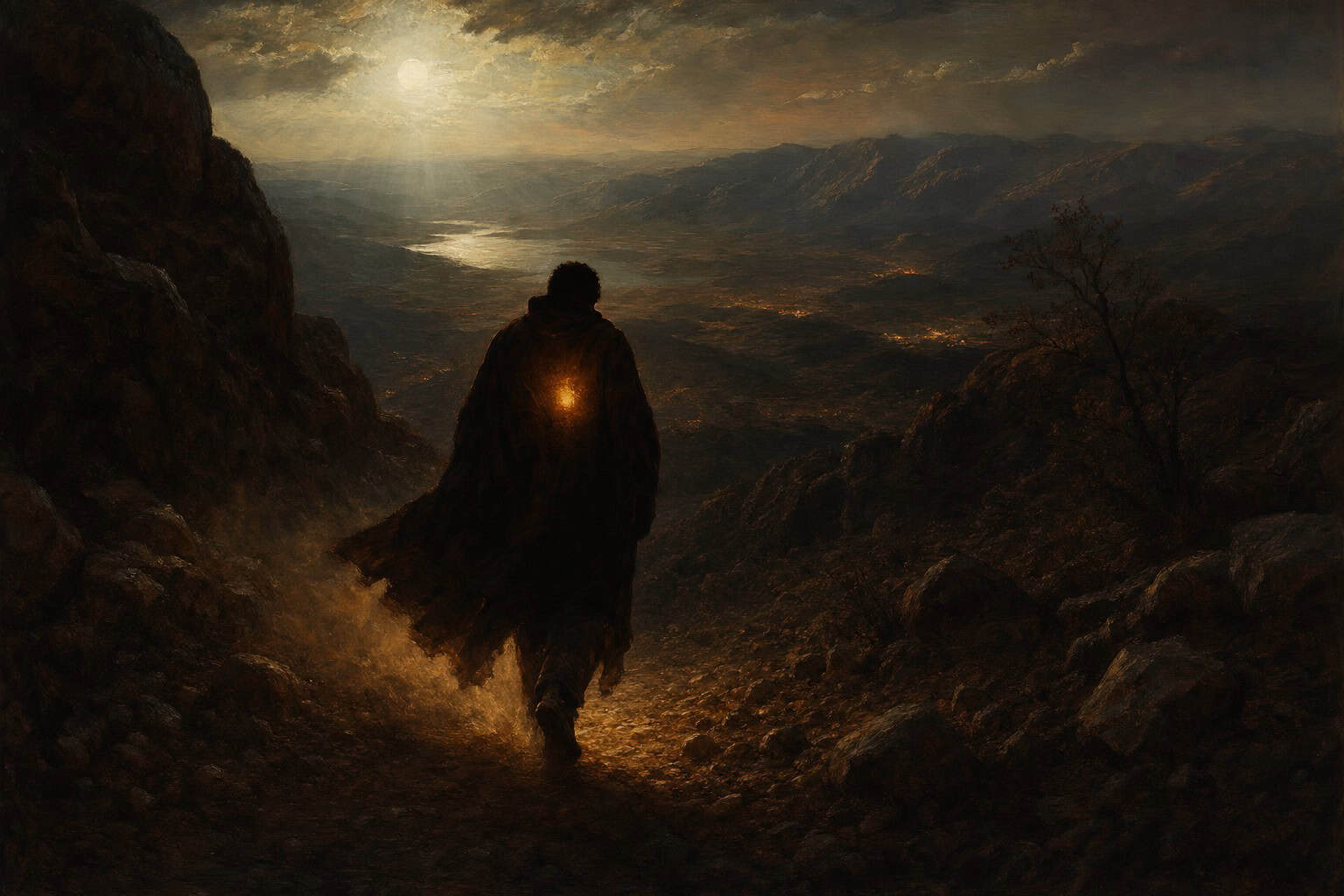
He walks on with dust on his soles and the memory of height still in his bones, asked to carry heaven and earth at once and to set neither down.
Dust On His Shoes, Light In His Bones
He is already walking again when this passage catches him, soles scraping against coarse ground that throws up small clouds of dust. His body remembers the height he has just left—the thin, bright air where God felt near enough to touch—but now his calves burn with the slope, and the valley spreads ahead with its errands, noise, and unpaid debts. The contrast is not poetic to him; it is felt in muscle and breath, in the way his shirt clings with sweat after what had felt like weightlessness. In his chest, something of that high place still glows, a pressure that does not match the scene around him. He does not get to stay where words came clear and time slowed; instead, he must carry that clarity into streets that do not care. The movement of his body down the incline becomes its own prayer: not escape from the world, not surrender to it, but a strange obedience to both gravity and grace.
The Unquiet Note Under His Ribcage
As he descends, there is a sound inside him that will not quiet, like a single note held too long on a violin string. It is not the gentle harmony promised in glossy homilies about conversion. It is sharp, almost proud, a piece of his old vanity that refuses to die even in the wake of such intimate touch from God. He feels it when he imagines telling someone about the height he reached, when his chest swells at the thought of being seen as holy. He hates that impulse and yet knows it is stitched into him, bound up with his quick intelligence, his hunger to matter, his very style of loving. This passage does not flatter him with the lie that grace has erased that note. Instead, it names the insult honestly: the same chord that once pulled him toward self-display now throbs under sanctity, unwilling to disappear, demanding its place in the new score being written with his life.
A Wire Pulled Tight Between Altar And Street
The strain becomes clearest when he feels both summons at once: the interior pull back toward wordless resting in God, and the rough tug of people, tasks, and history that will not pause for his prayer. His soul feels like a wire stretched between an altar and a crowded intersection, vibrating with every movement on either end. When he leans too far into stillness, faces drift through his mind—those who will not eat if he does not act, those whose despair he has promised to carry. When he throws himself into action, his chest aches with hunger for the One who called him higher, the One whose voice he heard in the thin air. Neither pull relents. The wire hums, almost painful, and there is no place to step that does not increase the tension somewhere. This is not balance; it is strain accepted, a decision to remain stretched rather than cut either side loose for the sake of comfort.
Holiness is not choosing between heaven and earth but bearing the weight of both at once, and never setting either down.
When Monday Morning Smells Like Incense And Exhaust Fumes
Anybody who has stepped out of a chapel and straight into traffic knows this collision in their own flesh. One hour you are kneeling, cheek still damp, air sweet with incense or candle wax; the next hour you are gripping a steering wheel, jaw clenched at the red light that will make you late. You have felt the shame of losing your temper five minutes after a whispered promise to belong to God, the sting of realizing your hunger for praise did not die at the communion rail. This passage insists you are not asked to choose between the chapel and the street. It suggests that your particular holiness may require you to carry the scent of incense into the smell of exhaust, to let the unhealed parts of you be drawn into service instead of hidden away. The ache you feel trying to pray and answer emails, love God and pay bills, might itself be holy ground, not proof that you are failing at both.
Metal In The Fire, Not Yet Hammered Flat
By the end of this scene, nothing is tidy. He has not solved the problem of his divided hunger, nor has God offered him a life of pure contemplation or pure labor. What he is given instead feels more like being held over a forge: heat from above, demand from below, the loud vein of pride still visible in the glowing metal. The consolation is that the fire is not random; there is a hand at work, though the pattern of the blows is not yet clear to him. He continues down the slope, dust rising around his ankles, that bright ache in his bones and the old dark chord still sounding under it. The shaping is unfinished, the wire still tight, the note still unresolved. For now, he walks with all of it, carrying a holiness that has not smoothed out his roughness, like metal cooling slowly under a sky that does not explain itself.