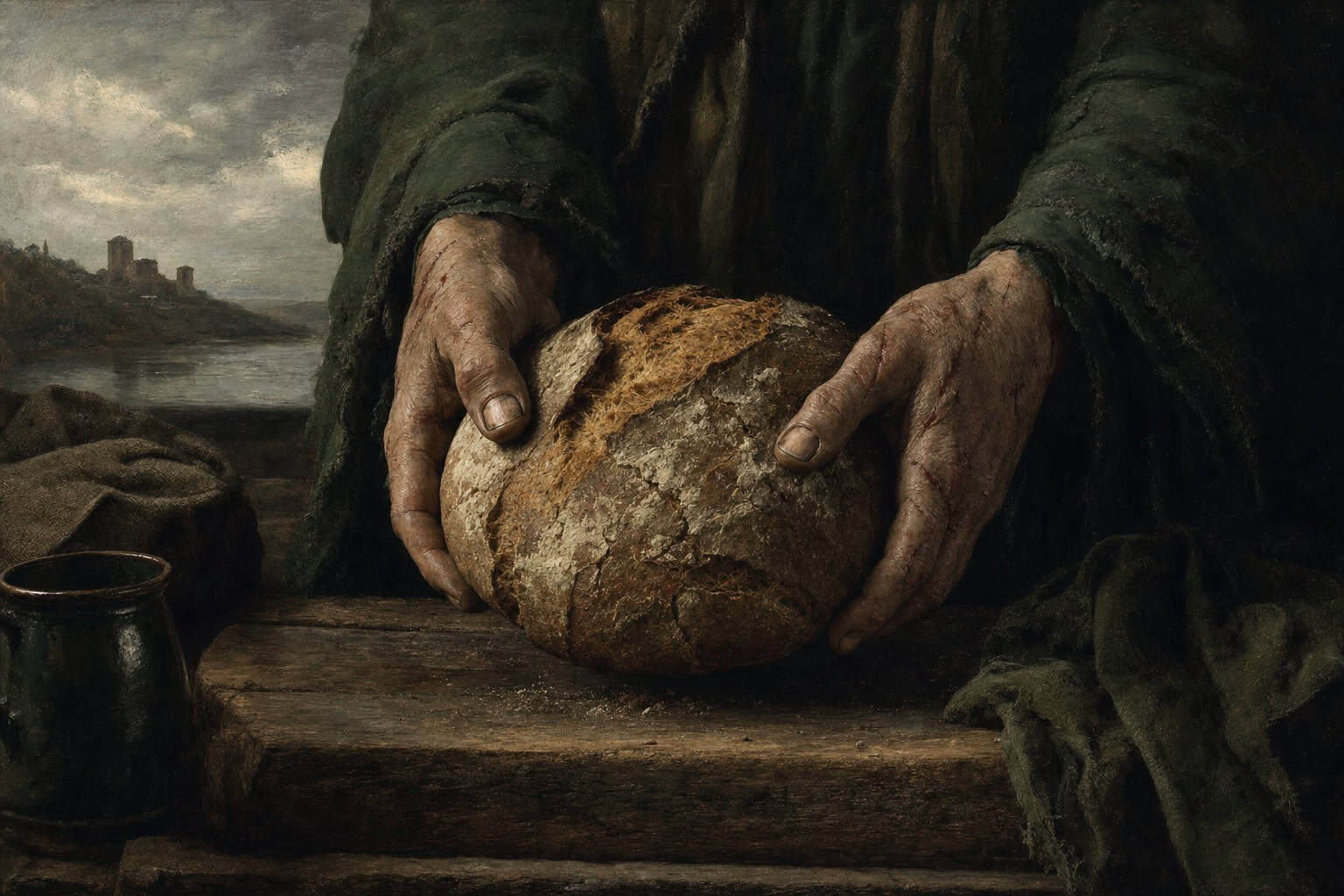
His hands tremble above a loaf that did not begin in him, and he learns the vertigo of every messenger: to give the bread and never hold its outcome.
Hands Hovering Over the Loaf
He sits with his hands almost trembling above an invisible loaf, aware that what he carries did not begin in him, yet now passes through his own scarred palms. The passage keeps circling this one act: he offers bread shaped from his years in shadow, bread soaked with the taste of his own story. He can describe the hunger that formed it, the nights that ground it, the quiet fire that baked it into something shareable. But there is a hard line he cannot cross. He cannot press it past anyone’s lips, cannot command teeth to chew or a stomach to receive. That helplessness is not a theory here; it tightens his throat as he remembers faces that stayed lean, eyes that slid away while his heart burned to give. All that remains in his control is the gesture itself: opening his hands, naming what has sustained him, holding it out without clutching for proof that it worked.
Flour Mixed with Ashes
The bread in his hands was not milled from happy grain. It was mixed from flour and ashes, from years where the only light came from fires that should have destroyed him. In this passage he names a quiet companion inside that took those ashes and did something he could not: turned private torment into food fit for another mouth. Without that hidden labor, his suffering would stay mute, a hard lump in the gut that feeds no one. Instead, those same nights become leaven, making the dark dough rise into something that can be broken and shared. He does not romanticize the pain; he calls it what it was—too much, too early, almost annihilating. Yet he recognizes that when the Spirit settles in that ruin, meaning begins to form like a crust over raw batter. The loaf he now holds is proof that even what should never have been can, under God’s hand, become bearable enough to give away.
Bread Offered with Bandaged Eyes
As he extends this bread, he admits his eyes are half-covered. He cannot see how far his words travel once they leave his mouth, cannot map the secret corridors where another person’s hunger lives. The passage leans hard on this confession: his story, even at its most illuminated, cannot become a strict diet for anyone else. What preserved him might choke someone with a different wound. He knows this, feels it like a stone in his shoe, even as he keeps speaking. So he chooses a strange posture—bold and hesitant at once. He names what has been given to him with authority, but he refuses to bind another soul to his path. The loaf leaves his hands as an offering, not an order. Behind that choice is a quiet terror: that he could misuse what was entrusted to him, that his own partial sight could harden into law and leave someone starving in the name of wisdom.
The one who breaks the bread cannot control whether it nourishes; we are asked to give the word and surrender how it is received.
When Your Loaf Lands on the Floor
Anyone who has tried to hand on hard-won truth knows the small thud when it drops, untouched, between you and the one you love. This passage speaks into that exact sound: the loaf landing on the floor of a teenager’s bedroom, a parish hall, a kitchen table where eyes roll or glaze over. You recognize the shape of their hunger because it once clawed at your own ribs, but your words fall heavy, dense as if the crust is too hard for their present teeth. Here, the text names both the grief and the command. You are not permitted to grind the bread into powder and spoon-feed it like medicine. You are not allowed to frighten them into swallowing. Love has to tolerate the sight of nourishment refused, of insight set aside like an unwanted plate. Yet you remain responsible to keep baking, to keep placing what you have learned within reach, even while you stand in the ache of watching it ignored.
A Loaf Cooling on the Counter
By the end of this passage, nothing dramatic has changed in the room. There is no rush of converts, no sudden understanding lighting every face he has ever tried to reach. What has changed is quieter: his stance toward the bread itself. He accepts that his task is to keep shaping this dark-earned dough, to let it cool where others can see it, to bless it with the sign of the One who first fed him and then step back. Some mouths will never taste it. Some will take a crumb and spit it out. Some will pocket a slice for years before daring a bite in some unknown tomorrow. All of that lies outside his grasp. His fidelity is measured not in results but in the steady work of kneading his own history with grace, again and again. The loaf rests on the counter between him and the world, still warm, still fragrant, waiting for hands he may never see.