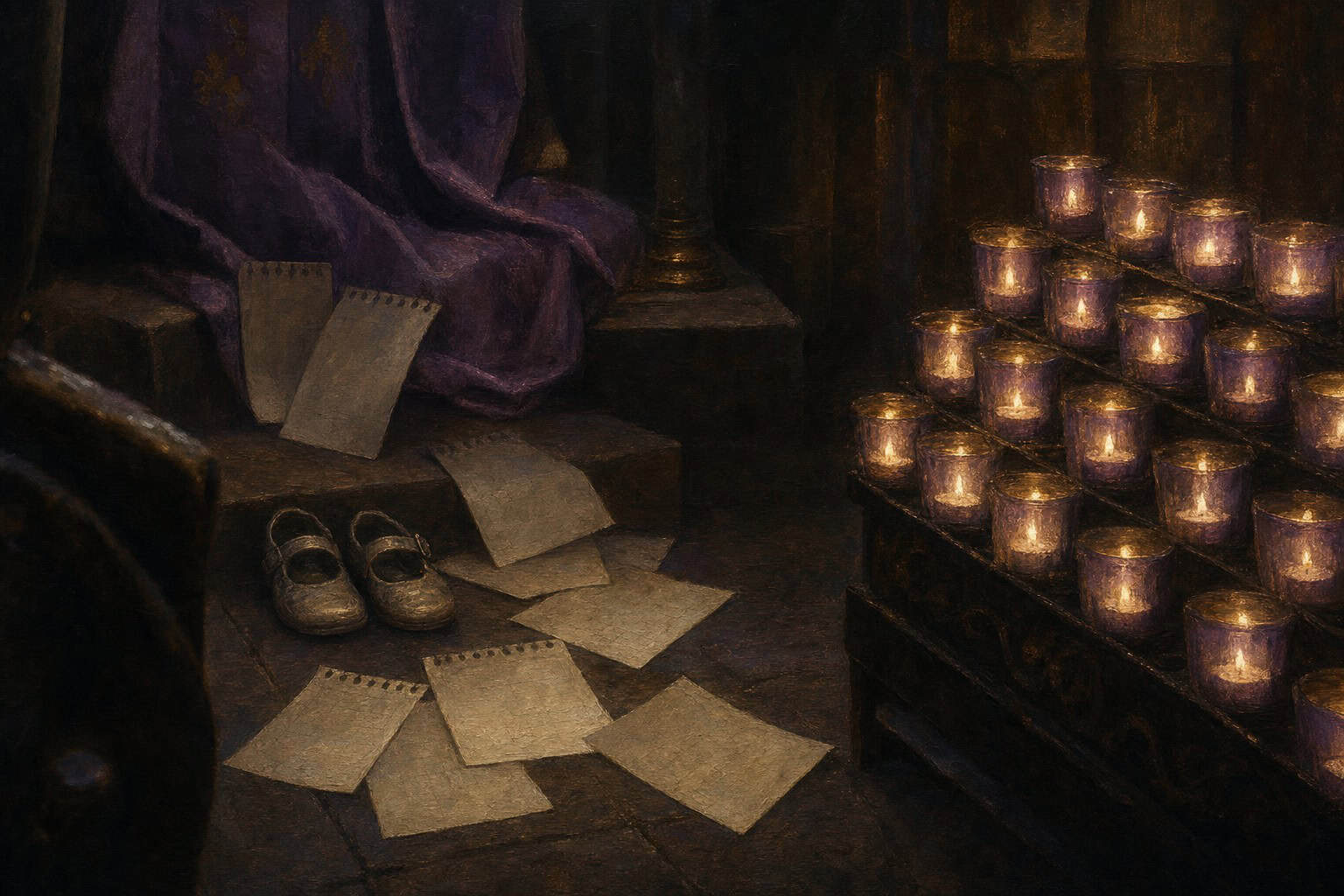
He lifts a box small enough for one man to carry and finds it heavier than any grave, freighted with all the years that will now never begin.
A Tiny Coffin Filled With Years
He stands before what should be impossible: a box small enough for one man to lift, heavy with a lifetime that never even started. In this passage, the father does not only see his infant’s still body; he sees a whole string of birthdays that will never be sung, school photos that will never be taken, late-night talks that will never unfold across a kitchen table. Every imagined scene lands in his chest like another stone, until the air itself feels thick. The moment narrows to simple, brutal facts—weight, wood, flowers, a name already finished. Yet beneath these objects rises a stranger arithmetic: he senses that what he grieves is not simply the days they had, but the decades they were promised. This is where the chapter lingers, inside that cramped, holy space where an eight-pound child somehow holds forty years, and the father is left balancing a future that now exists only as ache.
The Flood Behind the Nursery Wall
As he measures that loss, another realization presses in: this child had been holding something back in the adults around him. The narrator watches a partner, once busy changing diapers and managing feedings, now stripped of that urgent role, and the mask falls fast. Without bottles to warm and appointments to keep, all the delayed choices, avoided truths, and quiet self-betrayals surge forward. The baby’s presence had been a kind of wall—soft, innocent, and convenient—behind which one life hid from itself. Death smashes that wall in an instant. What looks from the outside like pure grief is, on the inside, tangled with the long-stored chaos of an unlived adulthood. Here the book refuses to flatter mourning: it will not call evasion devotion. In the emptied nursery, you can almost hear the roar within one surviving parent, realizing that what feels like drowning may not be only tears for the child, but terror at finally having to stand alone.
Skin That Carries Whole Histories
Underneath this domestic wreckage, the passage turns to the bed, to the way two adults once used flesh to keep from facing themselves. The narrator names how their touch was never just bodies seeking comfort; it was a trade in secrets, fears, and half-spoken promises. A hand on a shoulder after the funeral is no longer simple consolation. It drags old guilt into the open—nights when sex papered over resentment, moments when one body became a hiding place from hard conversations. Here, human skin refuses to stay neutral. Even in grief, desire flickers, and with it, shame: how can the body still want when the heart is crushed? Yet wanting exposes the deeper truth the scene circles: they were never just a pair of animals clinging together. Every embrace always carried mortgage notices, whispered arguments, private doubts, and shared dreams, all pressed into muscle and memory. In this chapter, touch itself becomes evidence that no part of a human life, not even pleasure, is free from meaning’s sharp edge.
The grief of a lost child is not only a body gone but the unbearable weight of every unlived day, decades of moments that will now never be witnessed.
Refusing to Build an Altar from Black Clothes
Into this tangle, the narrator speaks a hard command: do not kneel to grief as though it were the only truth left. He has seen how easy it would be for these parents to turn sorrow into a permanent costume—black clothes, dim rooms, every story circling back to the baby who died. The temptation is simple: if I never stop weeping, no one can say I failed my child. But that vow comes with a hidden price. When loss becomes a god, it demands sacrifice: friendships, marriages, work, prayer, even simple joy. The passage insists that mourning must bow to something higher, not the other way around. In Catholic language, that means placing grief inside a larger act of trust, however ragged. The narrator does not promise comfort or sense; he only refuses to call despair fidelity. Here the weight of the coffin and the heat of the bed meet a stark question: will this family serve love, will they serve the shadow of love twisted into endless self-punishment?
Learning to Breathe Beneath the Waterline
No tidy healing follows, only a harsher mercy. The narrator does not offer the parents a lesson to tidy the grave, nor a spiritual slogan to sterilize the bed. Instead he names what they are actually being asked to do: live on with this weight as part of their own spine, without letting it swallow their name. The father is not told to forget the unlived decades; the surviving partner is not scolded for the flood now breaking over her; their shared, complicated touch is not scrubbed clean. All of it remains, and yet they are forbidden to call any of it ultimate. This is the terrible permission the passage holds open: you may never understand this, and you are still commanded to remain human. To eat, to work, to pray badly, to reach for another’s hand even when that hand recalls every failure. The child is gone. The flood is real. The bed is still warm. Somewhere in that crowded, suffocating air, the next breath must still be drawn.