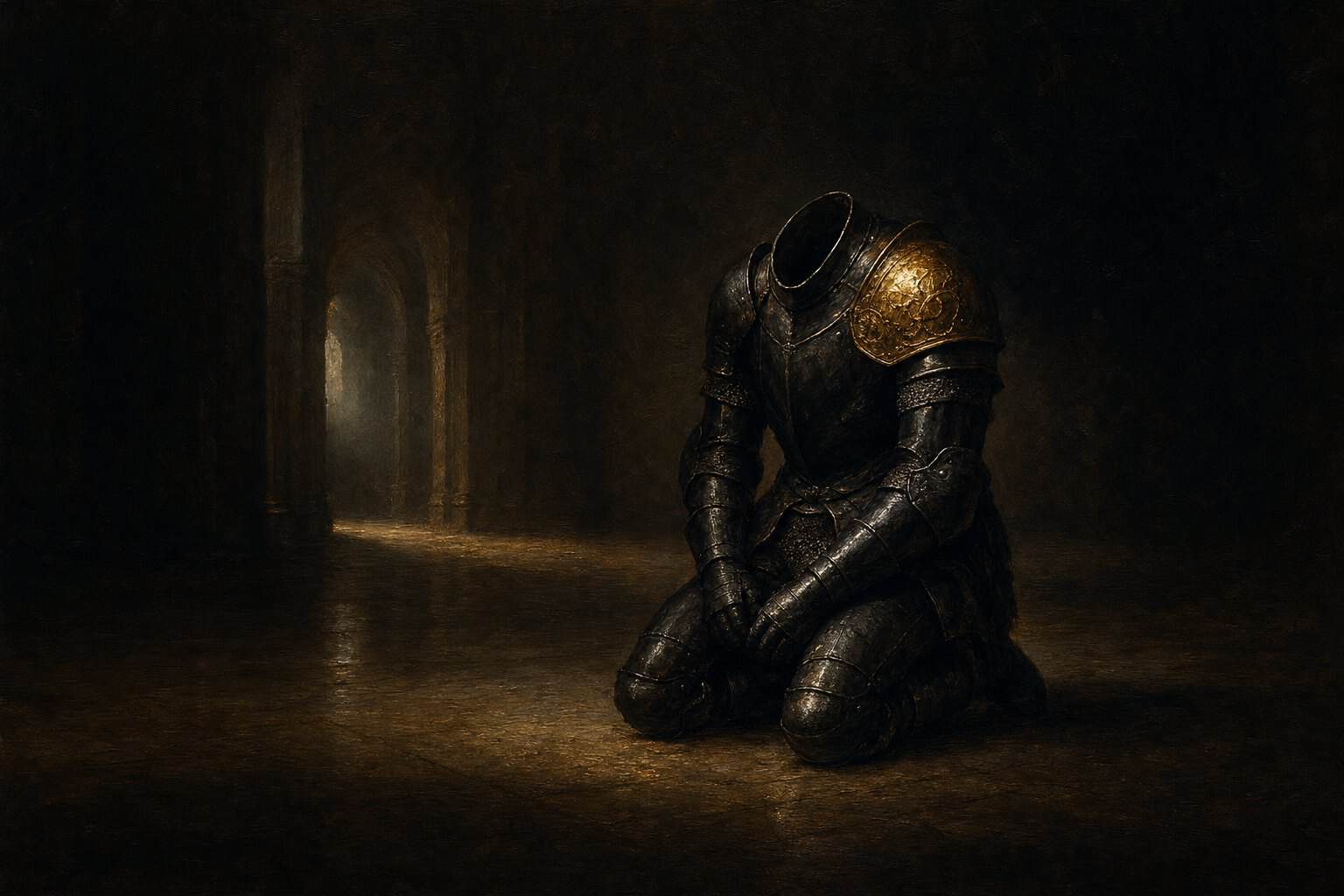
Before the empty chair, every mask you have ever worn is asked to answer for itself, and the armor you thought protected you turns out to be the wound.
The Waiter Who Was Only Ever a Waiter
Sartre begins his most famous illustration with a man serving coffee. Watch the café waiter, he says: his movement is too eager, his voice a shade too solicitous, his balance too exact. He is playing at being a waiter, performing the role with such devotion that nothing of him is left over. This is mauvaise foi — bad faith — the flight from the vertigo of freedom into the solidity of a role. To be a thing is restful. To be a fixed identity, a fate, a function, is to be excused from the exhausting labor of choosing oneself moment by moment. Yet the whole scene rests on a deception the man practices upon himself: he is never merely a waiter. He is a freedom that has agreed, for now, to pretend it is furniture.
Borrowed Armor
In Adoré’s memoirs the same flight has a different costume; he calls it borrowed armor. The boy who learns early that the household is not safe does not, at first, choose a self — he seizes a shape that will let him pass through the danger untouched. He becomes the good son, the unbothered one, the one who does not flinch. The armor is borrowed because it was never forged from his own interior; it is lifted from the expectations of others, worn precisely because it fits their gaze rather than his soul. And here Sartre’s insight cuts deep: bad faith is not lying to someone else. It is the strange feat of being simultaneously the deceiver and the deceived, the one who knows the armor is not the body and the one who has decided to forget he knows. The child survives by becoming his own most convincing liar.
When the Mask Learns the Shape of the Face
There is a mercy in armor and there is a cost, and the cost is patient. Worn long enough, the mask begins to warm to the temperature of the face beneath it. What was once a strategy becomes a reflex, and what was a reflex becomes, terribly, an identity. This is the peril Sartre names when he insists that we are ‘condemned to be free’ — that we can never actually become the thing we perform, however seamlessly we perform it. The waiter is not a waiter the way an inkwell is an inkwell. Yet the man in borrowed armor forgets this. He mistakes his performance for his essence and so surrenders the very freedom that could unmake the performance. In Fractions of the Soul this is the deep meaning of fragmentation: not that the self shatters, but that the self hardens into pieces it once merely tried on. The mask that fits too well is the one you can no longer remove without bleeding.
The armor that lets you survive the danger will, if worn too long, become the danger — for a mask that fits perfectly is a freedom quietly betrayed.
The Chair That Refuses the Performance
Husserl teaches us that consciousness is always consciousness of something — intentional, directed, reaching toward the world. Sartre inherits this and turns it toward the other: to be seen is to be constituted by a gaze, to become an object in someone else’s world. Bad faith is largely a management of that gaze, an arranging of the self to be received. But the empty chair, in Confessions to the Empty Chair, undoes the whole economy. It is a gaze that cannot be managed. You cannot flatter it, cannot perform for it, cannot borrow armor convincing enough to satisfy a listener who already sees beneath every plate of it. Before the unseen Listener the performance collapses not through argument but through exposure. The chair is empty of the human audience whose approval the armor was forged to win, and so it strips away the reason for the armor. What remains, trembling, is the freedom you had spent your whole life fleeing.
Post-Edenic Nakedness
Here Sartre and the Church converge in an unexpected clearing. The first gesture after the Fall is the reaching for a covering — fig leaves, then skins, the original borrowed armor. In Adoré’s post-edenic ontology the self is always-already fallen, which is to say always-already tempted to hide, to substitute a role for a soul, to answer the question who are you with a costume rather than a confession. Bad faith is thus not merely a philosophical error; it is the ancient flight from being seen naked and known. But the confessional turns the flight inside out. To sit before the empty chair and to remove the armor piece by piece is not to be destroyed — it is to discover that the freedom beneath the mask was never your enemy. It was the image of God in you, waiting for you to stop performing long enough to be loved. You are not the waiter. You are not the good son. You are a freedom that can, at last, choose the truth. And that choice, made in the open before the One who sees, is the beginning of a self no longer borrowed.