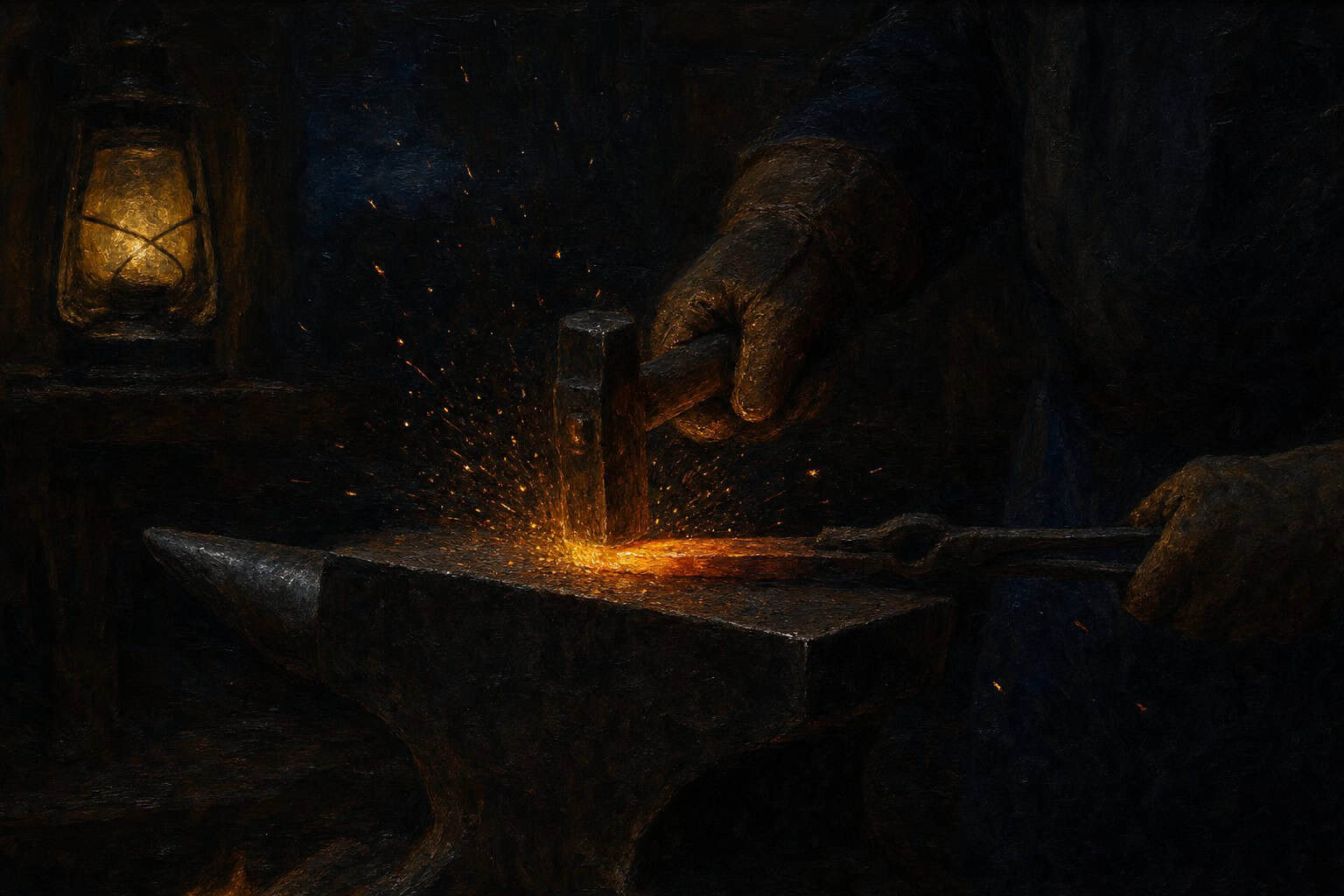
The forge turns him from gray to living red, and what he takes for abandonment is only the smith’s old rhythm — heat, then water, then heat again.
Metal Softens in the Red Glow
Heat comes first. Not a gentle warmth, but that thick, choking air around the forge, where metal turns from dull gray to living red. In this passage, the soul stands there, feeling that same softening in his own defenses as God draws near with real consolation. Prayer takes on weight, the sacraments taste like something, the heart loosens. Almost as soon as he dares to lean into it, the tongs lift. He is plunged, without warning, into cold. No feelings, no sweetness, just clarity that cuts. Back and forth it goes—fire, water, fire again—until he cannot tell anymore if he is being loved or punished. The blacksmith’s hands never appear as comfort; they show up as timing. When to heat. When to cool. When to strike. The body reads it as violence, the way muscles tense under each new impact, while somewhere under the pain a form begins to hint at itself, not yet named, not yet trusted.
When the Hammer Falls on What You Hide
Here the blow lands on a different place: not on surface habits but on the knot of pain he never invited. The text lingers over those who chase spiritual thrills—retreat highs, emotional worship, religious busyness—yet keep their rawest places sealed off. They want the warmth of the forge without the shaping of the strike. Christ’s hard saying about never having known some souls is heard in that light, not as a threat to the weak but as a mirror to the withholding. The soul in this section realizes that what separates false lovers of God from true is not the size of their sin but what they do with it. The hammer aims for the refusal itself, that stiff resistance that says, “Touch anything but this.” Under that impact, the pious mask rings hollow. The question pressed is whether he will let his ugliest patterns be welded to Christ’s suffering, or keep them as private fuel for another round of numbness and escape.
The First Blow That Landed Before Memory
The scene turns back before language, to the first shaping shocks that came long before any prayer. A child’s body registers a crossing it never chose: a hand where it should not be, a look that strips instead of shelters, a demand laced with threat. The passage does not dwell on detail for its own sake, but it refuses to tidy it. That early strike imprints itself like a bruise in the metal, buried beneath later polish. Years later, in the forge of adult faith, every descent into desolation brushes that hidden spot. He flinches, overreacts, shuts down, and cannot explain why the temperature of a room, the tone of a voice, a certain kind of nearness undoes him. The alternation of grace and dryness now presses against a bruise older than his first confession. This is not a new wound but a re-heating of old metal, the place where his history and God’s work collide, sending up sparks he still does not know how to read.
What feels like abandonment is often only the blacksmith’s rhythm; love shapes us by alternating fire and water, pressure and release.
Sparks in the Dark of Your Own Pattern
Read slowly, this passage refuses to stay on the page. It names the cycle many live in their bones: the binge that feels like fire, the crash that feels like water, the white-knuckled resolve that shatters under the next blow. You may recognize the same tight throat when someone touches a topic you avoid, the sudden rush to distraction when prayer edges near a certain memory, the way joy feels dangerous because loss seems guaranteed to follow. The text does not romanticize this; it calls it what it is—a life being shaped whether or not consent is given. Yet it also hints that the pattern you most despise might be the exact place God insists on meeting you. Not to excuse it, not to leave it as it is, but to fold it into Christ’s own descent. The stake named here is stark: either your pain stays raw material for another cycle, or it is laid on the anvil and claimed as matter for a different kind of fire.
A Blade Half-Formed on the Anvil
By the end of this passage, nothing is finished. The metal on the anvil is no showpiece; it is still misshapen, edges rough, surface scarred where earlier blows landed wrong. The alternation of heat and cold has not settled into a pattern the soul can predict. He has glimpsed, dimly, that the very darkness he carries from childhood is not an obstacle to divine love but its chosen contact point. He has not yet agreed to that fully. The dissonant music in him—the panic, the hunger, the strange mix of craving and disgust—still screams that if he yields it, he will vanish. What the scene holds open is the possibility that consent to love does not erase that music but tunes it. That the blade might, one day, cut in service of mercy instead of self-destruction. For now, the hammer hangs in the air, the forge breathes behind him, and the metal waits, humming with its own unfinished heat.