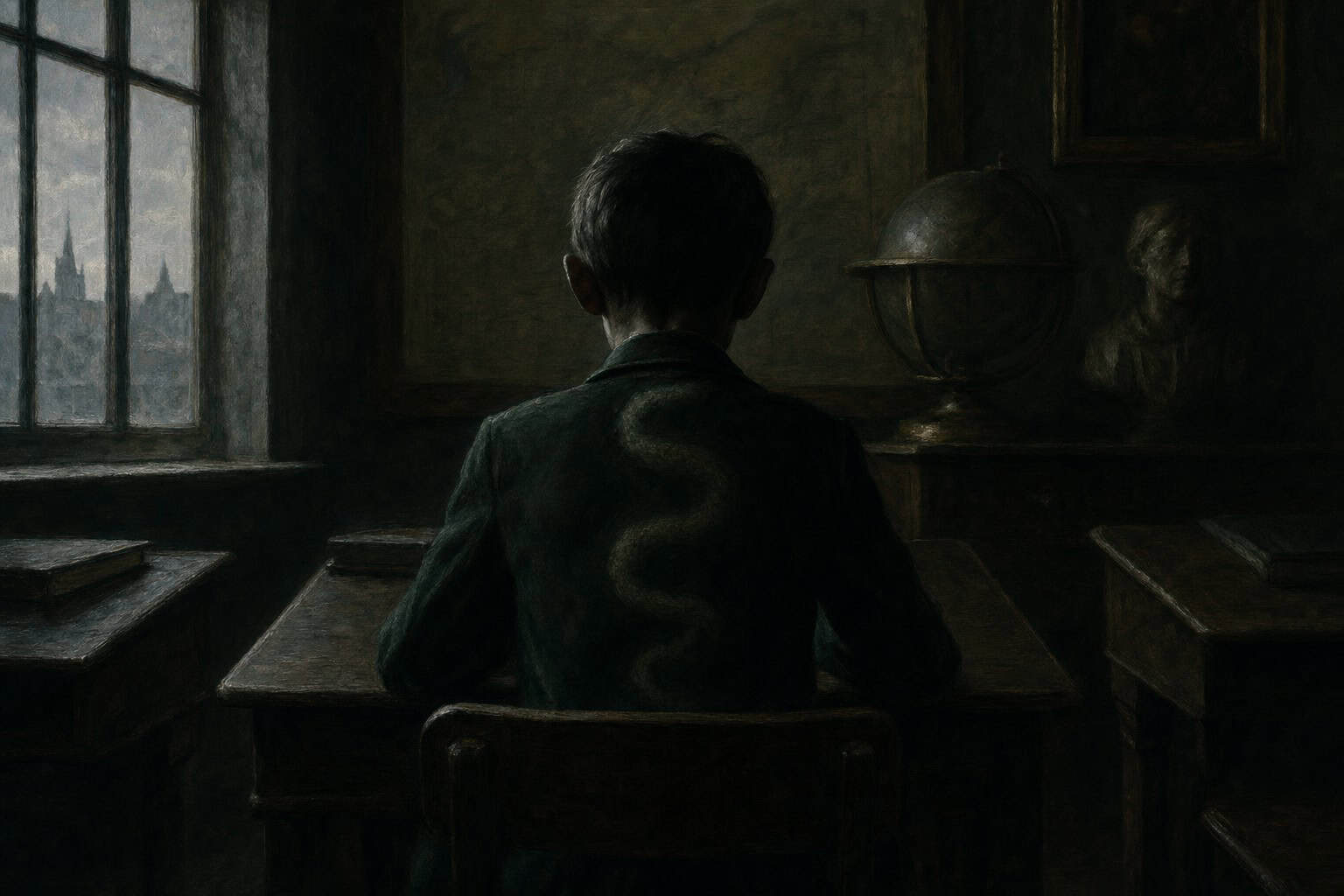
He is not in a church but in the dark with his own back on fire, an ache coiled along his spine since childhood, arriving at the hour when the poison once poured into him becomes the voice he chooses to speak.
A Spine Tightened Like a Coiled Serpent
He is not in a church; he is in the dark with his own back burning. The ache climbs his spine like something with its own intent, a tight, invisible coil that has lived there since childhood and only now starts to name itself. He speaks to God without script, words spilling out of a body that has carried more than it could ever say. What begins as a complaint about fathers and money and the way flesh was trained to kneel before wealth turns suddenly inward. Mid-sentence he notices the turn: his mouth is not repeating lessons imposed on him; it is defending them, savoring them, building arguments around them. The phantom weight along his spine feels less like an injury and more like a bone that never set right. In this passage the prayer itself becomes an X-ray, showing how a child’s borrowed slogans hardened into an adult’s own vertebrae, how poison once swallowed now holds him upright.
Meat Laid Out for the Worm
As he talks, the scene tilts from past to future, from family scripts to the slab. He sees his own body as if laid out on a metal table, pale under a single light, all the care and grooming and hidden indulgence reduced to meat waiting for the first soft bite. The image is not poetic to him; it is sickeningly precise. He can almost smell the sweet, rotting fat that comes from a life spent padding and protecting the self. The thought comes that death has a special appetite for those who anointed their bodies as small gods, that the grave tastes the difference between hunger and entitlement. In naming this, he indicts not only his father’s obsessions but the way he himself learned to love the feel of safety in his own skin, the buffer of privilege. Every luxury he enjoyed now appears as seasoning, every comfort as marinade, and the prayer edges toward a brutal honesty about what, exactly, he has been feeding.
Chalk Dust and Branded Skin
The image of the slab jerks him backward into a smaller body, legs swinging above a school chair, the smell of chalk and old paper thick in the air. He remembers the way a teacher’s eyes slid past him to rest warmly on the child with the right last name, the right house, the right car idling in the pickup line. In that moment, worth was not argued; it was assigned, stamped on foreheads by glances, by who got called on, who got forgiven, who got believed. He did not yet have words for “status” or “class,” but his skin understood. The memory presses into the prayer like a bruise being thumbed: he recalls the first time he sensed he was cheap in a room where others were expensive. Later he would learn to climb this crooked ladder himself, to read shoes and accents and use them. But here, in this passage, the focus stays on that first raw lesson, when respect stopped being an inner fact and became a currency printed by other people’s eyes.
There is a terrible hour when the poison poured into us becomes the voice we choose to speak, when we stop being victims and start being accomplices.
When Your Own Hand Tightens the Noose
Held between the cold table of his imagined corpse and the small desk of his childhood, he begins to see a line connecting them, and his own fingers gripping it. The realization comes without drama: there was a day, or maybe a hundred small days, when he stopped merely suffering the ranking of bodies and started enforcing it. He learned how to laugh at the right jokes, how to distance himself from the poor kid in the wrong shoes, how to enjoy being on the side that gets chosen first. The cruelty was never spectacular; it was ordinary, practiced in hallway glances and group projects and who sat alone at lunch. This is the reckoning the passage presses: that the serpent’s lesson is not only something done to him but something he began to teach by imitation, then by choice. Prayer will not let him stay only the wounded child. It forces him to own the adult who quietly tightened the noose around others to feel his own rope loosen.
The Taste of Dust on a Privileged Tongue
For anyone reading, the tension in his back and the vision of his body on the slab are not exotic visions but an accusation in common flesh. Most of us have a classroom like that stored somewhere, a first moment when we learned our place from the way a room reacted to us. This passage insists that such memories are not neutral history; they are blueprints we either repeat or resist. To keep blaming parents, teachers, systems forever is its own temptation, because blame feels cleaner than owning how we copied the harm and even enjoyed its benefits. The stakes are not only spiritual but physical: whose bodies we step over, whose hunger we ignore, how we decide someone is “not our problem” and walk away. When his tongue forms the words of this confession, it dries, as if dust has settled in his mouth. The sweetness he has chased all his life begins to taste like ash, and he is left holding that flavor between his teeth with no promise yet of water.