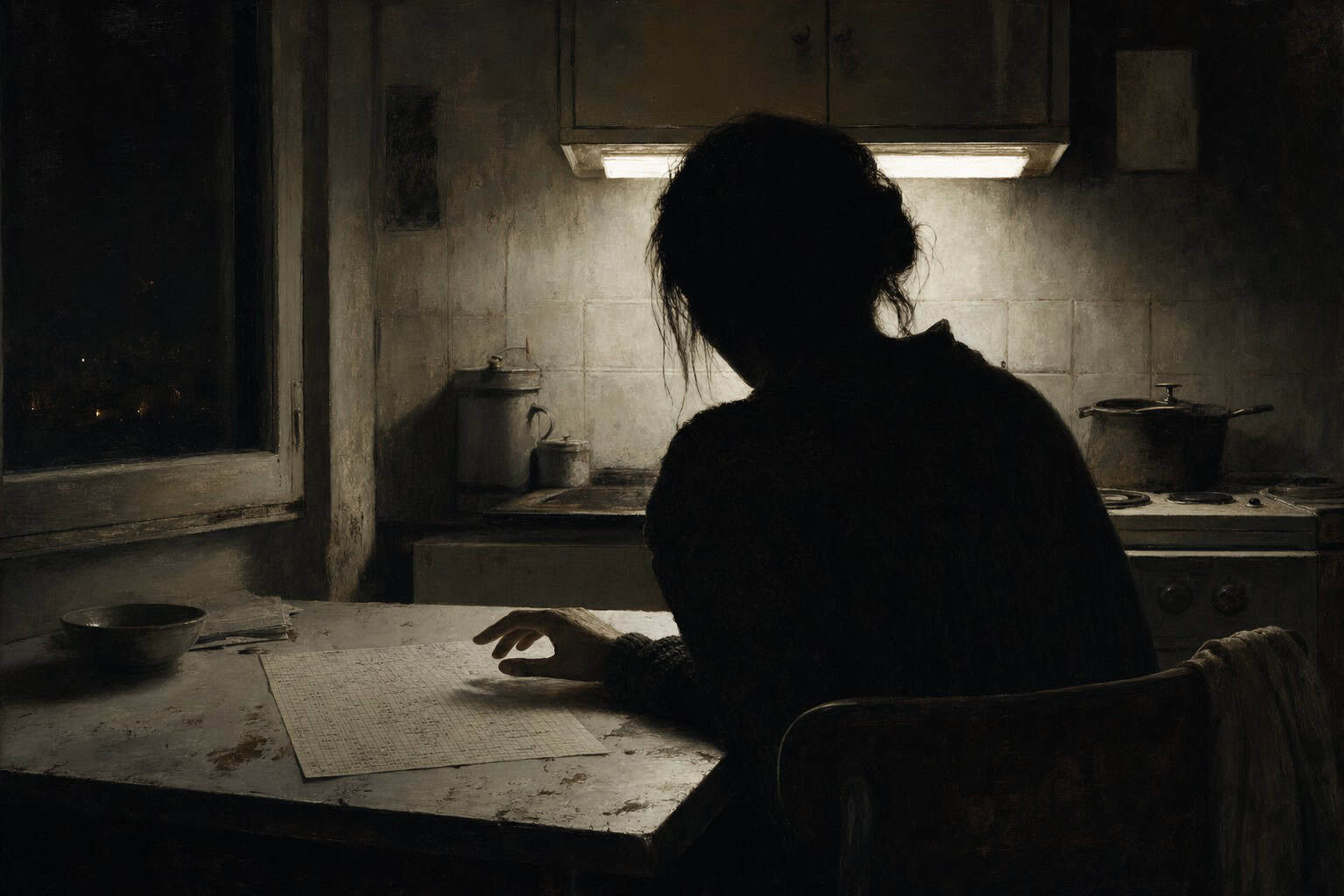
Ink pools in the groove of her thumb as she presses the pen too hard to the graph paper, a woman bent over a scarred kitchen table turning a husband into an equation, forgetting no soul was ever a problem to be solved.
Graph Paper Hearts
Ink pools in the groove of her thumb as she presses the pen too hard against the graph paper. A woman leans over a kitchen table scarred by years of plates and elbows, turning her husband’s day into columns and rows. The time he came home, the way his jaw tightened when she mentioned her coworker, how long he stared at his phone before answering her. Each mark lands like a small act of control, a hope that enough lines on the page will finally reveal the shape of his hidden life. This passage stays close to that gesture, to the way we try to map a living soul the way we might balance a checkbook. The coffee cools beside her untouched, a ring staining the margin, while she chases what cannot be pinned: the reason behind his silence, the secret behind his shrug. The dominant image here is simple and relentless: a hand tracing another person into numbers and notes.
When a Living Face Becomes a Chart
As the pages fill, something in her vision narrows. The man at the sink, rinsing a plate, is no longer a husband but a set of repeating values: late again, distracted again, polite again. The passage names this quiet violence without softening it—how the gaze that should receive a person instead flattens him into a chart. The familiar routines harden into a coffin made of expectations; nothing new is allowed to appear because any surprise would break the equation she is building. What feels like prudence—“I just need to understand him better”—rots into a fear of being wrong about him. The human idea under this scene is grave: to treat a free heart as a predictable object is not neutrality, it is betrayal. He reaches for a towel, she notes the speed of his movement, and with each scribble she risks burying the man under the diagram that wears his name.
The Cage of the Unblinking Eye
Her body pays the price for this constant measuring long before her mind will admit it. Sleep thins out; she wakes at 2 a.m., heart pounding, replaying the way he set his keys on the counter, wondering if the sound was sharper than usual. The text lingers on that tightening spiral, where every ordinary gesture is dragged under a floodlight. A pause before he answers becomes proof of disgust. A sudden kindness is flagged as compensation for some unknown guilt. This is the pressure building in the passage: the watcher cannot step outside her own gaze. Analysis, meant to give safety, becomes a kind of possession. The notebook swallows the house, but more terribly, it swallows her own freedom to respond freshly. Even her smiles turn strategic, little experiments to test his reactions. The graphite dust on her fingers is not neutral residue; it is the visible trace of a heart that no longer knows how to simply look without loading every glance with suspicion.
We gather the traces another person leaves and believe we can solve the equation of their heart, forgetting that no soul was ever a problem to be solved.
The Ledger You Keep Without Paper
You may never have pressed pen to graph paper, but your mind knows how to keep ledgers. You track how quickly a friend texts back, how often a spouse initiates touch, how many invitations go unanswered. No one else sees the columns, but you feel them every time you enter a room: the silent tally of who owes what, who has changed, who has failed the hidden test. This is where the passage reaches out of that kitchen and into an ordinary life, exposing how easily love turns into accounting. What begins as self-protection—“I just need to be realistic about people”—slides into a cold arithmetic that refuses to let anyone be more than their past entries. Underneath lies a deeper wound: a heart so used to being misread or abandoned that it would rather live inside its own calculations than risk being surprised again. The question presses hard here: how much of what you call prudence is actually fear scratching marks into an invisible page?
A Hand Hovering Above the Next Line
Near the end of this passage, the kitchen has not changed, the husband has not given a speech, no tidy revelation has appeared. What shifts is smaller and more dangerous: the slow, unnerving sense that the math will never close. The woman’s hand, cramped from years of writing, hesitates above the next line. The text lets that hesitation stretch, refusing to rescue her with a quick answer. If every action is a disclosure, then her own writing is one too—a confession of how terrified she is to be known without instruments, without graphs, without defenses. The theological edge cuts quietly here: a soul made for communion has settled for surveillance. Yet the pencil does not quite touch the paper. Somewhere between her pulse and the page, the legion inside her senses that this way of seeing cannot heal what it fears. The notebook stays open, the next square empty, while the sound of running water from the sink keeps time with a heart that has not yet decided how it will look again.