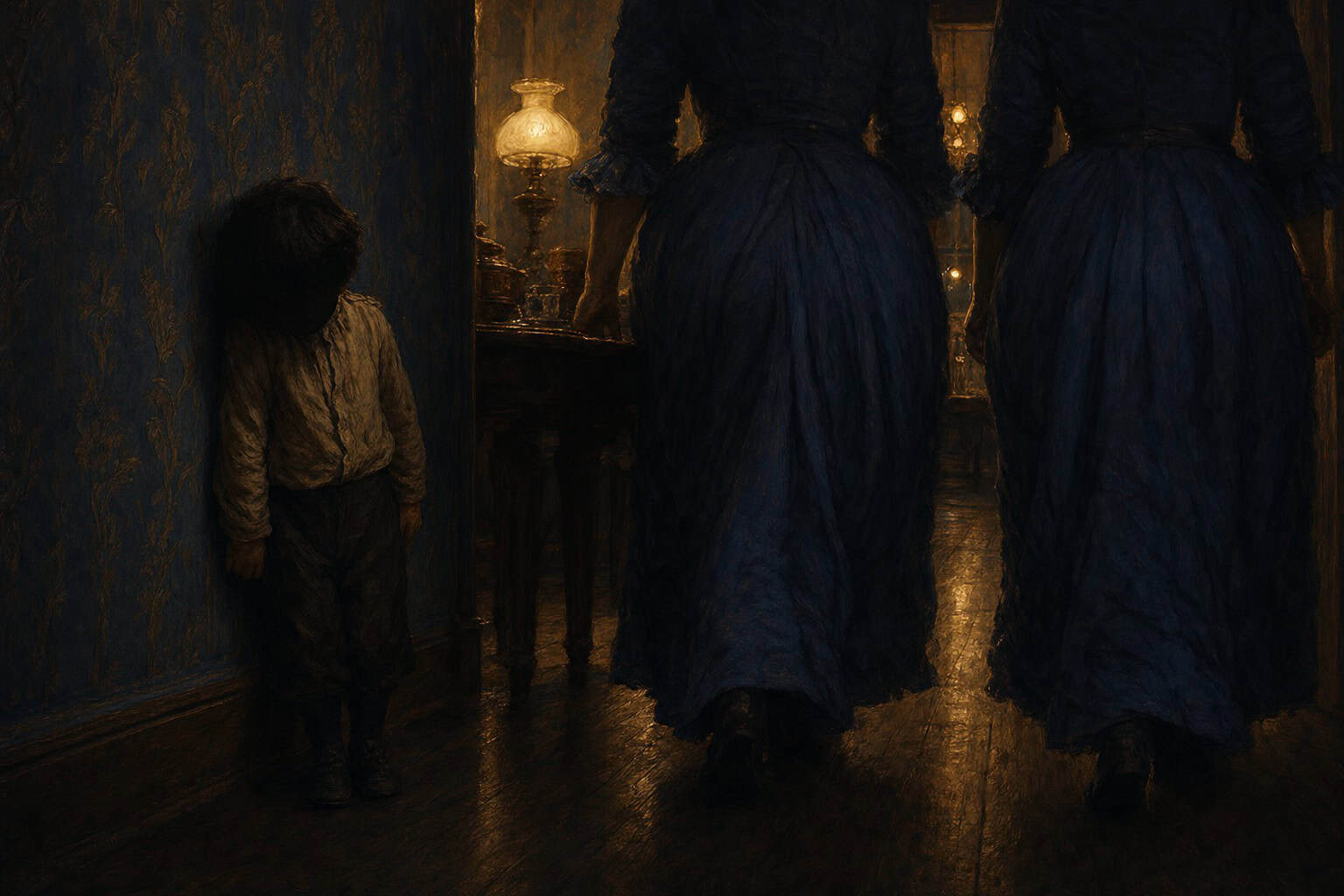
Thick hips enter first, long before any word of God, the matriarchs dropping into chairs that complain beneath them, while a watchful child maps the hungers hidden behind every face meant to keep him safe.
Hips That Claim the Floorboards
Thick hips enter first, long before any word about God or goodness. Fabric strains as the matriarchs lower themselves into chairs with a practiced drop that makes the wood complain, a small earthquake under small feet. Upper arms press against their sides, heavy and unmoving, turning the air around them into claimed territory. They do not simply walk into a room; they rearrange the available space, forcing the boy’s narrow body closer to the wall, into the seams between furniture. Their size has been learned and kept, layer on layer, like armor grown from the inside out. Every movement carries a message: you are small, we are not, and the world bends around our mass. He studies how a hip can block a hallway, how a shoulder can eclipse a window. Flesh itself becomes grammar, a full-stop at the end of any resistance. In that compression, the boy discovers that authority is not just a voice but a weight that can sit on your chest without ever touching you.
Wedding Rings and Hidden Altars
Beside these wide bodies stand men who seem to fold in on themselves, shoulders rounded, gestures clipped short. Their wedding rings shine, but the light does not reach their eyes. The women speak the language of virtue and empowerment, tossing out slogans about freedom and faith while their husbands nod like ornaments in the background. Yet the child’s listening stretches past the dinner-table speeches into the muffled nights, when a phone glows in a dark kitchen or a box of old letters is stroked instead of thrown away. There are names never spoken in daylight, memories tucked behind devotional statues, touches remembered but disowned. The boy notices the tilt of a jaw when a past lover’s hometown is mentioned, the extra salt shaken over potatoes when desire must be buried again. Publicly, these women preach surrender and spiritual renewal; privately, they burn incense on unacknowledged altars. He learns that hypocrisy is not just lying; it is loving two gods and calling it repentance.
The Quiet Boy’s Invisible Ledger
Pressed into corners, the boy begins to keep an invisible ledger. He does not write, but he records: which woman grows louder after the second glass, which man’s smile tightens when a priest’s name is spoken, which prayer meeting will end in slammed cupboards. His silence is not emptiness; it is storage. Every flinch, every forced laugh, every sudden change of subject is filed and cross‑referenced. He maps the distance between a hand lifted in blessing and the same hand clenching under the table. Even his own body becomes an index: the knot in his stomach marks one kind of danger, the heat in his ears another. Adults call him “so good,” “so quiet,” mistaking vigilance for virtue. They do not see the internal shelves filling with their inconsistencies, their broken vows, their rehearsed innocence. He is building, piece by piece, a private museum of the ways holiness can rot from the inside while the surface stays polished enough for Sunday.
A watchful child learns to read the hungers that hide behind authority, mapping the fault lines in those who were meant to keep him safe.
When Your Skin Becomes a Notebook
Anyone who grew up reading adults instead of storybooks will recognize this tightening of the nerves. Your shoulders remember the weight of other people’s storms before your mind names them. Like the boy, you may have learned to predict a blowup from the tempo of footsteps, to adjust your voice to match the most dangerous person in the room. This passage names that training for what it is: not maturity, not gift, but a childhood turned into a surveillance post. It shows how a soul that should be free to play instead becomes a secretary to other people’s secrets. And when faith gets pulled into this theater—when God-talk dresses up control, when confession becomes performance—the confusion sinks deeper into the bones. The body that is meant to be a temple of encounter becomes a scanner for threat, a notebook for offense and contradiction. The question hanging over these scenes is simple and brutal: once your very skin has learned to memorize danger, how can it ever relax enough to believe in tenderness?
Shelves of Secrets No Child Should Carry
The ledger does not vanish when the boy leaves those thick-hipped figures behind. The notes have sunk deeper, past thought, into reflex. New bosses, new pastors, new lovers are measured against the old catalogue, each gesture compared to stored entries he never meant to keep. He can see, with awful clarity, the sadness beneath the matriarchs’ armor, the hollow in the shrunken husbands’ compliance, and that very clarity chains him to their stories. Compassion becomes another weight: understanding the wound does not erase the bruise it left on his own spirit. Here the passage edges toward a harder terrain, where holy language must meet the raw fact that some of what shaped him was not accident but a kind of slow crushing. What he holds now is more than memory; it is a library of human distortion and half‑buried longing. How a man could stand before a burning love that asks for everything, yet keep these shelves intact, remains an unanswered problem—stacked high, dimly lit, waiting for a hand brave enough to begin pulling volumes down.