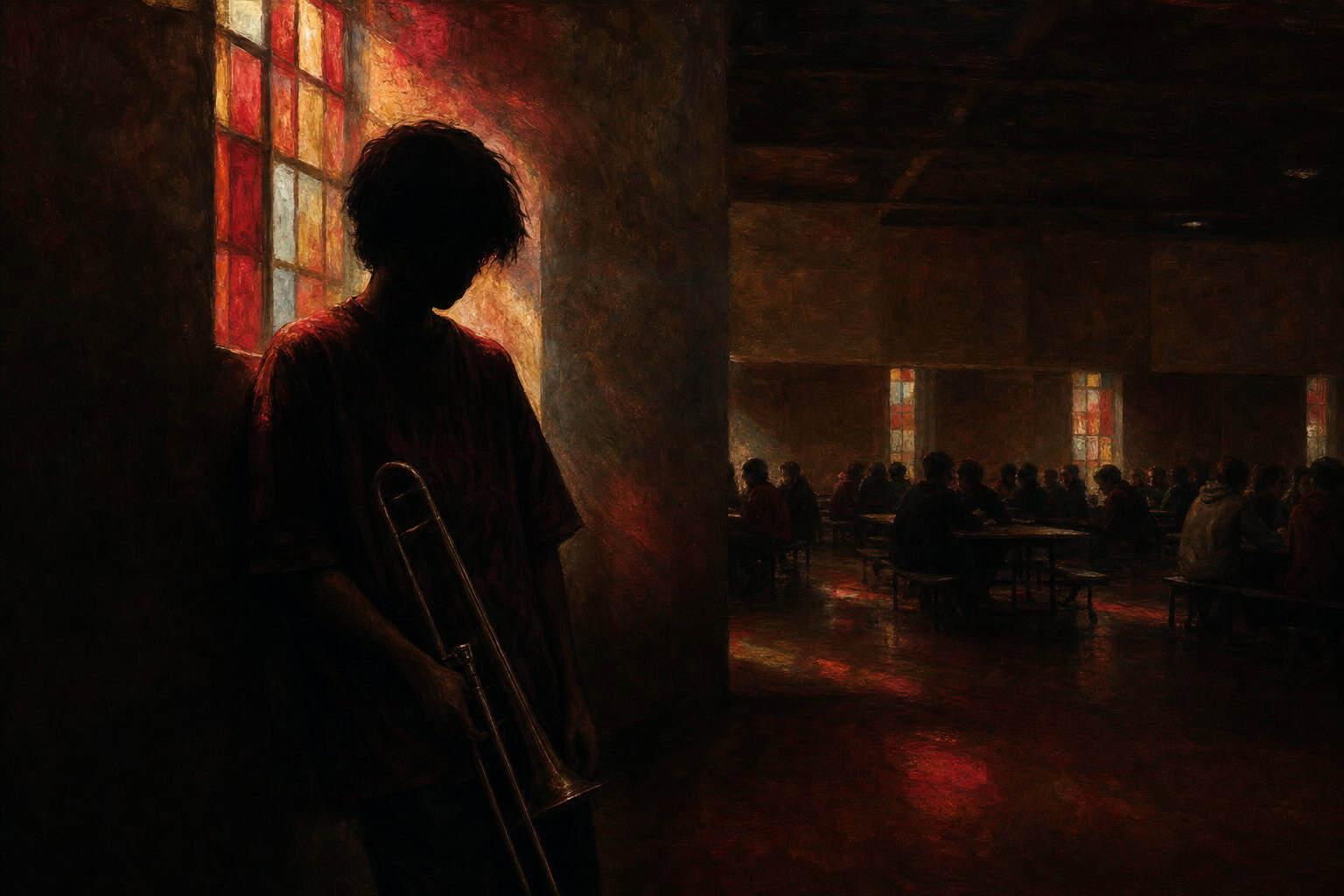
Junior high arrives like a new country thick with floor wax and cheap perfume and the heat of anxious bodies, and a wounded boy takes up his post at the margins, choosing invisibility as the safest place to watch.
Hallways That Smell Like Nerves
Junior high arrives as a new country, not a simple grade promotion. The air is thick with floor wax, cheap perfume, and the heat of a thousand anxious bodies pressed between lockers and bells. He enters carrying old humiliations like contraband, knowing a single familiar face from elementary school can reopen them in front of strangers. Seventh through ninth graders churn together, their bodies lengthening, voices dropping, breasts and beards announcing a season he cannot stop or slow. Locker doors slam like verdicts in a place where reputation is traded faster than anyone can learn a name. He practices taking up less space, shoulders rounded, eyes down, rehearsing exits and answers before anyone speaks. This chapter lives in that shift: from a small gifted program with known enemies into a vast, layered marketplace where worth is weighed by height, wealth, athleticism, and the stories others tell about your skin before you open your mouth.
The Trombone’s Heavy Mouth
At the center of the chapter is a single bodily choice: which instrument to hold between himself and the world. He signs up for band to dodge communal showers, not to make music, clinging to the thin cotton of modesty as if it were armor. Clarinet tempts him at first, inspired by smooth adult sounds from distant speakers, but the practice room reveals stricter laws. Woodwinds mean girls, gossip, and open hunger for the same small ring of high‑ranking boys. Brass means boys, sarcasm, and a rougher, simpler code. The weight of the trombone in his hands becomes a decision: desire will bend, survival will choose. Its slide drags and sings, lower and more commanding than his own voice, offering a gender-safe camouflage and a borrowed lineage through his father. The instrument does not just make sound; it grants him a sanctioned place to stand, a way to speak without being asked who he wants or who wants him.
Counting Shoelaces in the Cafeteria
Once his spot in band is fixed, the chapter widens into a map of the whole school. Old friends scatter—one to another campus, one to another city—and the boy is left with Doug and a sea of unfamiliar, average students. The cafeteria, bleachers, and hallways harden into separate territories: kickers in boots, jocks in school colors, preppies in clean logos, stoners in sagging denim, each orbiting its own music, slang, and saints. Girls cluster around the tallest, strongest, richest boys, forming a willing ring of waiting, trading gossip and touch like tickets for their turn. He watches the choreography from the edge, choosing tables by angle and distance, counting shoelace knots instead of meeting eyes. That small fixation captures the chapter’s mood: sight narrowed to safe ground, attention turned downward so nothing dangerous can be read in his face. From there, tribes become specimens, desire a pattern, and he begins to see the cost of every banner people raise over their own loneliness.
Long before he understood desire, the wounded boy learned to study it from the margins, choosing invisibility as the safest place to watch.
Beige Screens in Place of Faces
Threaded through this social map is a quieter, forming refuge: the glow of early personal computers. While classmates mine magazines, radio, and movies for identities to wear, he and Doug trade a cafeteria table for a desk with a beige box humming on it. These machines, clunky and rare, give him a place where rules feel written and predictable, where systems respond to inputs instead of moods. Band keeps his body covered; computers shelter his attention. The chapter hints at a shift from simple avoidance into construction: he is not only hiding from locker rooms and crushes, he is building alternate worlds in code and text, bulletin boards and private messages. The boy who once only flinched now records, categorizes, tests. Junior high’s cruelty is not softened, but re-purposed into a method of seeing. This is where his two melodies—wounded watchfulness and sharp, hungry mind—begin to arrange themselves into something like a discipline.
Mercy That Leaves You Hungry
The promise of this chapter is harsh and honest: it will not pretend that being overlooked is freedom. Invisibility spares him the sharper edges of ridicule, the nakedness of group showers, the exposure of failed flirtations. It is a kind of mercy to be forgotten by the clarinet girls and ignored by the tribal saints, a reprieve from the public theater of desire and dominance. But mercy like this makes poor company. It keeps him fed on analysis instead of affection, on patterns instead of touch. By the end of the chapter, he has learned to hoard distance like wealth, to choose the trombone’s loud voice while keeping his own quiet, to live at the edge of the cafeteria watching the kingdoms rise and fall. The book’s larger question—how a soul marked in childhood consents to love without killing its dissonant music—passes through this precise season where safety tastes thin, like air in a long fluorescent hallway.