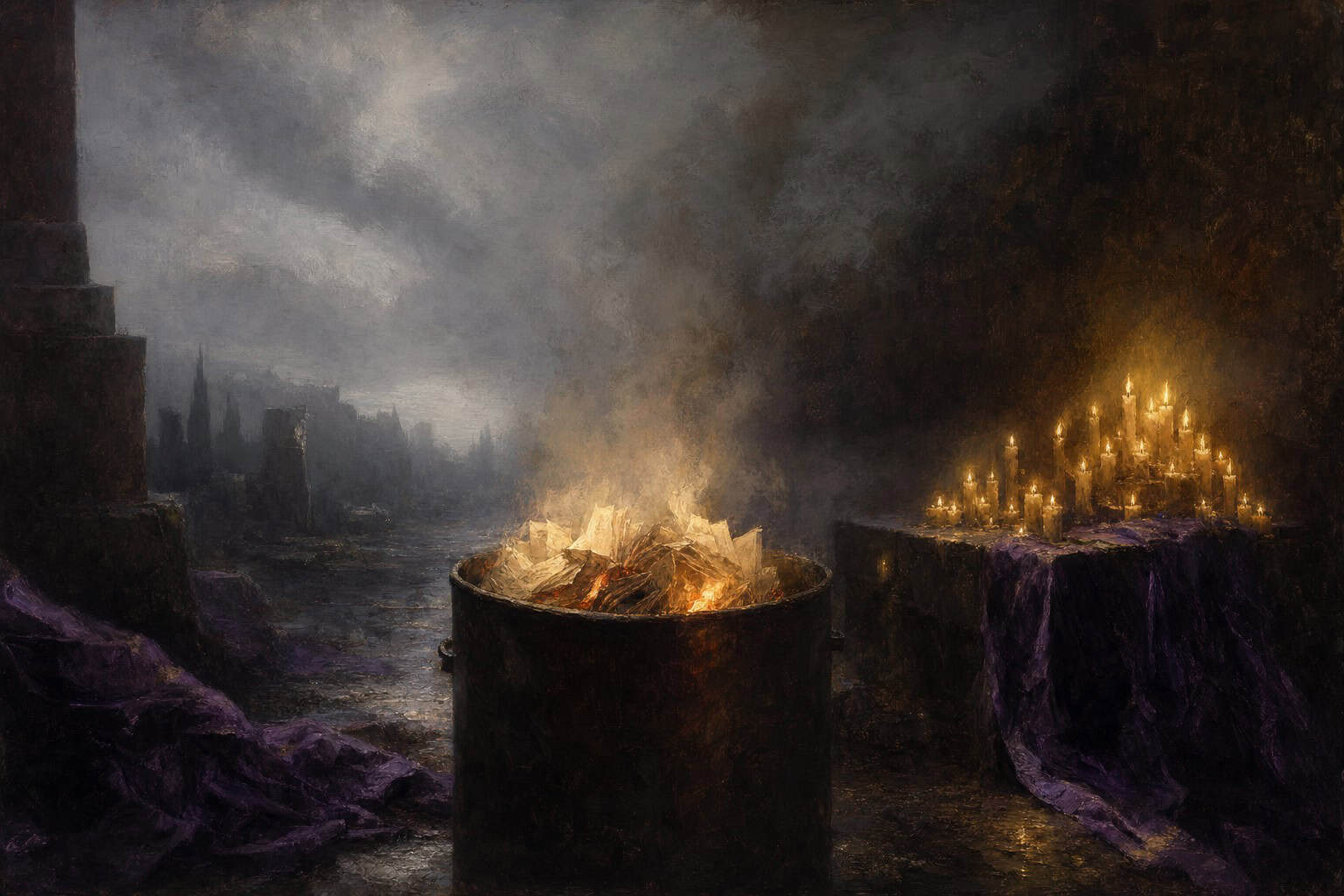
Folded pages thick with seminary ink go one by one into the mouth of a blackened backyard barrel, and he tends the fire like a man clinging to his own dissonant music because heaven, it seems, has taken the other side.
Ash Rising from a Backyard Barrel
A dented metal barrel squats in the backyard, blackened from old use, smelling of rust and past fires. Into its mouth go folded pages, each one thick with careful ink from seminary days, and the brittle palms once lifted high on a Sunday that named Christ as king. Fingers that once traced the chalice now strike a cheap match, hold it to newsprint, and wait for the orange bite. Heat blooms, paper curls, and the green of the blessed branches crackles into charcoal. There is no psalm, no chant, only the low roar of flame as confessions of love and vows toward the altar buckle together, turn black, and fall in on themselves. Smoke carries both offerings upward in the same gray breath. In this small, ugly liturgy, two different futures die in the same fire, and the only priest presiding is a man who cannot tell which loss burns worse on his skin.
Turning Her Face into a Cave Painting
While the barrel breathes fire, the mind goes to work with its own knives. Her face, once vivid with private jokes and shy glances in chapel corridors, gets flattened into a diagram from a textbook. She is redrawn as an early creature at the mouth of a cave, choosing the strongest hunter, following a script etched into bone long before vows or rings or altars. The word betrayal slides away, replaced with selection, adaptation, advantage. Every remembered softness is refiled: her listening becomes strategy, her tenderness becomes a calculated bid for security, her yes to another man a simple pivot toward better genes. It feels cleaner to see her this way, less humiliating than admitting she simply did not want him enough to stay. By shrinking her to a survival reflex, he tries to amputate the part of his own heart that had met her as person, not specimen.
The Silk Voice Beside the Flames
When the last letter blackens at the edges, the inner courtroom finally falls quiet. No more cross-examination, no more rerunning of scenes in the chapel parking lot or at the retreat house stairs. Into that raw clearing comes a different sound, as if someone has stepped just behind his shoulder. The tone is low, almost maternal, stroking the ache instead of probing it. She does not bother with arguments about right or wrong; she brushes against the burning with promises of coolness. Stop naming this as wound, she suggests. Stop lifting it toward any altar. Lay it down. Let the fire take not only the letters but the part of you that still believes love should cost you anything. Her cadence moves past thought and nests in the body, relaxing muscles, loosening the fists. The offer is simple: feel less, sleep more, drift into a long, practiced numbness while the barrel does its work.
When it seems heaven favors the one who betrayed you, the soul learns to cling to its own dissonant music just to keep from going cold.
Watching Blessing Fall on the Wrong Shore
Even as embers redden in the barrel, another scene runs parallel in his chest. He pictures himself thrashing in dark water, lungs full, arms heavy, while far off on a dry shore someone else stands under easy sunlight. That someone is the man who took her hand. Over that sunlit figure, God seems to lean in, pouring out consolations, new beginnings, warm assurances that the story will turn out well. From the cold water, it looks like heaven has chosen a side, and it is not his. Prayer in this moment is not ornate; it is closer to a held-back scream, a question without grammar. To love God while believing God has passed you over for your rival stretches the soul in a direction that feels like tearing. Underneath the theology, the plain thought surfaces: if this is how grace distributes itself, why keep your heart exposed to it at all?
A Vow Spoken to the Cooling Coals
When the fire finally dies down, only a skin of ash lines the bottom of the barrel, soft as talc, ready to smear on any hand that dares touch it. In that gray quiet, another decision hardens. If love can be computed like an animal instinct and providence can skip the drowning, then warmth itself begins to look like a rigged game. So he drafts a different kind of rule in his chest: offer less, expect nothing, keep every future bond on a short, measurable leash. Not wild vengeance, but measured distance—treating his own heart as a resource to be managed, not a gift to be spent. The mind that just turned a woman into an equation now turns its numbers on every possible intimacy. Somewhere beneath that calculus, another part of him still vibrates with the strange, off-key music that once reached for altar and marriage at once. Whether that dissonant strain will survive under the layer of ash remains, for now, as undecided as the wind that might scatter it.