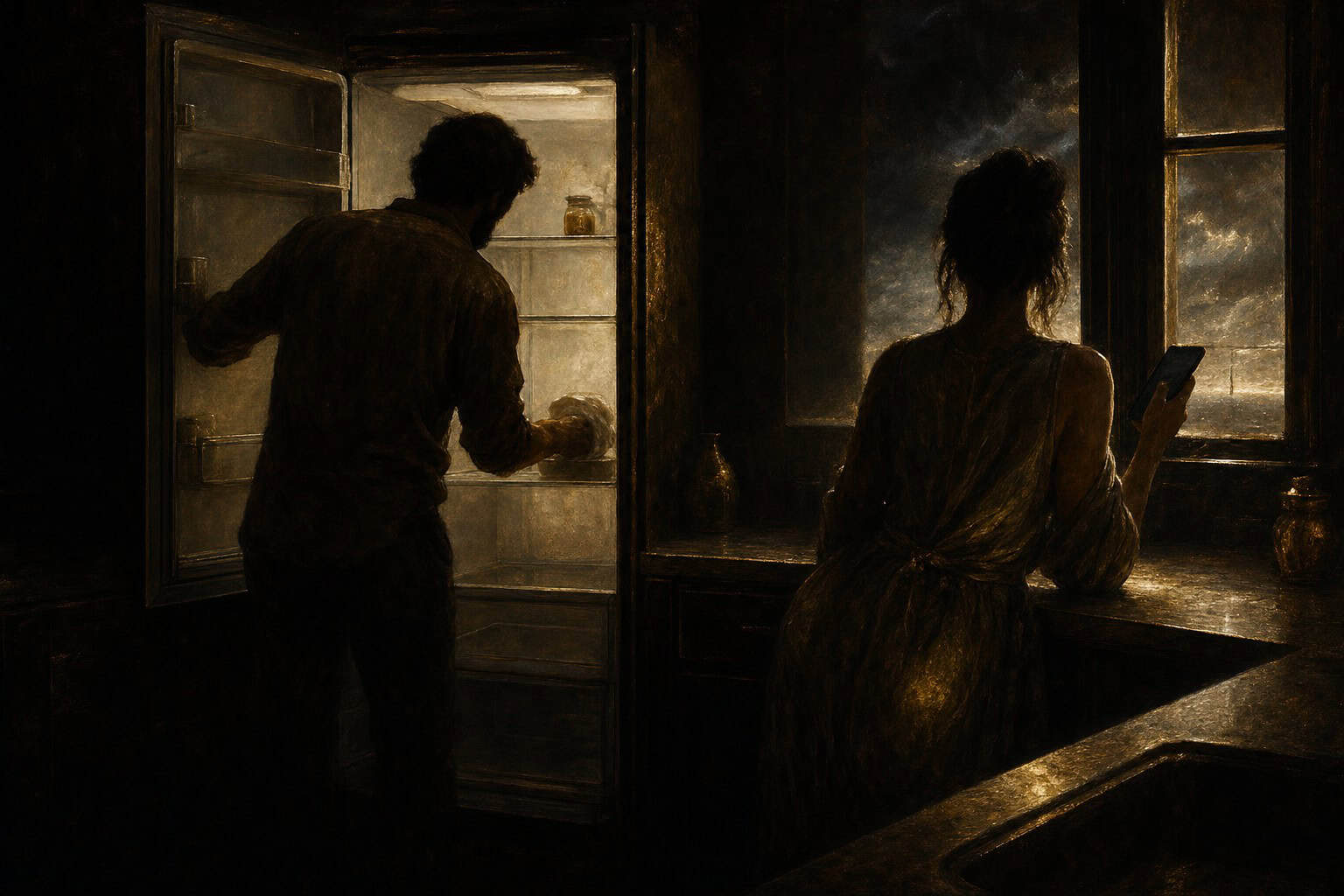
Plastic bags sweat on the counter as he restocks her barren shelves — the good coffee, the berries, a bottle of wine he will not let himself picture her drinking with someone else — devotion spent as the currency of his own erasure.
Groceries in an Empty Fridge
Plastic bags sweat on the counter while he bends to restock her barren shelves. Milk, eggs, meat, the small luxuries he knows she likes—berries, the good coffee, a bottle of wine he imagines sharing with her someday. Behind him, the faint light of her phone flashes as her thumbs move fast, her attention pulled somewhere he cannot see. He thinks he is filling her lack, repairing a week that has been hard, building a quiet future with every item he slides into place. But this passage names the harder truth: his gifts are already marked for someone else. The gas money he presses into her palm will carry her to another man’s street. The dress he buys will be ironed smooth for another man’s gaze. This is not simple cheating; it is a careful redirection, a whole economy where devotion arrives labeled “ours” and is spent as “theirs,” while he stands in the kitchen, surrounded by proof he will never be allowed to use.
The Sacred Word She Spends Like Small Change
She calls him her best friend, lets the word sit between them like a warm blanket that somehow never reaches his shoulders. Friendship, on her tongue, sounds pure and safe, a place where no one is owed and no one can complain of being refused. Yet the scenes here show how she trims and shapes that word until it becomes a tool. She leans on his shoulder after other dates go wrong, wipes her tears with hands he has just used to carry her boxes, takes his late-night drives, his emergency money, his patient listening. Each favor is folded into a story of “just friends,” an arrangement that keeps him close enough to harvest his steadiness but far enough that he cannot accuse her of deceit without sounding ungrateful. The hierarchy is invisible yet exact: some men receive her painted mouth, others her unguarded complaints; he receives the labor of a lover and the access of a stranger.
The Panic That Turns Affection into Hoarding
Beneath the polished exchanges, the chapter lets something raw bleed through: she is not only calculating; she is afraid. Not the quick fear of a sudden noise, but the old, bone-deep terror of being dropped and never caught again. Once, love vanished without warning, and her body remembers. Now, every man becomes a spare tire, a backup generator, a second refrigerator filled in case the first one fails. She cannot risk depending on a single heart; the thought feels like standing at the edge of a cliff with wind at her back. So she stacks people the way some stack canned food, each one labeled for a different kind of hunger—attention, protection, status, touch. The taking looks cold from the outside, but from inside her chest it feels like survival. Still, the passage will not excuse her. It holds her terror and her theft together, refusing to let one erase the other.
There is a betrayal deeper than infidelity: when your sacrifice quietly funds someone else’s romance, and your devotion becomes the currency of your own erasure.
When Your Labor Sets Someone Else’s Table
Most readers do not move through a carousel of suitors, but the pattern here is uncomfortably familiar. You have stayed late at work so another person could shine in the meeting, their praise resting on your unseen effort. You have listened through the night to someone’s heartbreak, then watched them rise in the morning and dress for the very person who keeps wounding them. Or, more quietly, you have accepted rides, meals, and loyal attention from someone you knew you would never truly choose, telling yourself that your honesty about “just friends” was enough. This passage forces a harder naming: where have you allowed another’s sacrifice to underwrite the intimacy you offer elsewhere? And where do you keep paying into a bond that never matures, praying that one more favor, one more stocked fridge, will finally buy you a place at the table you keep setting for others?
The Cart That Never Reaches Your Own Stove
The economy described here has its own cruel physics. His offerings pile up—receipts, text histories, late-night drives—but never convert into the one thing he longs for: freely given, undivided affection. Her network of lifelines grows thicker, yet the hole in her chest does not shrink; it yawns. Each redirected gift increases the pressure she must manage, each half-promise adds another strand to the web she has to keep from tearing. No one can admit the truth without threatening the entire structure. The man risks facing that his cart of devotion has never once been cooked into a shared meal. She risks facing that her careful hoarding has not prevented abandonment so much as rehearsed it in slow motion. The chapter leaves them there for now, standing in a kitchen crowded with full bags and unused ingredients, the air heavy with meals prepared for mouths that have not yet arrived.