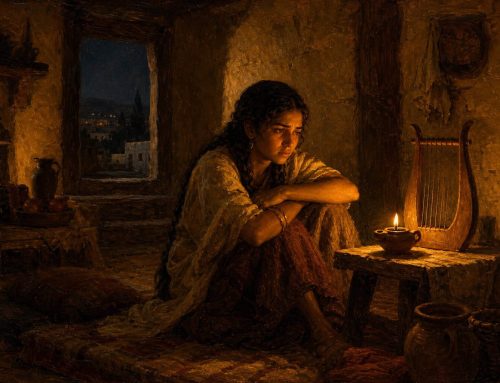
He grips a stem of cheap glass at the edge of a Roman courtyard while laughter rises bright as the chandeliers and reaches him as if through water — a breathing man watching the living feast.
The Wineglass Held Like a Shield
A stem of cheap glass anchors him to the edge of a Roman courtyard, fingers damp from the sweat of the bowl. Laughter spills and rises around him, bright as the chandeliers, but it reaches his skin the way sound reaches someone underwater—distorted, delayed, strangely distant. Priests in good jackets, professors with polished teeth, move in gentle orbits, trading stories and contact information. He knows their language, their jokes, their references, yet each syllable lands as if it belongs to a different species. The hand not holding the wine stays buried in his pocket, nails digging into palm, a small, hidden proof he is still made of flesh. He times his sips to the rhythm of their talk, an actor without lines clutching the only prop he trusts. The glass becomes a border: on one side, bodies that assume they are welcome; on the other, his own body, upright but already laid out. No one sees a corpse when the corpse remembers to nod and lift the glass on cue.
Calculating Survival in the Tilt of a Glass
Every second near that table feels like solving an equation that keeps rewriting itself. He angles his chair so he can be counted in the group’s circle without being trapped by anyone’s eyes. The wine he chose was not the cheapest, not the best—just enough to pass as taste without inviting conversation about vineyards he has only ever seen on labels. Even his laugh is measured, released after theirs with the precision of someone who has studied tapes of normal people and is trying to mimic the timing. Underneath it all runs the old theorem: abandon before you are abandoned. He will leave the moment anyone’s gaze lingers too long, before warmth can harden into appraisal. To stay unhurt, he must stay unchosen. The glass in his hand is less a drink than a calculation, a way to keep both hands busy so they will not reach out and ask for more than this careful distance.
When Another Hand Grips the Stem Beside Yours
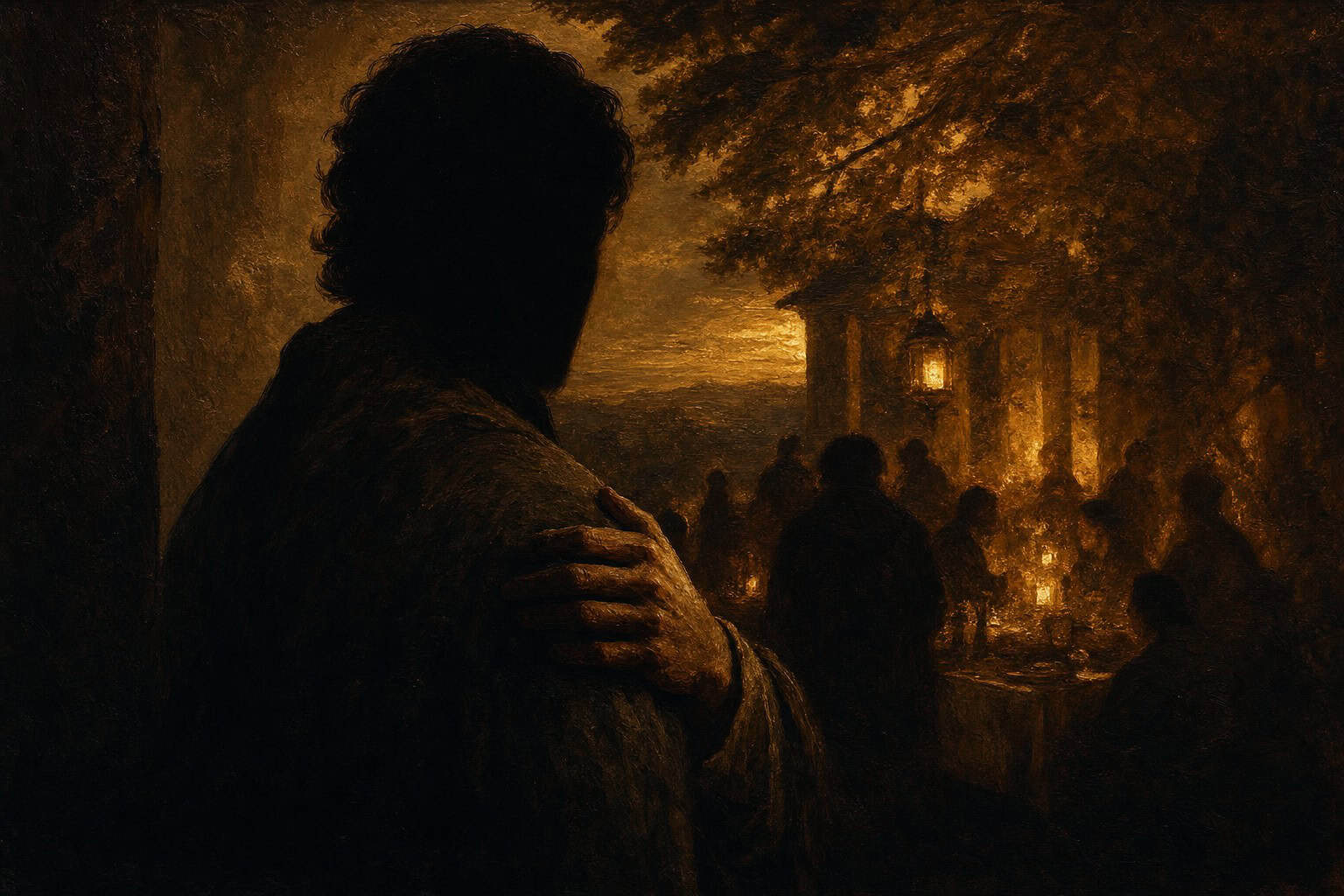
The equation shatters when a hand settles on his shoulder, warm and firm enough that he feels its weight through cotton and skin. It is not a passing brush; the fingers curl with the unselfconscious pressure of someone who has never had to ask permission to touch. He smells cologne and wine on the breath leaning close, hears his own name spoken as if it has always belonged in this mouth. The body attached to the hand moves with that unfair ease of the beloved, the sort of man whose glass is an ornament, not armor. Without asking, he tugs the chair, shifts the axis of the circle, pulls the ghosted man into the speaking radius. His muscles tense for the price—mockery, pity, a favor that will need repayment in flattery or compliance. Yet the hand stays light and absolute, ignoring the silent panic, ignoring the years of practiced retreat. For a suspended moment, the wineglass is no longer his shield but a small weight trapped between two gravitational pulls.
Sorrow can leave you dead while still breathing, watching others feast through glass, until even beauty becomes another kind of cage.
Starving While Your Hand Still Holds the Cup
Most people know this scene in softer forms: the office party, the parish reception, the family wedding where others move through the room as if they were born invited. You stand with a drink you do not really want because an empty hand feels too naked. You listen to laughter that never quite includes you, even when you’re close enough to feel the heat of bodies and breath. Desire flattens whatever separates you—degrees, salaries, reputations—because at the bottom there is the same hunger: to be seen without having to perform, to be held without having to purchase the privilege. The passage names that cruel equalizer with no romance: everyone here wants, but some can hide it under success while others choke on it in silence. The man at the edge of Rome’s beauty carries the kind of wanting that has been shamed so often it has learned to walk with a limp. His clenched grip on the glass becomes a mirror for any life that has ever chosen isolation over the terror of asking to be fed.
A Hand That Refuses to Let the Glass Drop
When he finally moves to leave, it is almost muscle memory: drain a last respectful sip, set the glass on a table near the door, disappear before anyone is forced to notice his exit. But the hand on his shoulder tightens just enough to stop that small liturgy. There is a quiet amusement in the eyes looking into his, as if this escape had been anticipated and gently vetoed. Words come—direct, unhurried, carrying no hint of barter—inviting him not into romance or obligation but into a simple, startling fact: you are wanted here, now, as you are. The old training stands at full alert, searching for the hook, the angle, the hidden cost. None is obvious. Around them the reception continues: glass against glass, silver against porcelain, Rome’s evening laid out like a painting. He remains standing in the middle of it, pulse loud in his ears, one hand still wrapped around his drink, the other pinned in place by a warmth he never planned for, caught between the safety of the familiar tomb and the frightening weight of being claimed.