A saw screams through a plank while Latin declensions run under his tongue, and behind his eyes a colder architecture rises — a grieving man learning to freeze each new tenderness before it can cost him.
The Weight of the Hammer
Steel bites wood while Latin declensions run under his tongue. A circular saw screams through a plank, and behind his eyes a very different architecture rises—creeds, councils, arguments with God that no one on the scaffold will ever hear. He shoulders sheets of plywood as if they were anonymous crosses, his back slick with sweat, his mind still tasting last night’s theology. Around him, men joke about weekend plans and bad backs; inside, he wrestles with mercy, judgment, and the strange economy of grace. The real labor is double: frame the wall square, keep the soul’s questions hidden. He times his interior arguments to the rhythm of the nail gun, lets the compressor drown out the sentences he cannot speak aloud. By lunch break his hands are nicked and raw, but the more secret fatigue comes from holding two lives in one body—one that measures joists and one that measures eternity, both using the same breath.
A White Coat That Smells Like Courage
She enters his life not in lace but in a lab coat, the faint smell of antiseptic and perfume clinging to her like a second skin. Older, certain, unashamed of the heat in her gaze, she does not circle him with strategy; she stands in front of him and simply wants. No coy prelude, no bargaining about futures—just the steady presence of a woman whose body and history have stopped apologizing. Her hand on his arm is not tentative. It carries years of disease spoken aloud, diagnoses delivered, people lost. That same steadiness now turns toward desire, and he feels it like a clean incision across his carefully preserved grief. She offers him something without contract: an evening, a body, a meeting of equal hungers. He registers every detail—the way her eyes do not flinch, the calm in her breathing—knowing a whole different life could begin if he stepped toward her. His muscles stay still while his mind writes footnotes he will regret for years.
The Glass Garden of Other People’s Tears
When women cry in his presence, the salt on their cheeks does not dry; it hardens. In his memory, each tear becomes a small, clear bloom added to a growing glass garden he never meant to plant. A younger woman realizing she is loved only at the edge of his attention, the doctor sensing he will not follow her courage—each one leaves a brief wet trail that stiffens into sculpture the moment it falls. He watches, not as a sadist, but as a man who already signed his loyalty to a woman who is no longer there to release him. The weeping does not move him toward new devotion; it reassures him that the old devotion still reigns. Every fresh hurt proves the seal has not been broken. These women lie beside him yet face a wall they cannot see: the invisible tomb where his first vow is kept. Their tears water nothing. They freeze on contact, shining, useless, sharp.
A man in mourning can turn every new tenderness to ice, sacrificing the living on the altar of a love that has already died.
Warnings That Glow Like Coals
He tells the truth with a precision that should repel. I am taken by someone absent. I am not available. I am dangerous to anyone who hopes. These sentences fall between him and each woman like bright, hot coals laid in a line. Instead of backing away, they step closer, toes just short of the heat, convinced that their tenderness can cool him, that they will be the first to walk through unburned. His refusal to promise anything feels, to them, like depth instead of drought. Pain named in advance sounds like intimacy. They mistake his clarity for invitation, his boundary-setting for the first act of a shared story. In reality, he is describing a locked gate, not hinting at a secret passage. Yet the more severely he names his inability to bend, the more his rigidness takes on a strange beauty. They lean in, not realizing that this glow is not hearth but furnace.
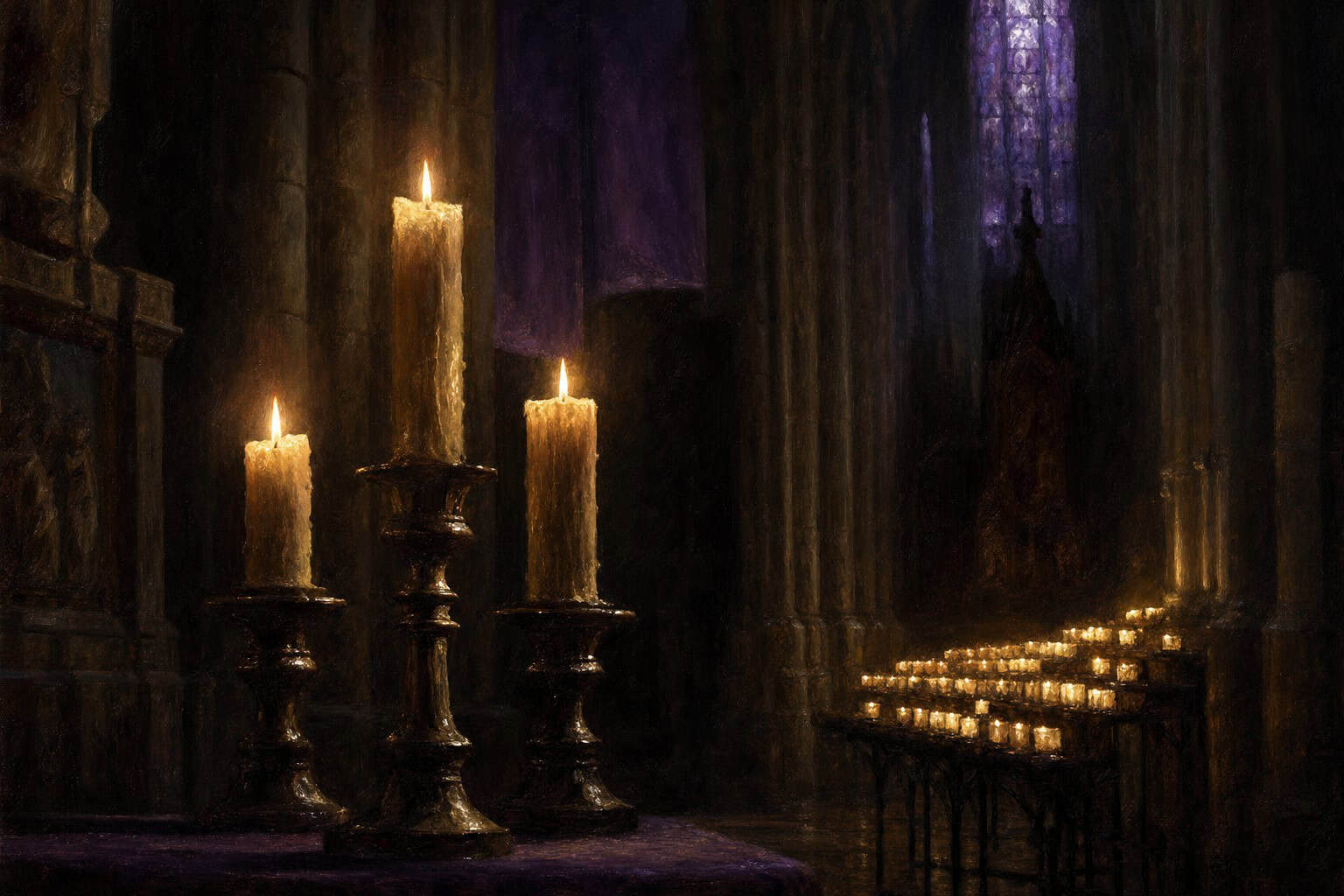
Three Small Flames in a Sea of Stone
Far from construction dust and tangled bedsheets, he stands before a long stone ledge pierced with little cups of fire. The church around him is mostly dark, arches dissolving into shadow, air thick with wax and old incense. He strikes a match and lights one candle for the boy he was, unwillingly drafted into darkness. Another for the man he is, living as a split atom—body in labor, mind in scripture, heart in a grave. A third wick flares for the future he cannot picture without that dark companion. This is not a plea for sunny conversion; it is a grim, honest offering of a life that may never warm to ordinary light. Here, he does not ask God to erase the dissonant music that has scored his days. He only demands that it be heard, even if it never resolves. The three flames tremble in the draft as he turns away, leaving their small, stubborn heat to burn down into clean, molten pools.