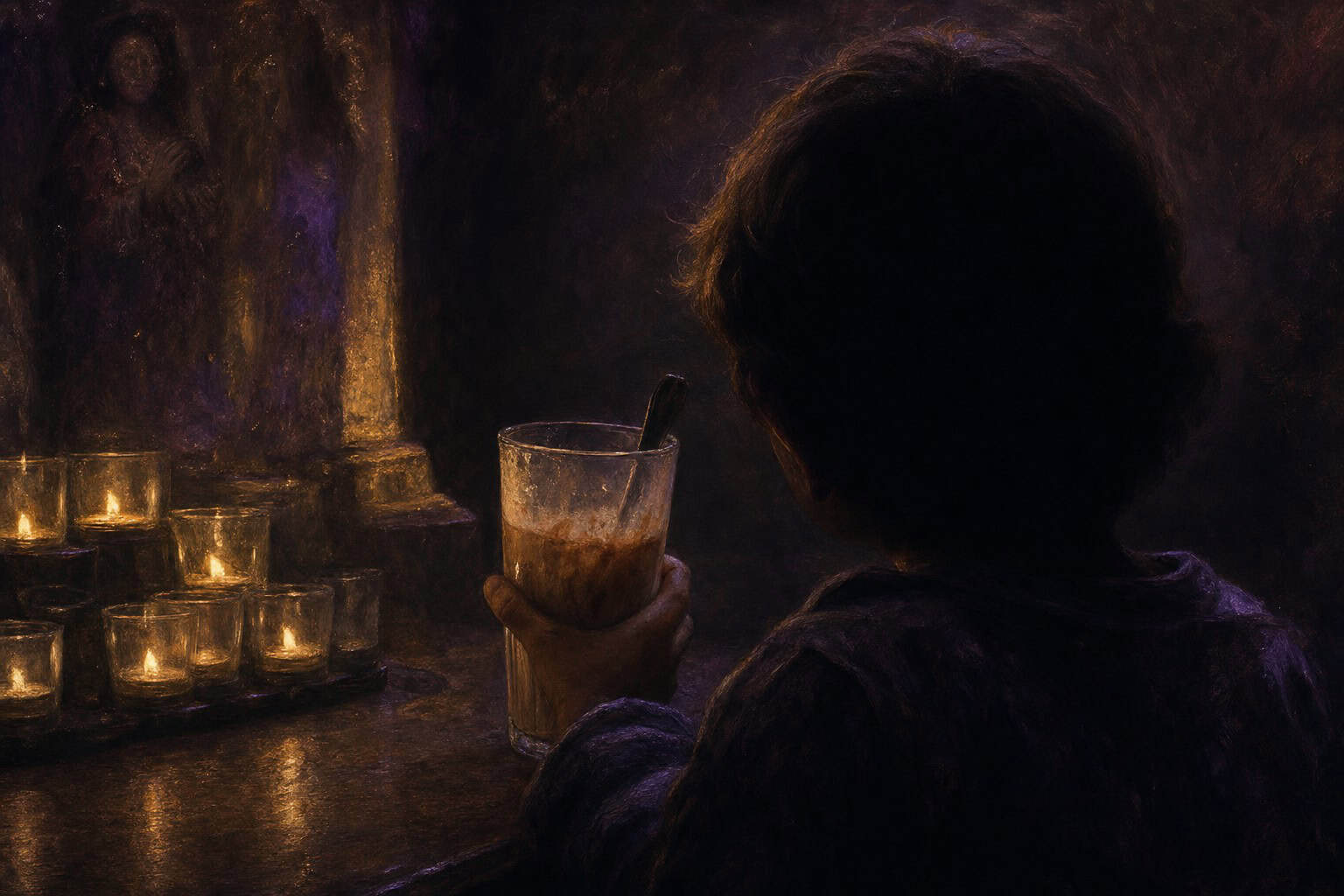
Cold milk, a metal spoon, cheap glass — his whole universe before school — and he heaps too much chocolate powder into a small brown hill, arming himself with the one sweetness he can control against a dark he cannot yet name.
Brown Swirls in a Glass Morning
Cold milk, metal spoon, cheap glass—this is the boy’s whole universe before school. He heaps too much chocolate powder into the milk until it forms a small brown hill, then drives the spoon straight through, slow and intent. The clink against the glass sounds steady in a house where voices and tempers are not. Powder lifts, spins, and sinks into the white, drawing circles that darken with each turn. He fixes his eyes on that motion, on the thickening color, because this is something his hands can govern when his own skin already knows what it means to be handled without consent. Adults move behind him—footsteps, a cupboard door, a sigh—but he keeps his gaze on the glass. Each swallow is cold and sweet, heavy on the tongue, and in that weight he finds a small border between himself and the memory of fingers, of breath, of a wrongness that lodged in his body before he could name it as sin.
Sweetness as Counterweight
This passage does not show a child escaping into fantasy so much as building ballast. The chocolate is not a treat for good behavior; it is the one trustworthy pleasure in a landscape where kindness and harm have already fused in the same faces. He learns that if he loads enough sweetness into his morning, he can hold the darker knowledge without tipping over. The Nestlé tin, the spoon, the glass become implements in an unspoken liturgy: measure, stir, drink, endure. This is how a marked soul first bargains with God without knowing it’s prayer—if there is pain I cannot stop, then let there be taste I can choose. Beneath that bargain lies the ache that drives this whole chapter: how to let anything good near him again without mistaking it for the bait of another predator, how to receive delight without flinching as though pleasure itself were a trap.
The Discipline of Distance at the Table
Even here, with cereal boxes and coffee mugs on the table, the boy is already rehearsing the distances that will govern his life. He sits where he can see the doorway, shoulders squared just enough to look relaxed, knees angled away so no sudden hand can slide too close without notice. One self is busy with the glass—counting stirs, feeling the cold against his palm, tracking the exact sweetness on his tongue. The other self is scanning: the way an adult’s gaze lingers a second too long, the softened tone when they speak his name alone, the flash of irritation when he does not respond with the expected warmth. The passage holds that double attention tight without resolving it. His body wants to lean into any scrap of tenderness; his learned vigilance pulls him back by the collar. The tension hums under every sip: if he misreads the room by even a breath, the small safety of this table can turn on him with no warning at all.
When a child cannot name what wounded him, he arms himself with small comforts, and even chocolate milk can hold a line against the dark.
When Your First Language Is Threat
For anyone who grew up saturated in this kind of early knowledge, the scene lands less as nostalgia and more as recognition. The habit of reading every room, every hand, every laugh does not evaporate with age; it hardens into the lens through which friendship, romance, even prayer must pass. A partner’s lingering touch can feel like fingers on the nape in a dark hallway. A boss’s compliment can carry the same aftertaste as an uncle’s praise before a locked-door afternoon. What looks like aloofness from the outside is very often this same breakfast calculation, carried into adult life: how close can I sit without offering myself up; how much warmth can I show without triggering another person’s sense that I am available to be used. The passage insists that this is not mere personality but formation, and raises the cost plainly: if sweetness once arrived on the same tray as violation, how does a person later consent to joy, even divine joy, without fearing they are reaching again for poisoned sugar?
The Glass That Never Quite Empties
Years will pass, bodies will grow, cities will change, but a man can still find himself at a counter at midnight, stirring powder into milk with that same old care. The muscles know the pattern before the mind does—heap, stir, watch the spirals, taste. He is no longer trapped in that childhood kitchen, yet his hand traces the same arc, as if drawing a circle around something he refuses to surrender. The sweetness in the mouth is thinner now, cut with the awareness of how many times pleasure has come carrying teeth. Still, he drinks, if only to prove that not every delight has been taken hostage by the past. This is where the passage leaves him: glass sweating on the table, chocolate ring staining the rim, his tongue catching the last grainy trace at the bottom. The question is not whether he will ever stop stirring, but what—if anything—will one day be allowed to join that sweetness without turning it sour.