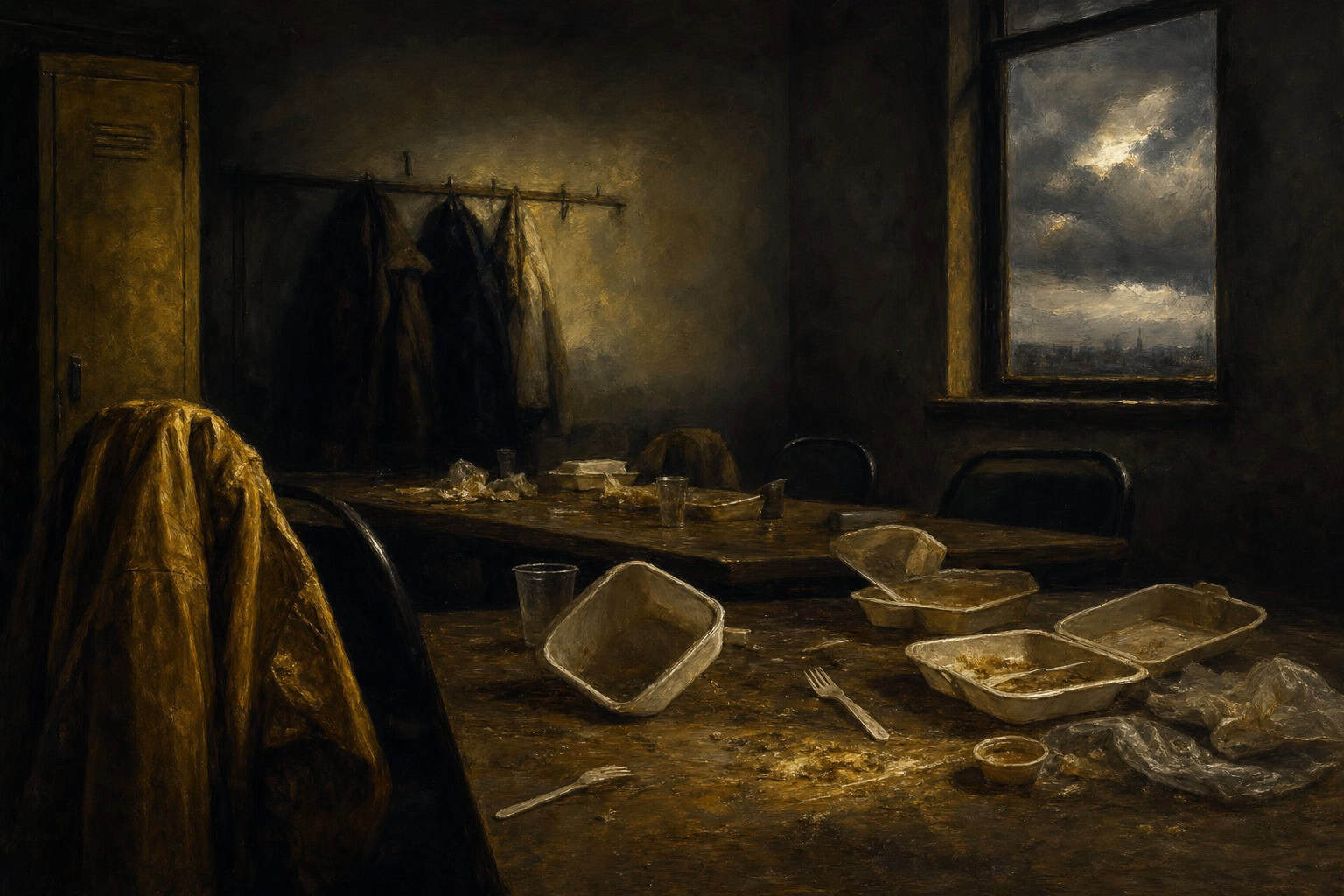
Hard plastic chairs scrape linoleum as the teachers fold around their lunch trays, the air thick with reheated casserole and quiet judgment, and a child takes in the lesson that silence is safer than speech — and carries it into every room he ever kneels to pray in.
Fluorescent Light on Greasy Plates
Hard plastic chairs scrape against linoleum as the teachers settle in, their bodies folding around Styrofoam containers and plastic forks. The air is thick with the smell of reheated casseroles, burnt coffee, and something sour that clings beneath the steam—like sweat trapped under too many layers of fabric. The evangelical women sit widest, skirts stretching, cardigans pulled tight, as if their size alone could stake a claim on the room. Their laughter is loud and flat, bouncing off cinderblock walls while they swap stories about problem children between mouthfuls of food. Every bite seems to thicken them, not just at the waist but in the way they move, slower, more certain that their weight gives them the right to occupy every inch of space. The quiet boy exists only as subject matter here, his name tossed between them like a condiment, something to flavor their shared disgust. He is not present, yet his absence is carved into the way they eat.
Sorting Children Between Forkfuls
Between sips of lukewarm coffee, they begin their real work. A child’s fate is weighed in offhand comments, sharpened by the clink of metal cutlery against cheap plates. Last names are spoken like passwords, each syllable unlocking a whole world of assumptions: which families donate, who shows up in polished Sunday clothes, who arrives late with wrinkled shirts. Behavior becomes code for class, spirituality a costume for favoritism. The quiet boy, whose stillness once seemed like promise, now becomes an irritation they cannot categorize. His silence refuses their script, and so they recast it as defiance, or worse, as danger. In this liturgy, material comfort is treated as blessing and poverty as moral failure, and no one in that cramped room needs to say it aloud. Their nods, their pursed lips, the way one woman jabs her fork for emphasis—this is how a serpent’s order passes itself off as common sense.
Grease Hardening on the Paper Plates
Time does not halt for their petty kingdom; it only congeals. Grease cools on half-finished meals while they trade prayer requests that sound more like gossip, each crisis another chance to prove they are favored. Yet small betrayals of their own script begin to surface. A hand trembles slightly as a woman lifts her fork. Another stares too long at the table when someone mentions a son gone off the rails. The laugh that once rolled out so easily now catches in a throat when marriage is praised too loudly. Their bodies, once confident instruments of control, start to show hairline fractures: weight gained in grief, dark circles that concealer cannot smudge out, a tightness in shoulders that no worship song eases. The boy, always watching from a distance, senses these cracks before they do. He sees how their power feeds on children because looking inward would mean facing the void they keep stuffing with food and piety.
A child who learns that silence is safer than speech carries that lesson into every room he will ever pray in.
The Child Who Learned to Stop Breathing Loudly
Somewhere outside that staff room, a child is mastering the art of disappearing. He moves through hallways like a shadow pressed thin against painted brick, learning exactly how much noise a shoe can make before it draws attention. His silence becomes a second skin, armor fashioned in response to the way those adults speak when they think the children are safely elsewhere. Many readers know that bodily memory: the way your chest learned to hold air instead of risk a wrong word, the way your shoulders rounded in on themselves to take up less space under fluorescent lights. You understood too early that the ones grading your papers were themselves trapped in a grading system of social standing and hidden shame. To survive, you mimicked what pleased them just enough, while hiding the strange, raw part of you that did not fit their chart. That hiding worked, but it left you unsure which parts of you were real and which were camouflage.
A Plastic Fork Left Staining the Table
Years later, the staff room may be gone or remodeled, the greasy smell replaced by some new corporate version of order. Yet the scene lingers in the body like a stain that never quite lifts: the scrape of forks, the lazy certainty with which grown bodies filled the space, the quiet knowledge that love there was always on a sliding scale. The boy grows up carrying two parallel truths—that he was misread by broken people, and that the misreading still shaped him. Divine love begins to press against that old shell, not by erasing the darkness he knows so well, but by refusing to play by the staff room’s arithmetic. The danger is real: to let himself be loved without becoming soft in the way of those adults, to consent to mercy without selling his anger about injustice for comfort. This passage leaves him standing in that tension, still listening to the echo of their laughter, a single plastic fork forgotten on a table, its tines stained orange and waiting to be thrown away or finally touched.