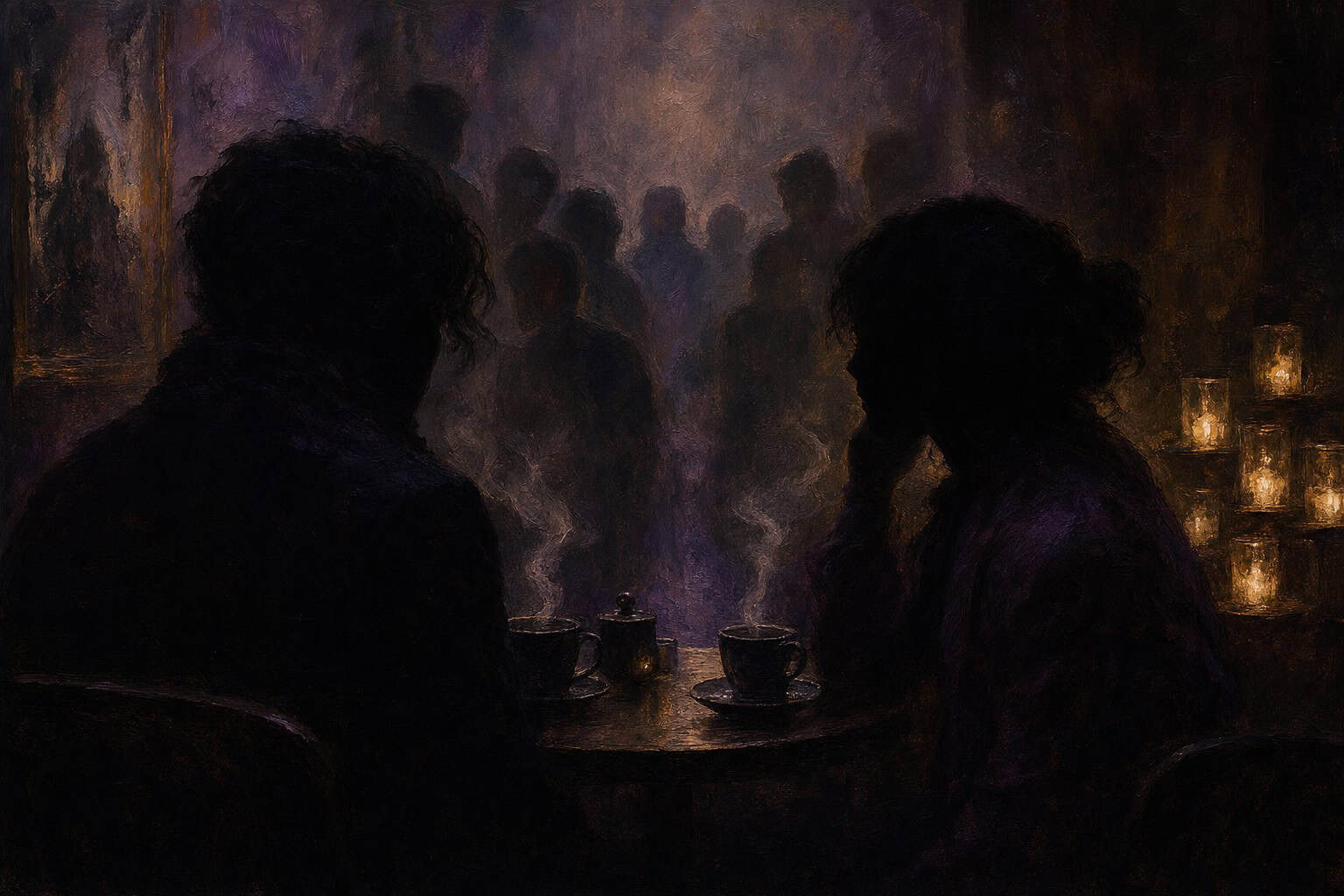
Steam rises from two cups in a setting that should feel harmless — a café, a folding chair in a church hall — and yet the room is already crowded, because no two people ever meet alone; they arrive trailing everyone who made them.
Hands Hovering Above A Coffee Cup
Steam rises from two cups on a small table, the kind of small talk setting that should feel harmless: a café, a fluorescent office, a folding chair in a church hall. Yet the real action lives in the hands that hover, withdraw, fidget at the rim. A casual question lands—something about family, work, trust—and one set of fingers tightens around porcelain as if bracing for impact. In that small tightening, the passage pulls back a curtain: this grip is not new. It carries old nights at kitchen tables, raised voices, the learned timing of when to speak and when to disappear. What seems like a simple pause in conversation is in fact a crowded scene, histories rushing in like cold air when a window cracks. Two visible bodies sit there, but the space between their cups is packed shoulder-to-shoulder with everyone who ever taught them what happens when the truth crosses a table.
The Legion Behind A Single Flinch
Here the text forces an accounting: that flinch at a harmless joke, the tight jaw at a soft question, are not overreactions but faithful translations of earlier rooms. The boy who learned that sarcasm was always the prelude to humiliation now hears danger in a stranger’s playful tone; the girl trained to earn affection by solving everyone’s problems leans forward at the first hint of distress, script already memorized. These patterns are not merely bad habits. They are the chiseled result of years spent surviving particular faces, voices, moods. The scene insists that what we call “personality” is often this sediment of roles: peacekeeper, lightning rod, invisible child, perpetual host. Each present encounter becomes a fresh stage where these parts rush to their marks, terrified of losing the only lines that once kept them safe. You think two adults are chatting; in truth an entire cast of former selves scrambles to take control of the scene.
Archaeology In The Tilt Of A Shoulder
Watch long enough and even the smallest adjustment becomes an excavation site. Someone leans back a few inches when the other grows animated; another leans in too quickly, flooding the gap with reassurances no one asked for. The chapter lingers here, almost cruelly slow, as if pressing a magnifying glass against the tilt of a shoulder, the angle of a chin. Each micro-movement is treated as a shard of pottery in dry earth, hinting at a buried city of past talks, past fights, past betrayals. Averted eyes may carry the shape of a father’s stare; a too-steady gaze might cover the terror of losing control. The pressure rises when you realize how little of what unfolds is freely chosen. The choreography of the present is being dictated by rooms that no longer exist, by voices that are not physically present and yet still choreograph who gets close, who stays safely out of frame, who is quietly exiled before they can even speak.
No two people ever meet alone; every room fills with the ghosts of everyone who shaped them, wounded them, and loved them into being.
When Your Reactions Arrive Before You Do
For anyone reading, the scene lands as accusation and mercy at once: your reactions usually walk into the room ten seconds before your conscious self catches up. You bristle at a colleague’s tone and only later realize it matches the rhythm of an older command; you melt toward someone’s gentle weariness because it smells like the first teacher who saw you. This passage names the hard truth that so much of what feels like intuition is often recycled history, not fresh discernment. Left unseen, this means you keep punishing strangers for crimes they never committed, or handing your trust to people who only resemble former saviors. The stakes, then, are not small: marriages, vocations, friendships, even your image of God become shaped by these unexamined echoes. To ignore them is to let absent figures continue casting votes in every decision, long after they should have lost their power to govern your days.
The Crowd That Will Not Take Its Seats
The text does not tidy this into an easy promise of pure encounters, as if a few insights could clear the table and leave only two honest faces. Instead, it leaves you in the crowded café, heart aware now of how many chairs are actually occupied. Some presences still serve you, sharpening your sense of threat; others lie, insisting that tenderness is always a trap, that conflict is always fatal, that leaving first is safer than being left. The hinted grace is not a spell to dismiss them, but a slow training of the inner ear: to hear which voice is speaking when you tense, to notice whose shadow stretches over a harmless question. Conversion here is imagined less as sudden light and more as learning to ask, in the middle of an ordinary conversation, who else just walked in. The scene closes without an answer, only the low murmur of that unseen crowd shifting its weight around your chair.