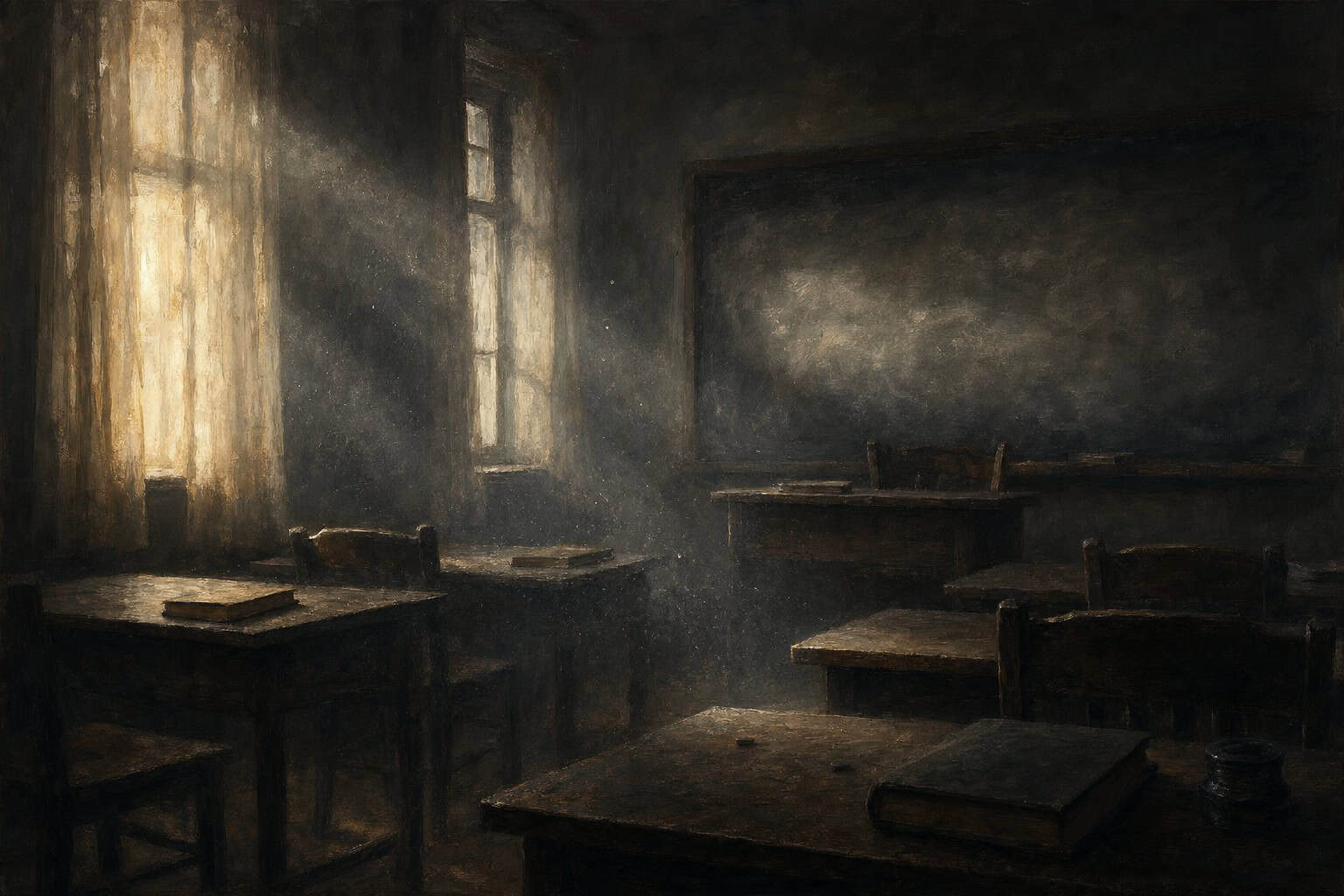
Chalk dust hangs over pastel collars in a magnet-school morning, desks in straight rows while the real order lives elsewhere — a place where cruelty wears its most innocent uniform and grades a child long before he understands the test.
Pastel Collars in a Chalk-Dust Air
Chalk dust hangs in the magnet school air while pastel collars and crisp polos announce an inheritance no brochure mentions. Desks line up in straight rows, but the real order lives in glances, in who sits where at lunch, in who never has to ask for a turn at kickball. The boy who arrives in 1984 carries a damaged interior lens, already scratched by earlier spiritual trespass, and now he must read this new landscape with it. Merit supposedly won every child their seat, yet some arrive wrapped in the practiced ease of kids whose parents own offices, not timecards. Their cruelty is rarely loud; it travels in a delayed response, a slight step back, a quick eye-roll shared across the room. This chapter expands that single classroom into an entire ecosystem: hallways, playground, apartment complexes, talent shows, each one a different arena where class, power, and vulnerability circle each other like wary animals beneath the buzz of fluorescent lights.
The Boy with the Invisible Notebook
He moves through those years like a boy carrying an invisible notebook, recording every small betrayal and unexpected mercy. A refused marker during art leaves a sting that lingers longer than recess; a shared sandwich carves a bright groove in memory. He studies the way a teacher’s praise feels different when it lands on a wealthy child than when it finally lands on him. Trust becomes a scarce currency, spent only after long observation. Friendships are not formed by proximity but by a slow, almost forensic testing: Who laughs when the joke cuts too deep? Who looks away when the rich kids choose sides? In these ordinary scenes—glue sticks, soccer balls, lunch trays—he begins to name patterns that later theology will only confirm: pride swelling when picked first, envy fermenting in comparison, charity appearing in a quiet defense on a loud playground. Every hairline crack in a classmate’s smile becomes another entry in his internal ledger.
A Microphone, an Izod Collar, and the Crowd
One day there is a microphone on a stage, a cheap stand in the middle of the school cafetorium, and Stephen steps up to it. His jokes, borrowed from older-brother cassette tapes and late-night shows, are filtered through a child’s body that knows what it is to be the punchline. When the crowd—the same kids who track status like a sport—starts laughing with him rather than at him, something in the air loosens. For a brief moment, the verdict written over the misfits blurs. Later, at a lunch table, another scene: Doug’s pastel Izod collar, popped just right, moving toward the outcasts like a flag from the wrong country. His first overtures feel like a setup, a slow-motion replay of earlier humiliations staged under the guise of affection. As Doug stands between tables—one crowded with safety, one ringed with scorn—the chapter tightens its grip around a single, raw tension: the danger of hoping that someone with power might choose you and keep choosing you when it costs them.
Cruelty wears its most innocent uniforms in childhood, where the wounded learn that the world grades you long before you understand the test.
Country Club Children and a Darkened Bedroom
The fluorescent hum of the classroom speaks to the book’s deeper question: how a soul, already marked by a dark visitation, learns to live with both that darkness and the offer of love. The country club children mocking on the playground are not separate from the shadow that once crossed his bedroom; they are another mask over the same old refusal to see the weak as kin. Here, social contempt and earlier spiritual violation begin to braid. His tight inner circle, his habit of testing people before letting them close, his instinct to turn intellect and imagination into armor—all of it starts in these sticky-floored hallways. The early sense that some people exist only to be used or entertained will later drive him toward systems of conquest, even as he clings to flashes of goodness that never quite die. This chapter plants seeds: the codex of defense, the empty space where a listener should have been, the double melody of beauty and bitterness that will score his adolescence and beyond.
Laughter as a Brief Suspension of Gravity
The promise of this chapter lies in how seriously it takes recess-level events without inflating them into tragedy. A kickball lineup, a cafeteria joke, a boy sliding his tray beside the wrong friends—these scenes are shown as early skirmishes in the wars his soul will fight for decades. The magnet school becomes a catechism written in sweat and pencil shavings: you are useful or you are not, you are safe or you are prey, you harden or you break. Yet within that curriculum, there are interruptions: a teacher who notices effort over polish, Stephen making the whole room forget itself and laugh, Doug risking a seat at the loser table while his old world watches. The chapter does not resolve these tensions; it holds them steady, letting their weight gather. What it offers is a clear look at how a child learns to expect cruelty while still being surprised by kindness, like hearing a sudden hush fall over a playground just before the bell rings.