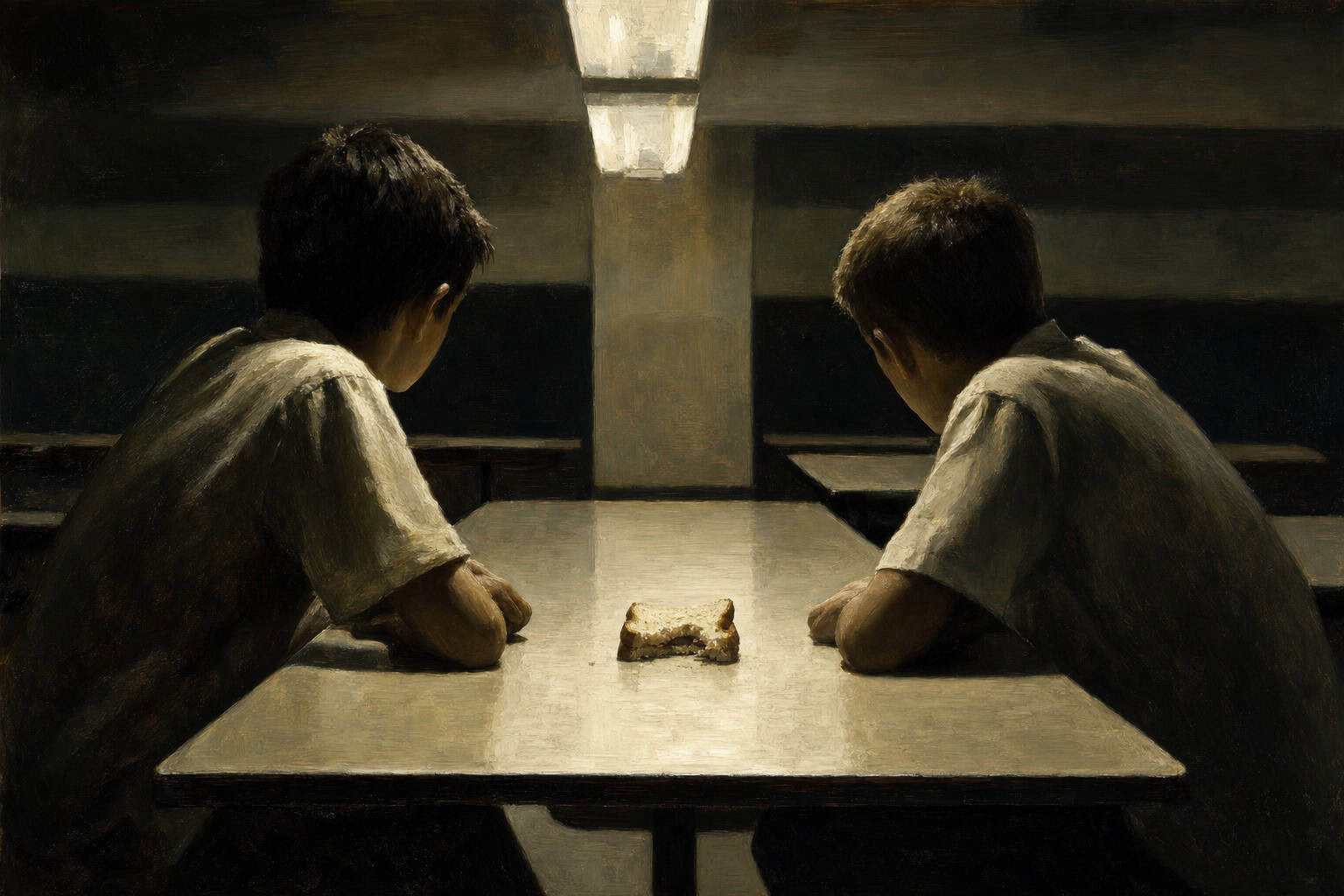
Grease stains the paper where a sandwich has been torn in two, one half nudged across a scratched tray toward him, and the small mercy frightens him more than cruelty ever did, because hope reopens the places he sealed to survive.
Half a Sandwich on a Plastic Tray
Grease stains the thin paper where the sandwich has been torn in two, one half nudged across the scratched plastic tray toward him. Around them, metal chair legs scrape, milk cartons snap open, and someone shouts from another table, but his world has narrowed to bread, tuna, and the hand that pushed it his way. This is the same hand that once rested comfortably at the edge of the mockery circle, not rescuing, not stopping, simply watching. Now it hovers, uncertain, over the table between them. The fluorescent lights flatten every color into the same sickly tone, so the food looks almost gray, but his stomach twists anyway. Hunger and dread share the same muscles. In that cramped cafeteria air, thick with ketchup and sweat, the half-sandwich becomes strange—no longer just lunch, but a test of what kind of story this boy’s life is going to tell about other people.
The Cost Hidden in the Crumbs
On the surface, nothing dramatic happens: a boy offers food, another boy considers it. But under his skin, this small gesture drags every earlier humiliation to the table like silent witnesses. He has learned that nothing in this social order is free. Favors cost allegiance, laughter costs dignity, even silence has its price. So his body does the math faster than thought: if he takes this half-sandwich, what does he owe in return—loyalty, stories, a share in the next cruel joke? Or worse, does he owe his heart, the part that still aches to be chosen, to belong? The real reckoning is not about whether the other boy has changed. It is about whether he can endure being wrong about him, again. Whether he can stand one more proof that his hunger for connection makes him easy to use.
Chewing on the Edge of a Trap
His fingers hover just above the bread, close enough to feel the cool damp of mayo-softened crust, far enough to still claim refusal. Every instinct built from years of cafeteria politics and locker-room jokes screams that this is how traps are set: draw the loser close with kindness, then spring the laughter when he bites. The other boy waits, shoulders slightly hunched, gaze lowered to the table as if aware that eye contact might be too much. Around them, the social tribes maintain their borders—girls orbiting the favored boys, quiet kids bent over notebooks, loud ones throwing food across sanctioned lines. The half-sandwich sits between these worlds like contraband. His throat tightens at the thought of swallowing even one bite. If he eats, he becomes visible again, bound to someone else’s story. If he refuses, he keeps his distance but confirms the cruel script that he is too strange, too damaged, to share even a meal. The bread doesn’t move. Neither does he.
Kindness can frighten the wounded more than cruelty ever did, because hope reopens the very places we sealed to survive.
When Your Hunger Knows Too Much
An ordinary reader doesn’t need a cafeteria to recognize this. The half-sandwich shows up in other shapes: a text after years of silence, an unexpected invitation in a meeting, an apology that arrives long after the bruise has faded from the skin but not from the mind. By now, you have your own calculus for these offers. You know how to nod politely while keeping your insides armored, how to accept help without letting it mean anything. This passage names why that armor feels holy and suffocating at once. Somewhere in you lives a child who once trusted the wrong face, or the right face at the wrong time, and learned that being seen can be more dangerous than being ignored. So when kindness returns from a direction marked “unsafe,” your body shakes like his. You understand the terror of letting even a crumb past your guard, knowing it might awaken a hunger you can’t easily quiet again.
Bread Held Between Two Futures
The scene leaves us with a boy, a tray, and an untouched half-sandwich cooling in the stale cafeteria air. No verdict is handed down, no neat lesson wrapped around the crust. What stretches between those two boys is not just social awkwardness but a whole theology of risk: either the human heart is capable of turning from cruelty toward mercy, or it isn’t. Either the soul can receive such turns without losing itself, or it can’t. In this narrow pause before any decision, both futures sit side by side—the one where he eats and finds a fragile, strange companionship, and the one where the first bite becomes the setup for a deeper, sharper humiliation. The passage refuses to settle which story wins. It holds us at the table, in that bright, ugly light, where the simplest act—taking bread from another’s hand—still waits to become either a blessing or a fresh bruise on the tongue.