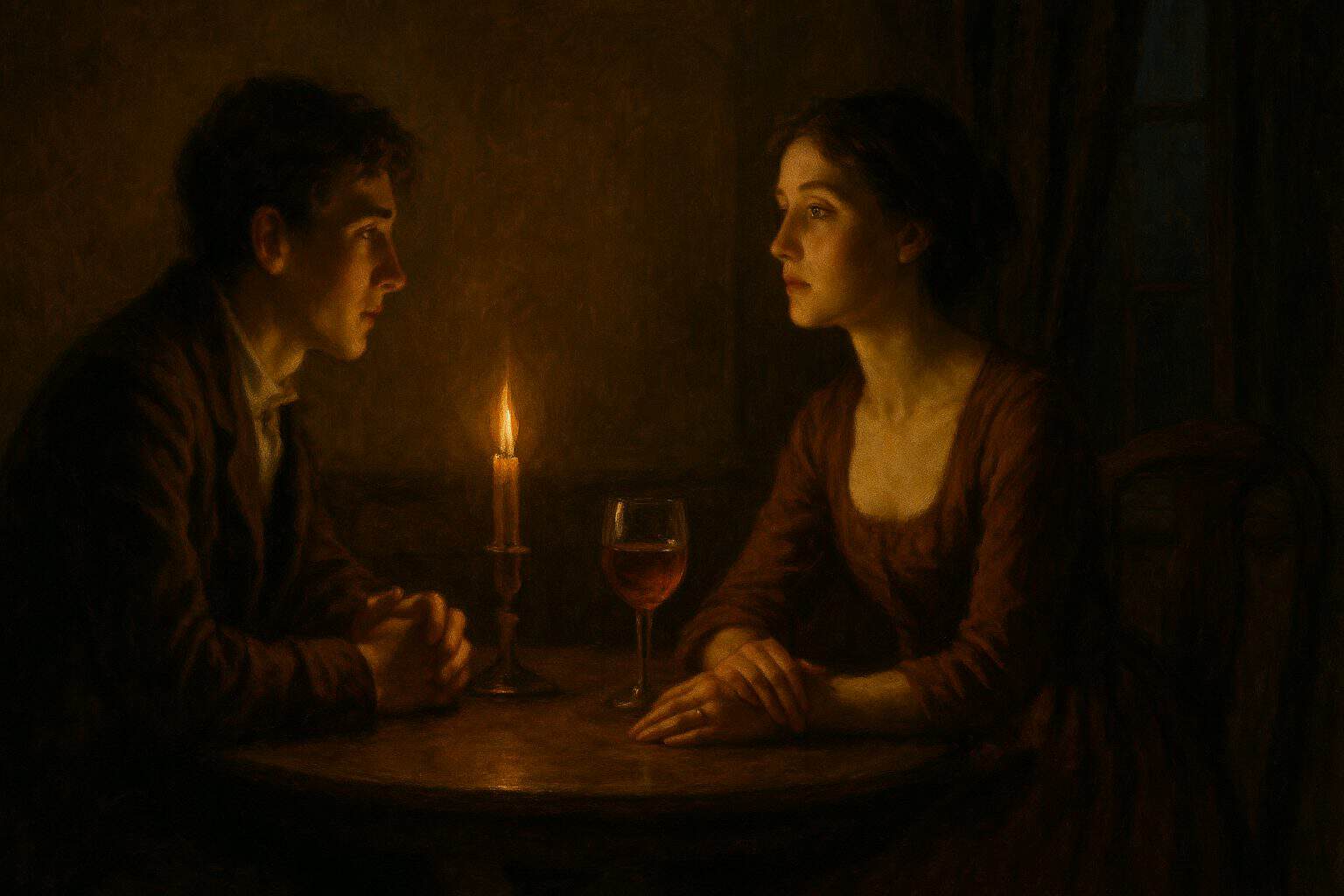
Where the cartographer’s precision meets the explorer’s wonder—the eternal dance between knowing and unknowing in the landscape of human desire.
The woman sits across from you at dinner, candlelight catching the subtle shimmer of her lipstick. You notice how the color calls forth something primal, how the blush on her cheeks mimics the flush of arousal—nature’s own advertisement rendered in cosmetic form. Yet even as you catalog these signals, even as you think you understand the evolutionary mechanics at play, something else moves beneath the surface. A mystery that no amount of analysis can capture.
The Verdict Before the Trial
There is a particular quality to rejection that arrives not as judgment but as pre-existing fact. The man discovers, often too late, that the verdict was rendered before he knew there was a trial. He thought he was building toward something, negotiating terms, making his case. But desire—her desire—does not operate according to the rules of debate or persuasion. It exists or it does not, a primal force that precedes all reasoning.
Watch how a man tries to argue his way into her affection. See him present evidence of his worthiness, his stability, his devotion. Notice how each effort becomes proof of the very absence he seeks to overcome. The more he chases, persuades, reasons, the more he confirms what her body already knows: the spark is not there. Cannot be manufactured. Will not be negotiated into existence.
Her arousal arrives as verdict, not as conclusion to be reached through deliberation. It announces itself in the quickening pulse, the dilating pupils, the subtle lean toward or away. These are not choices but revelations—the body speaking truths the mind may spend years trying to understand or deny.
The Double Strategy
“The ideal mate, from my point of view, is one who excites both evolution, the physical and material, and the spirit, the mind and the passions.”
The feminine psyche navigates a complex terrain, pulled between competing imperatives that evolution has woven into the very fabric of desire. On one hand, the need for superior genetics—the man who stirs something wild and untamed, whose very presence activates ancient circuits of attraction. On the other, the requirement for absolute investment—the provider, the protector, the one who will stay.
Few men master both roles. The pragmatic solution emerges not through conscious calculation but through a kind of embodied wisdom: she splits her affections across the men in her life, each fulfilling different aspects of this dual need. One man receives her passion, another her partnership. One ignites her fantasies, another secures her future.
This is not duplicity but biology expressing itself through the available channels of modern life. The woman herself may not fully understand why she feels so differently toward different men, why one stirs her body while another engages her mind, why she can imagine a future with someone she struggles to desire in the present.
Maps and Territories
The modern man, confronted with the opacity of feminine desire, often responds by becoming a cartographer of attraction. He studies evolutionary psychology, reads about sexual market value, memorizes the indicators of interest. He drags desire onto his dissection table, determined to expose it as a mechanical fraud driven by instinct and pleasure.
Armed with theories from Buss about mate selection, insights from Tomassi about hypergamy, frameworks from evolutionary psychology about dual mating strategies, he believes he has mapped the territory. He can explain why women wear lipstick (to simulate arousal), why they test men (to assess fitness), why desire fades (novelty wearing off). The map grows ever more detailed, ever more comprehensive.
Yet something essential escapes the mapping. A woman’s “like” on social media becomes a complex communication—”I’m still here”—wrapped in plausible deniability. She signals intimacy not with her body but with her mind imprinted upon words. The space between two people shrinks from public to social to intimate through movements too subtle for any map to capture.
The Echo of Another
There are moments when the veil lifts, revealing the hidden archaeology of desire. A woman lies beside her lover and speaks words that seem to come from elsewhere: doubts about his attraction to her that make no sense in the present context. The man protests, confused—has he not shown his desire clearly, repeatedly, unmistakably?
Only later does understanding dawn. These were not her words but an echo—residue from another man, another time. Someone else had planted this doubt, and it took root so deeply that it now colors every subsequent encounter. The past lover who withheld affection, who made her question her desirability, continues to shape her experience long after his departure.
This is how desire operates not as pure present-tense phenomenon but as palimpsest—each new experience written over previous ones, never quite erasing what came before. The woman who seems to test and doubt is often not responding to the man before her but to ghosts he cannot see.
The Spiritual Mirror
When she chooses a husband, deeper patterns emerge. She seeks not just a mate but a mirror—someone who reflects back qualities she has internalized from the most significant men in her life. Often this means her father: his intellect, his authority, his spiritual likeness. The template was drawn in childhood, long before conscious mate selection began.
This is not simple repetition but a kind of seeking for coherence. The psyche desires to make sense of itself, to find in the external world confirmations of its internal architecture. The woman drawn to a certain kind of strength or vulnerability, to particular forms of authority or tenderness, is often following a map drawn by her earliest experiences of masculine presence.
“Beware the subtle idolatry of making another human being your ultimate source—your lowercase ‘g’ when only the uppercase ‘G’ deserves that place.”
Yet here lies a profound danger. When another human becomes the ultimate source—of validation, meaning, completion—the relationship bears a weight it was never meant to carry. The hunger for the divine gets displaced onto the human, creating expectations no mortal can fulfill.
The Failure of Transaction
The man who approaches relationship as transaction—his resources for her beauty, his commitment for her sexuality, his protection for her submission—discovers that something essential resists this economy. Yes, relationships involve exchange, but when exchange becomes the primary logic, when every gesture gets calculated according to its return on investment, the very thing being sought dissolves.
Watch how transactional desire reveals itself: in the scorekeeping, the negotiations, the careful tracking of who gives what. Notice how it generates not intimacy but distance, not connection but calculation. The woman operating from this framework has already disqualified the man as husband, reaching her verdict long before he knew he was on trial.
True desire—the kind that sustains rather than merely initiates—operates outside the logic of transaction. It gives without counting, receives without measuring. This is not naïveté but a different kind of wisdom, one that recognizes how the deepest human needs cannot be met through exchange but only through a kind of mutual overflow.
The Horizon of Mystery
After all the analysis, after every evolutionary explanation and psychological framework has been applied, something remains unaccounted for. Call it the irreducible mystery of the other, the horizon that recedes even as we approach it.
The man who believes he has mapped feminine desire through evolutionary psychology discovers a particular woman who confounds every expectation. The woman who thinks she understands her own patterns finds herself stirred by someone who fits no previous template. The very moment we believe we have grasped the mechanics, the phenomenon shifts, revealing new depths.
This is not failure of understanding but its fulfillment. To truly know another person, to genuinely encounter them, requires holding both map and mystery simultaneously. The map provides orientation, helps us navigate the general terrain. But the mystery reminds us that each person is ultimately unknowable in their fullness, that desire itself emerges from depths no theory can fully fathom.
Integration and Peace
The religious tradition speaks of making peace with our brothers and sisters before offering gifts at the altar. Some find this peace through denial, pushing uncomfortable truths about desire and sexuality into shadow. But another path exists: illuminating and integrating the darkness into waking consciousness.
This means acknowledging both the evolutionary imperatives that drive us and the spiritual longings that elevate us. It means recognizing how childhood patterns shape adult desire without becoming enslaved to those patterns. It means seeing through the illusions of transactional relationship while still honoring the legitimate needs for security and provision.
The map of desire—with all its evolutionary logic, its psychological patterns, its predictable strategies—need not negate the mystery. Instead, it can deepen our appreciation for how remarkable it is that two people ever truly meet, ever genuinely connect across the vast spaces that separate one consciousness from another.
In the end, perhaps this is what we are really seeking in all our desperate attempts to understand desire: not control but connection, not mastery but meeting. The maps we draw, the theories we construct, the patterns we identify—all of these are ultimately in service of something simpler and more profound. The hope that we might know and be known, might desire and be desired, might find in another human being not our ultimate source but a genuine companion for the journey toward that which truly deserves our ultimate devotion.
The candle burns lower. The woman across from you remains both utterly present and ultimately mysterious. This is as it should be. This is as it must be. The map guides us toward each other, but only mystery makes the journey worth taking.