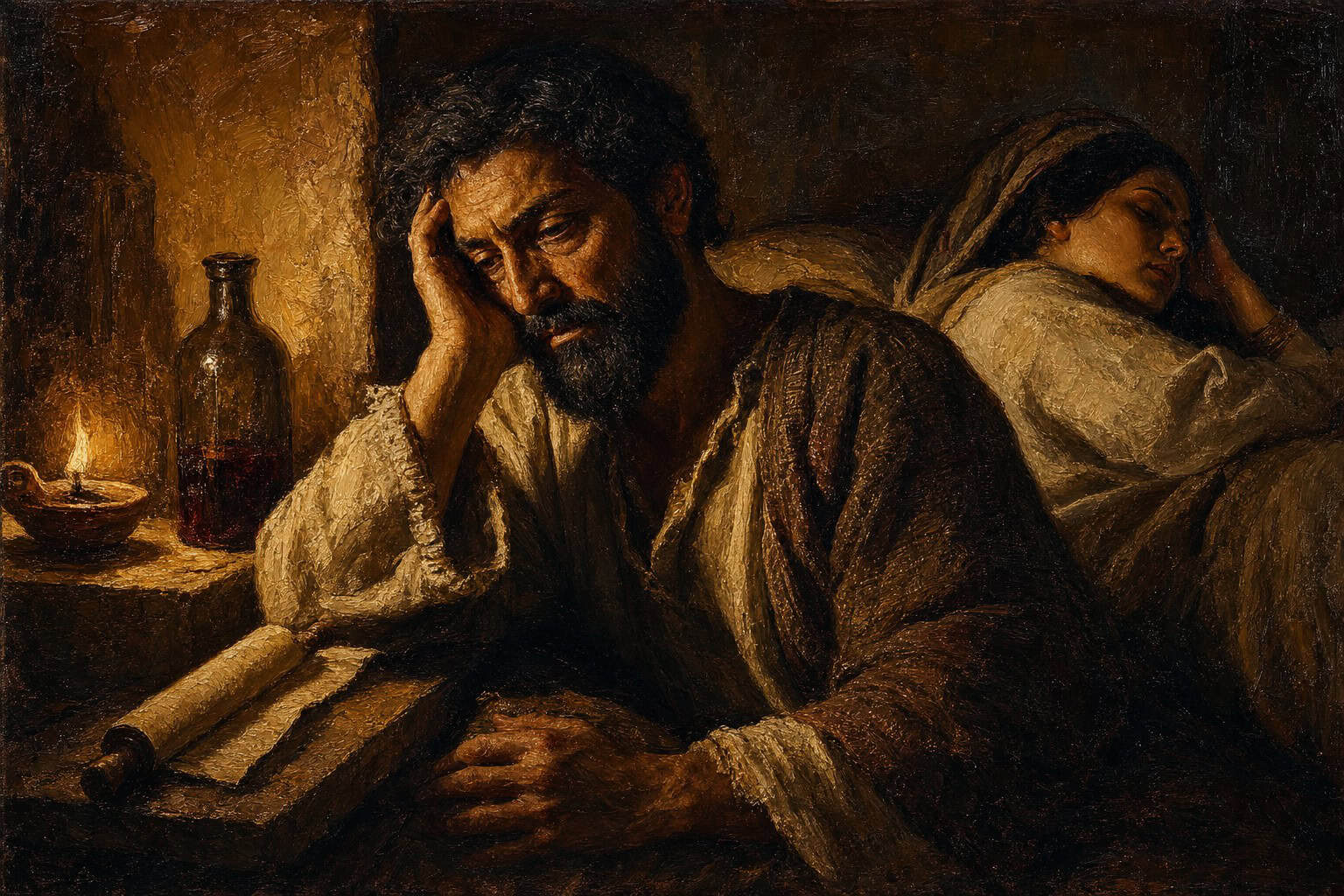
How do you know if you are just her rebound, the warm body she settled into after another man refused her? A raw reading of a moment when a woman’s quiet pity revealed more than words ever could.
Beer on Her Breath in a Quiet Room
What does her silence tell you when her words run out, and how do you know if you are just her rebound? I asked myself both on a night I keep circling back to, a night from Confessions to the Empty Chair where the whole scene hangs on a mouth that will not open. She came back late, the way she often did, her absences never explained, her steps loose on the floor. There was beer on her breath, sour and close. She slurred a sentence that dropped into the still room like something pulled loose from its pin: she said she did not think she was pretty, that she did not think she was attractive as a woman. I had shared a bed with her. I had shared my affection, my hands, my nights. And yet here was this thing rolled across the floor between us, live and waiting. I felt the old reflex rise in me, the one I trusted most, the pull toward the warmth of the body. I had once told her books were wonderful but would not keep her warm at night. I said it the way a man says a thing he is sure will win, sure it settles the argument. I offered heat where she offered ink. And in return she looked at me with the quiet, condescending pity of a scholar who has already read the last page of the argument you are only beginning. Her silence after my question was not empty air. It was a full room I was not allowed to enter, and I stood outside it with my warm hands useless. I wanted to be close to her. The distance she kept was measured, deliberate, a scholar’s cold distance held even in the dark. She could lie beside me in the same bed, her skin against mine, and still hold herself a hundred miles off. That is the strange geography of that night. Nearness of skin is not nearness of soul. A person can rest warm against you and remain in another country entirely, breathing another man’s air. I did not understand this then. I thought if I could make her feel wanted, if I could press enough affection into her, the border between us would dissolve like frost on glass. But her pity was not confusion. Her pity had a floor beneath it, a foundation laid long before I arrived, one I could not see and would not have believed if I could. She was quiet because the thing filling her had nothing to do with me. And I, in my confidence, in my sureness that warmth answered everything, had no idea I was answering a wound another man had opened years before I ever touched her.
The Handkerchief She Dropped for Someone Else
The more I pressed, the harder her silence set, and only years later did I learn to read it plainly. That drunken confession of hers was never self-reflection, never a woman turning to look at herself. It was residue. It was the fingerprint of another man left on her skin. Someone had told her he was not attracted to her in that way, and his rejection had lodged in her like a splinter you cannot dig out, working deeper with every day it stays. I was hearing his words when she spoke. His voice moved her mouth. She had dropped her handkerchief, in the old sense of it, before a man who chose not to bend and pick it up, and his refusal had pushed her, disappointed, backward into my arms. That is how you know you are just her rebound: her sorrow keeps speaking in another man’s voice. This is the tension I could not feel that night. I thought I was the man in the room. I thought her body beside mine meant I had won some ground, planted some flag. But I was the second man. I was the consolation. I was the seat kept warm while she waited for the first to notice her again. Her silence was resentment as much as sorrow, two things braided so tight I could not tell them apart. She rested against me and hated that it was me and not him. I can barely say how that reorders a whole night in memory. Every touch I offered as proof of my desire was landing on a woman measuring me against a shadow. My warmth was not competing with her books at all. It was competing with a man who was not even in the room, whose absence somehow filled it more completely than my presence ever could. And here is the harder question I put to myself now, the one that will not sit still. What did I want from her body that I could not ask for with words? I told myself I was giving her comfort, that I was the tender one. But there was a hunger in me to be chosen, to overwrite the other man through the flesh, to mark her as mine because I could not match whatever held her mind fast. That is a poor and grasping thing to admit. A man who fears he is outmatched in the soul reaches for the only field where he still thinks he can claim a win. I reached. Her silence told me I had already lost that field, though I would not hear it for years. The confession that seemed to plead for reassurance was not asking me for one thing. It was quietly judging the very need that drove me toward her. She saw the grasp in me, and she pitied it. And still I did not stop grasping, because I did not yet know what I was.
The Second Man Learns His Own Name
The turn came slow, not in that room but across the long years it took to read that room honestly. What her silence said about her, I finally understood, was also what it said about me. She was quiet because I was interchangeable to her, a stepping stone, a body she could shut her eyes and pretend was another body. Had a child come of those nights, she would have named it for one of the men in the shadows, a name folded around a secret only she and he would ever hold. A line from a song they both loved. A character from a book he had pressed into her hands. The child would have been mine by blood and his in spirit, and she would have carried the other man’s memory alive in the naming of my own son. That is a truth that costs something to set down. I was faithful to a woman who had already handed her real longing to another. I thought devotion earned desire, that if I stayed and stayed and stayed, her heart would eventually turn toward the one who remained. It does not work that way. Fidelity is not a spell you cast. Loyalty does not summon a love that was never mine to summon in the first place. Her silence was the plainest sermon I ever received on this hard truth, and I refused to hear the whole of it. I kept my ears shut and my hands warm. But there was something underneath the humiliation, something I only saw once I stopped defending myself, once I quit arguing with the memory. In that same dark room, God was not absent. He was not knocking on the window to pull me out. He was sitting in it, in the beer-stink and the pity and my own graceless hunger, close as breath, walking beside a man who had entered that bed already decided, already grasping, already lying to himself.
Silence is rarely empty; it is the room where a person keeps the truth they will not hand you.
What the Slurred Words Left Behind
After the turn, the fallout settles into the body the way cold settles into a house after the lamps go out. I understood at last that I had misread the whole exchange from the first word. My warmth against her books was never the real contest. The real ache in me was not even for her, though I had dressed it in her name. It was an older homesickness wearing the clothes of desire. I wanted a place where a word could be spoken without strategy, where I did not have to win anything, where I could simply be received as I was. I had gone looking for that place in her arms, and her arms could not hold it, because she was looking for the very same thing in the arms of a man who had already turned his back on her. We were two people in one bed, each reaching past the other toward someone who was not there. Counterpoint, the book names it, two lines of music that run alongside each other and never resolve into one chord. I hear it now in the memory, that unsettled sound. Her confession of being unattractive was another man’s voice moving through her throat. My offer of heat was my own fear of being the lesser mind, dressed up as tenderness and pressed against her in the dark. Neither of us was speaking to the person actually present in that room. Neither of us was heard, because neither of us was listening for the other. We were listening for a ghost apiece. The expectations I carried, all of them unspoken, were the trap I built and walked into. Had she wanted only a friend, only warmth without any promise attached, I could have adjusted my hopes, named the ground plainly, and walked it with open eyes. But a woman is rarely so direct, and neither, I have to confess, was I. I let my own silence answer hers. I asked her a question I already half-knew the answer to, and when the answer came back as pity, I chose not to understand it. I chose the bed over the truth. That is the sin beneath the sin, the one I circle at night. Not that I was second in her heart, but that I would rather be second in her arms than first in my own honesty. The fallout is not loud. It does not slam or shatter. It is quiet, and it stays. It is a man lying awake beside a woman, both of them warm under the same blanket, both of them unbearably far apart, learning that the nearness of skin can be the loneliest distance a person ever crosses.
A Word Spoken Without Strategy
So how do you know if you are just her rebound? Listen to her silence. It says everything she will not hand you directly, everything she cannot or will not put into your open palm. Her silence carried another man’s rejection, her own resentment, her settling, her pity, and beneath all of it a longing for acceptance she could not name any better than I could name mine. Silence is never empty. It is a full room with the latch held shut from inside, and what fills it is the truth a person is not willing, or not yet able, to say out loud. I learned to read hers only long after she was gone from my bed and my days, and the reading changed what I thought I knew about love, about fidelity, about the poor bargain of trying to win a heart through the flesh. I had believed warmth would answer everything that ailed her. Books won’t keep you warm at night, I told her, so sure of my footing. But my warmth did not keep her either. Nothing I offered reached the place her silence guarded, because that place was already taken, already furnished by a man who was not me. This is where Confessions to the Empty Chair does its slow, unsentimental work. It refuses to comfort me. It will not let me play the hero of the night, nor even the wounded innocent nursing a fair grievance. It shows me my grasping and my self-deception in the same steady light it shows her sorrow, and it does not pretend the two cancel each other out. And yet the darkness is not the last word in that room, only because I was not left alone in it. I keep returning to that fact above all the others: the strange, quiet nearness of God in the very place where I was least worthy to be found by Him. Not a rescue lowered from above. Not a tidy lesson pinned to the headboard for me to read in the morning. Just a presence, sitting close, walking beside a foolish and faithful and grasping man through the whole of his own dim country, seeing every corner of it, loving him before he had earned so much as an inch of that love. If you have ever lain beside someone and felt the entire width of the world open in the six inches between your body and theirs, if you have ever tried to answer a wound your hands did not open, this book will lie down beside you there and stay. It will not lie to you to make you feel better. It lets the silence stay full, and it lets the grace stay quiet, and it trusts you to hear both breathing in the dark.