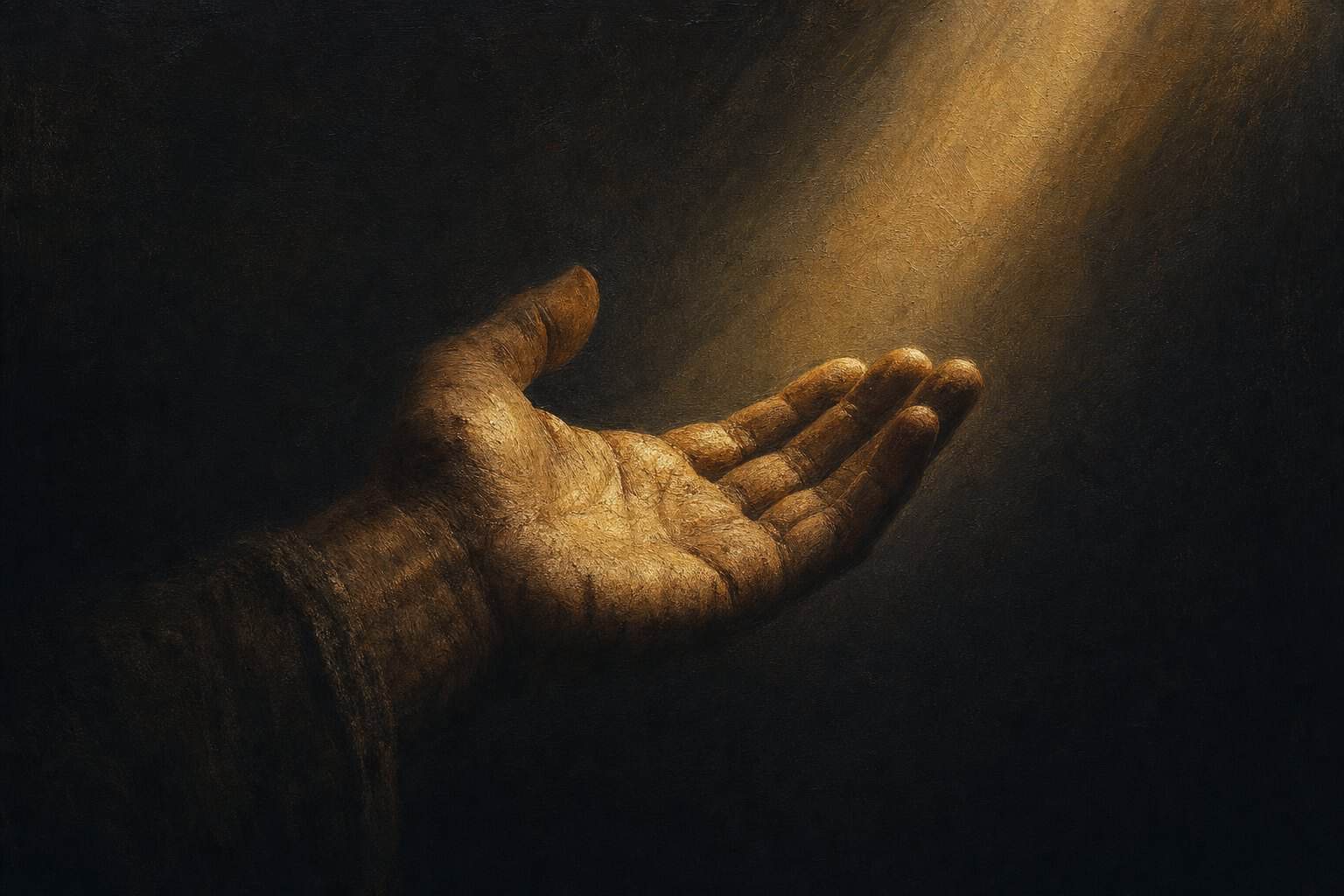
Before the mind confesses, the flesh has already kept the account; every remembering is a translation of what the body learned in the dark of touch and dread.
The First Knowing
There is a knowledge that arrives before you have words for it, and it arrives through the skin. Maurice Merleau-Ponty, heir to the Husserlian intuition that consciousness is always consciousness of something, refused to leave that consciousness bodiless. Where Husserl grounded meaning in transcendental subjectivity, in the intentional correlation between consciousness and its objects, Merleau-Ponty asked where that subject actually lives. His answer was scandalously simple: in the flesh. The body is not an instrument the mind plays upon; it is the corps propre, the lived body through which a world becomes available at all. You do not first perceive a room and then decide to be afraid; the fear is already in the tightening of the shoulders, the shallow breath, the way the feet orient toward the door. Merleau-Ponty called this motor intentionality — a directedness that runs beneath thought, older than the sentence you will later use to explain yourself.
Trauma Written Under the Skin
In Confessions to the Empty Chair, the wound of childhood does not announce itself as a proposition. It surfaces as flinch, as the involuntary bracing before a door opens, as the body knowing danger a full beat before the mind consents to name it. This is precisely what a Merleau-Pontian reading illuminates: trauma is not stored primarily as narrative but as sedimented posture, as a habit-body that has learned the shape of threat and will not unlearn it on command. Where Husserl might diagnose disturbances in the retentional flow of inner time-consciousness — the passive syntheses of a wounded subjectivity — Merleau-Ponty locates the disturbance lower still, in the pre-personal life of the flesh. The child’s body made a decision about the world, and the adult inherits that decision as a mood he cannot argue with. This is why the later accounting always feels like translation: the memoirist is rendering into language a text the body composed before language existed for him. The mind arrives, as it so often does, late and reverent, trying to read what the flesh has already inscribed.
Desire and the Ambiguity of the Flesh
Desire, too, is first a bodily fact. Fractions of the Soul traces the fragmentation of a self across the field of wanting, and here Merleau-Ponty’s refusal to separate seer from seen becomes indispensable. The flesh is reversible: the hand that touches is also the hand that can be touched, the eye that gazes is also a body offered to the gaze of others. To desire is to be caught in this ambiguity — never a pure subject surveying a pure object, but a body implicated, exposed, thrown into being-for-others through its own vulnerability. The relational pattern that recurs around a figure like Jeannètte is not, at root, a story the mind tells about attraction; it is the flesh’s own way of reaching, of orienting toward another before the self has decided what it means. And here the POST-EDENIC ONTOLOGY of Adoré’s world presses in: the body that reaches is already a fallen body, its desiring bent, its perception clouded, so that even the first innocent motion toward the good carries the crease of the disordered. The flesh does not desire cleanly. It desires the way a fallen thing desires — truly, and never simply.
The body remembers before the mind can speak, and every honest word we later write is only a reverent translation of what the flesh already knew.
Grace Enters Where the Body Waits
If wound and desire are known first in the flesh, then grace, too, must find the body before it finds the intellect. This is the deep Catholic instinct that Merleau-Ponty’s phenomenology unexpectedly serves: we are not angels informed of salvation by memorandum, but incarnate creatures who kneel, who fast, who are washed and anointed and fed. The sacramental life is a pedagogy of the flesh. You genuflect before you understand why, and the understanding, when it comes, is a translation of what the bent knee already confessed. The empty chair itself is a phenomenon of the body’s expectation — the seat kept for the unseen listener is a posture of attention held open, a physical grammar of waiting. Long before the mind can articulate the presence of God or the absence of the confessor, the body has already turned toward the empty place and left it empty, has already refused to fill it with a substitute. That refusal is a kind of faith the flesh keeps when the reasoning self has run out of arguments.
The Late and Reverent Word
So the memoirist’s task is humbler and stranger than it first appears. He is not the author of his experience but its translator, working from an original written in a language he did not choose — the sedimented postures, the motor intentions, the pre-predicative depths where meaning gathers before it can be said. Every clean sentence he sets down is a small betrayal and a small fidelity at once: betrayal, because the flesh knew it more fully than words can carry; fidelity, because to leave it unspoken would be to abandon the body to its silence. Merleau-Ponty teaches that the essential structures of experience are revealed even, perhaps especially, through their distortion — that the broken temporality and dissociated voices of a wounded life are not noise obscuring the truth but the very site where truth becomes legible. When you finally find the word for what happened to you, do not mistake it for the beginning. The beginning was in the body, in the dark, in the flesh that remembered so that one day you might understand.