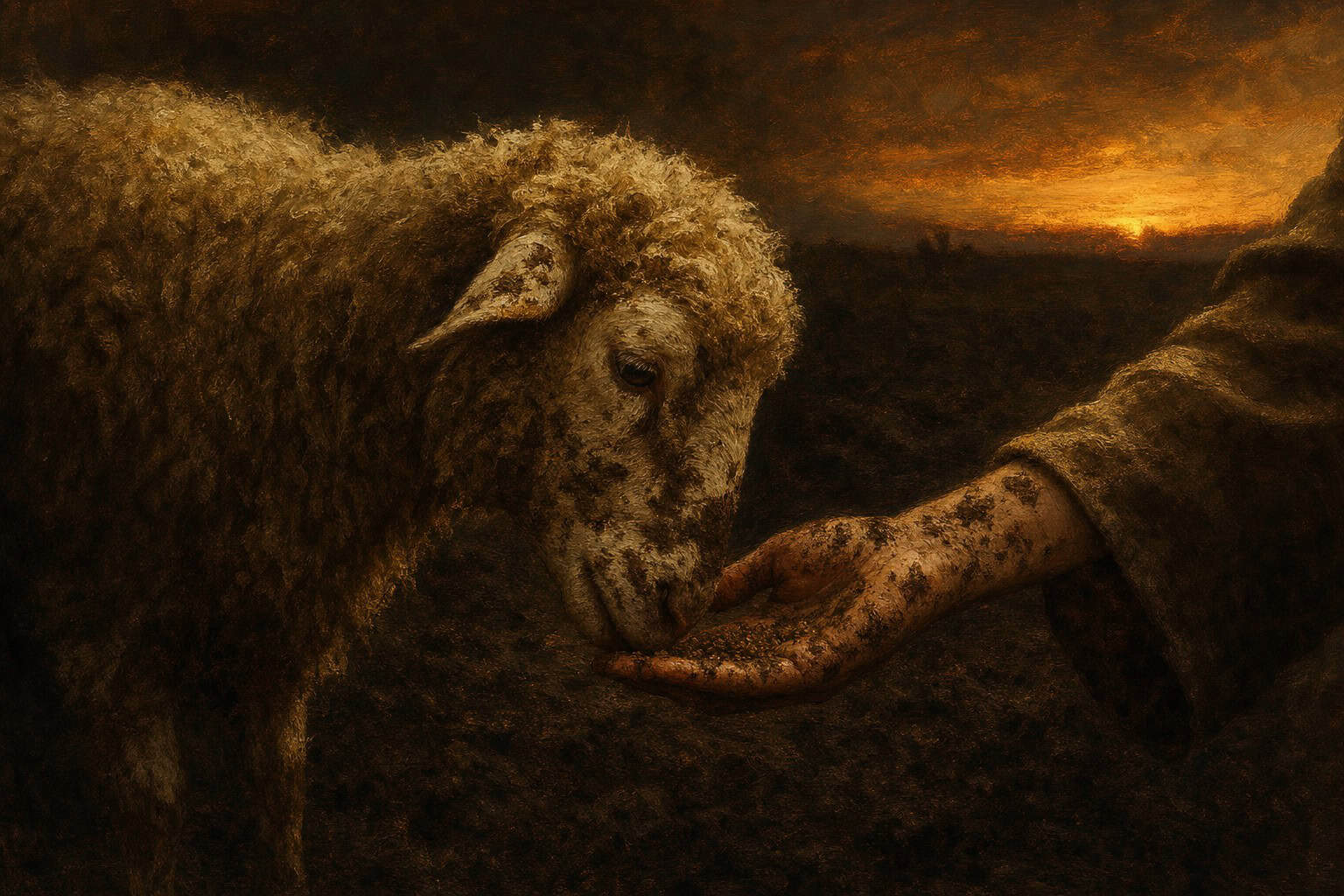
Spit hangs green from the jaw of the thing he is told to love, and the whole of the gospel narrows to whether he can lower his hand to it.
Mouthful of Grass, Handful of Obligation
A single animal lowers its head and tears at the grass with flat, grinding teeth. Spit hangs from its jaw, green and stringy, dribbling onto your boot. The smell is heavy and sour, a mix of damp earth and old wool, and it crawls up into your throat until you have to breathe through your mouth. This is the moment the command lands, not in a chapel, not in clean silence, but in the thick breath of something stupidly alive. Feed them. It doesn’t come wrapped in comfort or admiration for your wounds. It falls like a blunt weight across your shoulders while the animal chews, indifferent, as if your private history and your sharpened disgust have no vote here. You stand with a pail in your hand, childhood darkness still pulsing in your nerves, and realize that the One who marked you there is now tying that same marked body to this hungry mouth.
Ledgers Inked in Fear of Being Left
In this passage, the inner Codex comes into view not as a noble love for order but as a desperate bookkeeping of who may approach you. You remember the years spent ranking people in your mind—useful, dangerous, expendable—each category a line of defense against the old terror of being abandoned again. Every rule about who you may want, who you may trust, who you must avoid, sits behind your ribs like a locked filing cabinet. Standing here with the pail, you see how those ledgers were never about holiness; they were about surviving the panic of need. The divine command slices straight through that archive. No consultation, no revision process, no appeal. Feed my sheep means the categories are overruled. Your system, built to keep you from ever again being helpless before another’s absence, is exposed for what it is: a monument to the very fear that now trembles in your hands as you extend them toward the animal’s open mouth.
The Ache That Points Toward What Sickens You
Pressure builds where nausea and longing meet. The same loneliness that once drove you into bodies, into noise, into any surface that might absorb your panic, begins to hum inside your chest as the animal noses your palm. Its rough tongue scrapes your skin, hot and insistent, and something in you flinches at the contact, not just from disgust but from recognition. The emptiness you tried to drown with flesh and distraction is answering this low, needy bleat. You feel the old ache pull like a compass needle, not away from the filth but through it, toward a center that somehow includes this smell, this weight, this idiot need. Your mind reaches for escape routes—refinements, exceptions, a more symbolic sheep that would cost less of your pride. None appear. The tension holds: the part of you that cannot bear humanity’s stupidity and the part that cannot bear to be alone are suddenly bound to the same creature, chewing noisily at your hand.
The hardest command is to feed the sheep who disgusts you, to serve with tenderness the very thing your soul recoils from.
When Your Superior Taste Becomes Your Poverty
An ordinary reader knows this scene without sheep or pails. It shows up in the coworker who repeats the same mistake until you feel sick with contempt, in the family member whose clinging texts make your skin crawl, in the parish line where someone’s need pours out in halting, graceless words. You feel that reflex inside: I am not for this. I am made for sharper company, cleaner problems. Yet illness, failure, or grief has probably already brought you to days when you yourself needed help with things embarrassingly simple—a ride, a meal, someone to sit nearby while you didn’t have answers. In those hours, your refined disgust became a kind of poverty; it left you without practice in receiving or giving basic care. This passage presses that sore place. It suggests that the very people you dismiss as sheep might be the ones whose hunger could train your heart to stay, and that your fastidious recoil may be less about standards and more about terror of being just as needy as they are.
Hands That Smell Like the Flock
The deeper violation in this scene is not that God issues a hard assignment; it’s that He refuses to honor your boundary between sacred fire and filthy need. The same God who, in childhood, seemed to crash through your defenses without consent now directs that searing mark toward the creatures you least want to touch. You do not get to keep your darkness as a private relic, an explanation for why you are too damaged for ordinary love. Instead, the scar in your soul becomes the very place He grips as He turns your body toward the bleating field. Your fingers sink into coarse, damp fleece as you steady the animal, and the smell of it climbs into your skin. You cannot wash it off quickly. The command remains unresolved in the air around you, as stubborn as the chewing at your feet. Somewhere between the pail and the animal’s hot breath, a life you did not plan waits, patient as ruminating jaws working one stubborn mouthful after another.