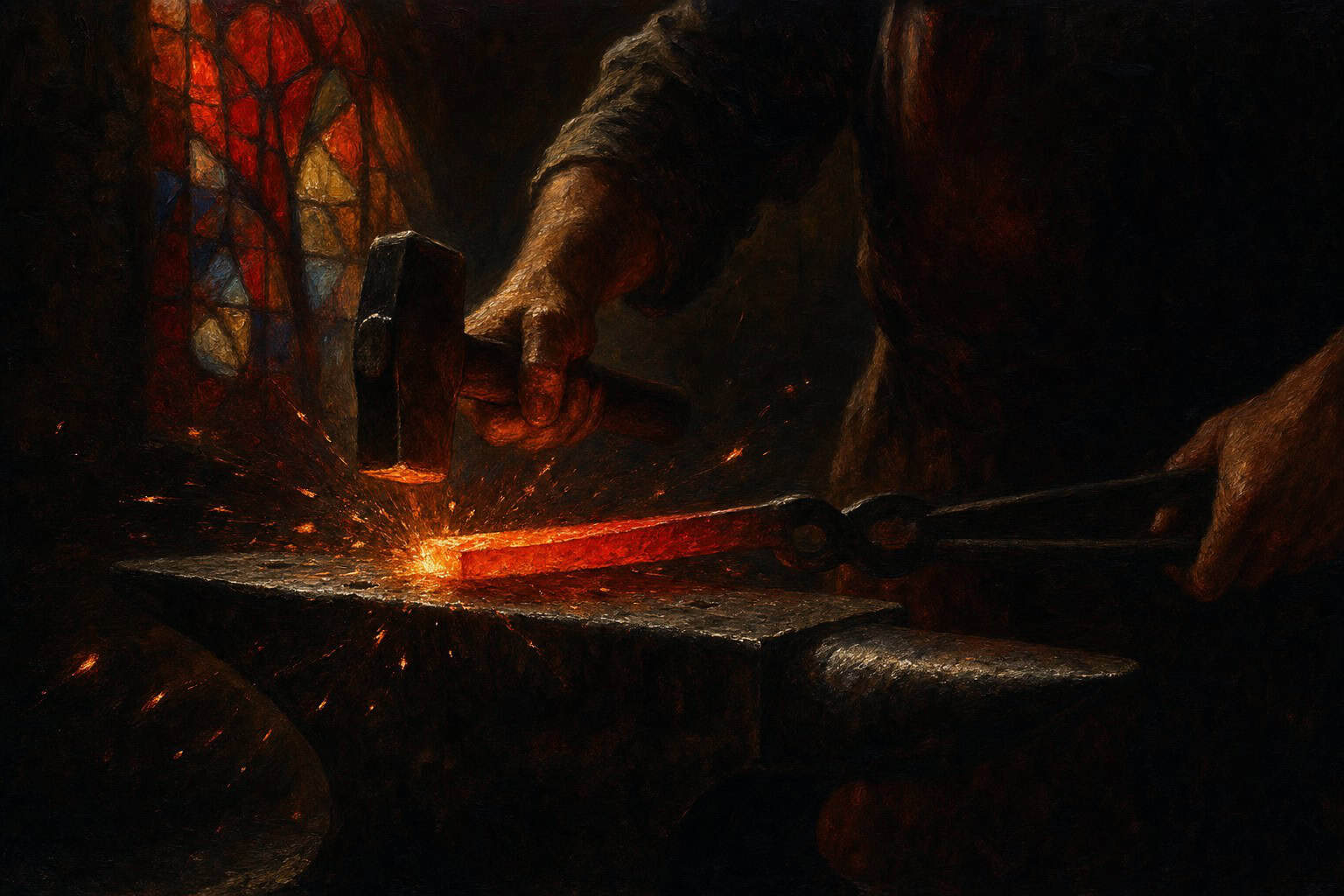
He is lifted toward the light and then pressed back into the dust of his days, and only slowly grasps that the hammer and the height are the same love.
Sparks Lifting Off the Steel
Heat, impact, brief light—that is the air this chapter breathes. The man stands between what draws him upward and what keeps his feet in the dust: Leigh and the children, the remembered streets of Deep Ellum, the quiet hill that once held a city’s glow like a secret. He names these loves not as mistakes, but as weights that can still seize his ankles when grace begins to lift. Over all of it hangs the fear of becoming fixed mid-rise, like something crystallized by one wrong backward glance. Across these pages, ascent is not escape from the earth but a strange pressure in the chest, God’s own breath in human lungs wanting to go home. Descent is not a fall from grace but a sending—into mission, into conflict, into the same world that once tasted like poison and perfume at the same time. Between those two motions, the soul is worked like metal that has not yet decided what kind of blade it will become.
The Ache Under the Hammer Stroke
There is one reckoning underneath every line here: whether the blows that land on a life mean rejection or adoption. The chapter claims the latter, with a severity that refuses soft language. Loneliness that empties a bedroom, misunderstandings that fester at family tables, the slow cooling of affection that once felt reliable—none of it is excused, yet all of it is taken up as material. The Father hears a son ask for bread and hands him isolation, weariness, heartbreak that feels like a stone in the throat. That exchange is the scandal this chapter refuses to look away from: the insistence that what looks like stone is still bread, if you stay under the hammer long enough to see what emerges. The decisive question is not whether pain comes—it already has—but whether the soul will let that pain stay unspent, or press it into God’s hands as the only currency it has. Consent under the hammer, not escape from it, organizes everything here.
Molten Edges Meeting Cold Water
Across these pages, the mood keeps shifting temperature. There are high, clear notes of consolation: the upward pull that lightens the chest, the sense of being drawn out of noise into a cleaner air. Almost immediately, cold impact follows—mission that feels like being dropped back into a hostile crowd, trials that dog the heels of every interior rise. The chapter walks through that alternation by tracing Scripture’s hardest tensions: mercy that crashes through law, commands that seem to tear against earlier commands, a holy God who binds Himself to unfaithfulness and then uses the scandal as a sign. Each example tightens the same pressure in the gut: if God can move like this in the text, what will He dare to do in a single marked life? As the biblical accounts pile up—Saul on the ground, a prophet in a compromised marriage, kings undone by their own desire—the emotional temperature drops and spikes again. Sweetness never arrives without the metallic aftertaste of cost, and cost never comes without some veiled invitation to trust the hand plunging the blade. The reader is left standing in the hiss where heat meets water, not yet knowing what shape the metal will finally take.
We are forged in alternation, lifted for consolation and driven back down for mission, and the descent is no less holy than the height.
The Blade Remembering the First Cut
Chapter 16 sits where the book can finally name its earliest wound without pretending it was an accident God failed to notice. The opened door, the babysitter who did not guard it, Stickman’s mark—those are not re-told here for shock, but recalled as the first time the steel met hammer. The man admits he never asked for that fire, yet grace stepped toward him anyway in eighth grade, tasted once in a visit that did not last. From there, a pattern emerges that answers the book’s central question: why a soul born into violation and dissonance is not excused from ascent but invited into a harsher form of it. The upward movements—consolation, glimpses of belonging, flashes of God’s nearness—are never allowed to harden into a safe plateau. They are followed by descents into corridors “washed gray by absence,” into the same polluted currents that seeded his double music. Instead of purging the darker melody, the forging process presses it against the brighter one, insisting both be held. This chapter explains why the man cannot simply choose one song and discard the other; the hammer keeps falling where they intersect.
A Hand Still Holding the Tongs
The promise here is not that the fire will relent, but that it is governed by a hand that refuses to drop the work. The chapter insists God could have made souls already in their final polish, without this alternation of burning and quenching, but instead chose a world where desire ripens through lack and obedience is learned with skin in the game. It sketches the hard boundary placed around lust—not as a shaming lecture, but as sober notice that if kings close to God were broken on that wheel, ordinary men stand no chance without a forge. Free will remains intact, even as grace sometimes barges in unasked, as it did with Saul or the dying thief. That same mix of interruption and invitation hangs over the author’s own history, especially where the early stain of abuse meets later encounters with God. To step into this chapter is to stand beside the anvil and feel the ringing in your bones, knowing only this much is guaranteed: even when the metal glows and the blows seem wild, the tongs do not slip from the blacksmith’s grip, and the sparks do not rise into an empty sky.